TL;DR
- The core of «How to Read a Book» (interrogate the text, answer four questions in your own words) is the part that survived. It is close to what researchers call self-explanation, and a 2018 meta-analysis of 69 effect sizes puts that at g = 0.55.
- The engine Adler chose to drive the method is rereading. A 2013 review of ten study techniques rated rereading low utility, and a four-experiment study found rereading real textbook chapters did not reliably raise test scores.
- The two techniques that review rated high utility (practice testing and distributed practice) barely appear in the book. Adler tells you to reread and outline. He does not tell you to shut the book and recall.
- The 1972 revision’s treatment of speed reading is refuted outright. Skilled adults read at 200–400 words per minute, and the eye-movement evidence shows the speed you buy is paid for in comprehension.
- Syntopical reading (Adler’s fourth level) has never been tested under that name. That is untested, not refuted, and it is the one part of the book where the burden of proof has never been picked up.
Verdict
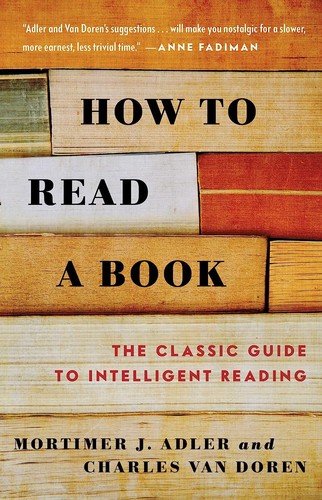
Read the notes. «How to Read a Book» is about 400 pages, and the defensible content is maybe fifteen. Adler and Van Doren correctly identified that most educated adults read passively and that asking hard questions of a text beats running your eyes over it twice. That is a real finding, and they got there thirty years before the experimental literature caught up. But the book’s operational advice (reread, outline, reread again) is the exact study strategy that later reviews rated lowest, and the strategies that rated highest are missing. One chapter is flatly wrong. You want the four questions and the inspectional pass. You do not want the other 385 pages.
The claim on trial
Adler’s central falsifiable claim: reading divides into four levels (elementary, inspectional, analytical, syntopical) and a difficult book can be understood by a specific, teachable procedure of analytical reading, so that method rather than prior expertise carries the reader through.
Two halves. The first half (that a procedure can be taught and improves comprehension) is partly supported, but only for the questioning components, not the rereading ones. The second half (that method substitutes for background knowledge) does not survive contact with the reading research at all.
What held up: the four questions
Adler’s analytical reader asks what the book is about as a whole, what is being said in detail and how, whether it is true, and what of it. Strip the mid-century phrasing and that is a prompt to generate explanations of the material to yourself while you read it — which is a technique with an experimental record.
Bisra, Liu, Nesbit, Salimi and Winne, Educational Psychology Review, 2018 pooled 64 research reports and 69 effect sizes on self-explanation prompts and found a weighted random-effects mean of g = 0.55, holding across problem solving, worked examples and text study. That is a genuine, medium-sized effect for the exact behaviour Adler is asking for.
The big review of study techniques agrees, with a ceiling. Dunlosky, Rawson, Marsh, Nathan and Willingham, Psychological Science in the Public Interest, 2013 assessed ten techniques and rated self-explanation and elaborative interrogation as moderate utility — promising, effective in the lab, under-tested in real classrooms over long horizons. Not high utility. Moderate. Adler’s best idea earns a solid B.
Credit where it is due: in 1940 nobody had a meta-analysis, and Adler picked the right mechanism by argument alone.
The blind spot: rereading instead of recall
Here is where the book breaks. Adler’s prescribed cycle for a difficult text is inspectional pass, then a full read, then a return pass with outlining and marginalia. Rereading is the load-bearing beam.
The 2013 review rated rereading low utility, alongside highlighting, summarization, imagery and the keyword mnemonic. Its blunt summary is that most students report rereading and highlighting, that these do not consistently improve performance, and that other techniques should be used in their place. The direct test is Callender and McDaniel, Contemporary Educational Psychology, 2009: across four experiments using actual textbook chapters and Scientific American articles, with multiple-choice, short-answer and summary outcomes, rereading did not significantly raise performance, with rare exceptions, and reading ability did not rescue it.
Now the two techniques that did earn high utility ratings. The first is practice testing. Roediger and Karpicke, Psychological Science, 2006 had students read prose passages and either take free-recall tests without feedback or restudy the same number of times. At a five-minute delay, restudying won. At two days and one week, testing won substantially — while the restudy group was more confident it would remember. Adesope, Trevisan and Sundararajan, Review of Educational Research, 2017 meta-analysed the literature and found practice tests more beneficial than restudying and than all other comparison conditions.
The second is distributed practice. Cepeda, Pashler, Vul, Wixted and Rohrer, Psychological Bulletin, 2006 synthesised 839 assessments across 317 experiments in 184 articles, and found that the optimal gap between study episodes grows as the delay to the final test grows.
So the mismatch is exact. The two highest-rated techniques in the modern literature are close the book and recall, and spread the sessions out. Adler’s method is open the book and go through it again, in one sitting, more slowly. He is not neutral on this — the rereading is the method. The illusion Roediger and Karpicke measured, where restudying raises confidence more than it raises retention, is precisely the trap a diligent reader following Adler’s procedure would fall into.
The chapter that is wrong
The 1972 revision endorses a limited, variable-speed version of speed reading: train yourself to move faster through easy material, slow down for hard material, and the fast setting costs you nothing you needed.
The eye-movement literature killed this. Rayner, Schotter, Masson, Potter and Treiman, Psychological Science in the Public Interest, 2016 reviewed the whole field and concluded there is a trade-off between speed and accuracy, and that there is no unique, easily learned behaviour in which reading speed and comprehension are both high. College-educated adults who are good readers run at roughly 200 to 400 words per minute. Public claims run far above that (one competitive speed reader reportedly took a Harry Potter book at over 4,200 words per minute, and one trainer has claimed 30,000) and the review’s verdict is that the constraint is not eye movement but language processing. Their recommendation for reading faster is more vocabulary and more practice, which is not a technique you can install in a weekend.
The cleanest single experiment is Schotter, Tran and Rayner, Psychological Science, 2014. They used a trailing-mask paradigm: as the reader’s eyes moved past each word, that word was masked, so it could be read only once. This mimics the rapid-serial-visual-presentation apps that were being sold as speed reading. Removing the reader’s ability to make regressions (to flick back to an earlier word) measurably damaged comprehension, and the damage was not confined to ambiguous sentences.
There is a real irony here. The one place rereading is unambiguously vindicated is the 200-millisecond scale Adler never discusses: the eyes going back a few words. The scale he does prescribe (reading the whole chapter again) is the one that does not pay.
Inspectional reading and the knowledge problem
Adler’s second level, inspectional reading, is a systematic skim to decide whether a book deserves the full treatment. This holds up better than the rest of the method. Duggan and Payne, Journal of Experimental Psychology: Applied, 2009 gave readers of expository texts only enough time to read half of each document. Skimming improved memory for the important ideas relative to carefully reading half the text — but it did not improve memory for less important details, and it did not improve inferences drawn from within the text. A second experiment found no advantage of skimming over reading the first or second half of every paragraph, and the benefit depended on how easily readers could navigate the document. Skimming is a real tool for extracting gist under time pressure. It is not a way to understand an argument.
The larger problem is what Adler leaves out. His framing is that the right procedure lets a reader above his weight class understand a book above his weight class. The reading research says background knowledge is doing far more of the work than method. Recht and Leslie, Journal of Educational Psychology, 1988 tested 64 junior-high students (32 seventh-graders and 32 eighth-graders) split by reading ability and by knowledge of baseball, on a passage describing a half-inning. Knowledge of the topic raised recall and delayed retention, and there was no interaction between prior knowledge and reading ability: knowing the subject helped strong and weak readers alike. Method does not substitute for that. If you lack the background, no sequence of four questions manufactures it, and Adler’s confidence that a determined amateur can crack Aristotle by procedure is the book’s most attractive and least supported promise.
Syntopical reading: untested, not refuted
Adler’s fourth level asks you to read many books on one subject, build a neutral vocabulary that none of the authors used, and construct your own synthesis. It is the most ambitious thing in the book and the least examined.
Checked negative, and here is the check. A Crossref title search for «syntopical» on 10 August 2026 returns ten records in total; none is a controlled test of Adler’s procedure, and most are Korean-language pedagogy papers or entomology articles using the ecological sense of the word. Europe PMC returns zero hits for the phrase «syntopical reading». Nobody has run the experiment. Untested is not the same as refuted, and this is the one place where the book’s claim is still live.
The nearest tested cousin is instruction in integrating multiple texts. Barzilai, Zohar and Mor-Hagani, Educational Psychology Review, 2018 reviewed that work from grade 5 through university and found integration across sources can be taught with medium to large effect sizes — through explicit strategy instruction, modelling, collaborative discussion and graphic organisers. That is encouraging for Adler’s ambition and unhelpful to his specific procedure: what worked in those studies was scaffolded instruction, not a reader alone with a stack of books and a term-mapping exercise.
Who should read it
- Read the full book if you work with primary texts for a living (philosophy, law, theology, close textual history) where the object is one difficult document and retention is not the goal. Adler’s taxonomy of what an argument is doing is still useful there.
- Read the notes if you want to read non-fiction better. The extractable method is four questions, one inspectional pass, and understand before you disagree. That fits on an index card.
- Skip it if you are trying to learn and remember material. Nothing in Adler will beat testing yourself and spacing the sessions, and following his procedure faithfully will cost you hours you should spend on recall. Our other book notes cover the study-technique literature directly.
Gardner’s «Five Minds for the Future» claims the same capacities can be taught but never measures them, and «Getting Things Done» is the same instinct applied to work rather than reading.
One thing to try
Read one chapter of a hard book. Then close it and write, from memory, the answers to Adler’s four questions: what the chapter is about as a whole, what it says in detail, whether it is true, and what follows. Writing from memory rather than with the book open converts Adler’s best idea into a practice test. Then do it again a week later rather than the same evening. That single substitution (recall instead of reread, spaced instead of massed) takes the part of the method that meta-analysis supports and drops it into the delivery format the 2013 review rated high utility.
Get the book
Find «How to Read a Book» on Amazon — as an Amazon Associate, The Boring Work earns from qualifying purchases (disclosure).
A different claim about reading travels far wider than anything in Adler, and there is no paper behind it: the 68% that nobody published.
The boring bottom line
Adler diagnosed the problem correctly in 1940: most adults decode words without questioning them, and asking hard questions of a text produces understanding that passive reading does not. Self-explanation research vindicates that, at g = 0.55 and a moderate utility rating. Then he built the delivery mechanism out of the wrong material. Rereading is rated low utility, tested directly on textbook chapters and found not to help. Retrieval and spacing are rated high utility and are close to absent from the book. The speed-reading chapter is refuted by the eye-movement literature, which finds a speed-comprehension trade-off imposed by language processing rather than by eye movements. Syntopical reading remains unexamined by anyone. Take the four questions, answer them from memory a week later, and leave the other 385 pages on the shelf.
Sources
- Dunlosky, Rawson, Marsh, Nathan & Willingham, «Improving Students’ Learning With Effective Learning Techniques», Psychological Science in the Public Interest, 2013, 14(1), 4–58
- Bisra, Liu, Nesbit, Salimi & Winne, «Inducing Self-Explanation: a Meta-Analysis», Educational Psychology Review, 2018, 30(3), 703–725
- Callender & McDaniel, «The limited benefits of rereading educational texts», Contemporary Educational Psychology, 2009, 34(1), 30–41
- Roediger & Karpicke, «Test-Enhanced Learning», Psychological Science, 2006, 17(3), 249–255
- Adesope, Trevisan & Sundararajan, «Rethinking the Use of Tests: A Meta-Analysis of Practice Testing», Review of Educational Research, 2017, 87(3), 659–701
- Cepeda, Pashler, Vul, Wixted & Rohrer, «Distributed practice in verbal recall tasks», Psychological Bulletin, 2006, 132(3), 354–380
- Rayner, Schotter, Masson, Potter & Treiman, «So Much to Read, So Little Time», Psychological Science in the Public Interest, 2016, 17(1), 4–34
- Schotter, Tran & Rayner, «Don’t Believe What You Read (Only Once)», Psychological Science, 2014, 25(6), 1218–1226
- Duggan & Payne, «Text skimming: The process and effectiveness of foraging through text under time pressure», Journal of Experimental Psychology: Applied, 2009, 15(3), 228–242
- Recht & Leslie, «Effect of prior knowledge on good and poor readers’ memory of text», Journal of Educational Psychology, 1988, 80(1), 16–20
- Barzilai, Zohar & Mor-Hagani, «Promoting Integration of Multiple Texts», Educational Psychology Review, 2018, 30(3), 973–999