TL;DR
- «The Rules of Wealth» is about a hundred numbered aphorisms with no citations, no data and no worked example. Its opening rule is «Anybody can be wealthy».
- Tax records covering more than 40 million American children put the odds of climbing from the bottom income fifth to the top at 7.5% — 4.4% in Charlotte, 12.9% in San Jose. The same address changes the number more than any attitude does.
- Swedish adoption registers are the cleanest test of «wealth is a state of mind». An adoptee’s adult wealth rank tracks the parents who raised them at 0.27 and the parents who conceived them at 0.11. Allow inheritance in and the rearing figure rises to 0.65.
- One rule survives contact with evidence. «Spend less than you earn» is correct — but the lever is a default, not a decision. Switching one firm’s retirement plan to automatic enrolment moved participation from 37% to 86%, teaching nobody anything.
- Verdict: skip it. The one true rule is on this page, and the mechanism that makes it work is the one thing the book never mentions.
Verdict
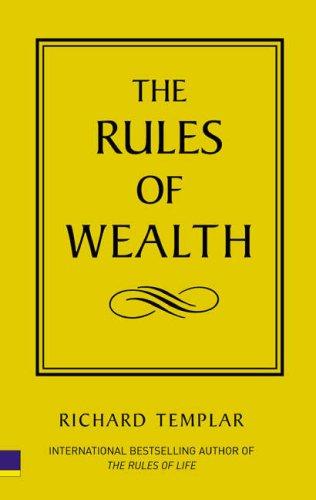
Skip it. Richard Templar’s 2006 book is calm, readable and almost entirely unfalsifiable by design — a hundred short rules grouped into parts on thinking wealthy, getting wealthy, getting wealthier, staying wealthy and sharing it. Almost nothing in it is checkable, and what is checkable splits cleanly: the arithmetic rule is right, the psychology rule is wrong, the investing rule is empty.
We are scoring one claim, not the author. That claim has been tested — by economists working with national tax records, by a Swedish adoption experiment nobody designed but everybody can read, and by four decades of mutual fund performance data. Where the book agrees with the evidence, we say so with the same citation standard we use against it.
The claim on trial
Stripped of the numbering, the book argues that wealth is the output of a set of attitudes and habits: think wealthy, decide for yourself what «enough» means, treat money as a tool rather than a moral object, spend less than you earn, and get the surplus working. Apply the rules and wealth follows. Fail to apply them and it does not.
That is a causal claim about a population, and it is testable in three separable pieces. First, whether the distribution of adult wealth is mostly explained by things a reader controls. Second, whether the specific behavioural rule about saving works when people try to apply it by deciding to. Third, whether «make your money work for you» describes anything an ordinary reader can execute better than the cheapest available default. The book presents all three as one thought. They score differently.
«Anybody can be wealthy»
The strongest evidence on this is administrative rather than survey-based, which matters, because self-reported income and wealth are noisy in exactly the direction that flatters mindset stories.
Chetty, Hendren, Kline and Saez, Quarterly Journal of Economics, 2014 linked federal tax records for more than 40 million American children and their parents. The probability that a child born into the bottom fifth of the income distribution reaches the top fifth is 7.5% nationally. It is 4.4% in Charlotte and 12.9% in San Jose — a factor of nearly three, driven by which commuting zone the child grew up in. For comparison, the same measure is 11.7% in Denmark. A book that says anybody can be wealthy is describing a 7.5% event and calling it a decision.
The trend is worse than the level. Chetty, Grusky, Hell, Hendren, Manduca and Narang, Science, 2017 measured absolute mobility — the fraction of children earning more than their parents did at the same age. It was 92% for the 1940 birth cohort and 50% for the 1984 cohort. The decomposition is the interesting part: holding growth at mid-century rates but distributing it as it is distributed now would recover only 29% of the fall, while distributing today’s growth as it was distributed in 1940 would recover 71%. The thing that changed was not how hard people thought about money.
Then wealth, which is not income. Charles and Hurst, Journal of Political Economy, 2003 tracked 1,491 parent-child pairs in the Panel Study of Income Dynamics and found an age-adjusted elasticity of child wealth with respect to parental wealth of 0.37, measured deliberately before bequests. Only 7% of children whose parents sat in the lowest wealth quintile reached the highest; 36% of children of the wealthiest parents stayed at the top. Roughly half the persistence is explained by similarity in lifetime income across generations, and another slice by which assets the family owns at all.
The cleanest test of the mindset thesis comes from Sweden. Black, Devereux, Lundborg and Majlesi, Review of Economic Studies, 2020 used national wealth registers on 2,519 adoptees born between 1950 and 1970 for whom both biological and adoptive parents are known. For children raised by their biological parents, the parent-child wealth rank coefficient is about 0.35. For adoptees, the coefficient on biological parents’ wealth is 0.11 and the coefficient on rearing parents’ wealth is 0.27. Environment beats genetics here, which sounds like good news for a book about learnable habits — until you look at the mechanism. Allow inheritance into the specification and the rearing-parent coefficient rises from 0.23 to 0.65. Parental education and earnings explain little of it. Money, transferred, explains most of it.
The reader-controllable share of adult wealth is real and not zero. It is nowhere near large enough to carry «anybody can be wealthy» as anything but encouragement.
The one rule that holds
«Spend less than you earn» is correct, boring and worth the price of the book on its own. The book’s account of how to do it is where it fails, and the failure is specific: it treats saving as a decision, and the evidence says decisions are the weak part.
Madrian and Shea, Quarterly Journal of Economics, 2001 studied a Fortune 500 firm that switched its 401(k) from opt-in to automatic enrolment. Among employees with three to fifteen months of tenure, participation went from 37% before the change to 86% after. Nothing was taught. No one was persuaded. The form’s default answer changed. The paper’s second finding is the sharper one for anyone writing rules: 61% of the automatically enrolled sat at both the default 3% contribution rate and the default money market fund, against 1% of earlier cohorts who had picked that combination for themselves. The same inertia that keeps people out of a plan keeps them parked inside it.
Thaler and Benartzi, Journal of Political Economy, 2004 built the constructive version. Employees who had refused a financial consultant’s advice to save more were offered a plan that raised their contribution rate automatically with each future pay rise. Of 207 such employees, 162 (78%) joined, 80% were still in it after four pay rises, and their average saving rate went from 3.5% to 13.6% over 40 months. Employees who took the consultant’s ordinary advice (the equivalent of following a rule because they had agreed with it) went from 4.4% to 9.1%, and slipped to 8.8%. Structure roughly doubled the effect of intention.
Neither of those studies is randomised at the individual level, and Thaler and Benartzi is explicit that participants selected themselves in. The direction survives the caveat: the successful interventions all moved the default, and the book moves only the reader.
«Make your money work for you»
This rule is not wrong so much as unattached to any method. Compounding is arithmetic; the operational question is what you buy, and there the book offers exhortation about deals rather than fees.
Carhart, Journal of Finance, 1997 used a survivorship-bias-free sample and found that common return factors and expenses almost completely explain apparent persistence in equity fund performance; the only persistence he could not explain away was concentrated in the funds that kept losing. Fama and French, Journal of Finance, 2010 put it in one sentence: the aggregate portfolio of actively managed US equity funds is close to the market portfolio, and the high costs of active management show up intact as lower returns to investors. Their bootstrap simulations find few funds earning enough benchmark-adjusted return to cover their own costs.
Fama and French’s sample ends in September 2006, and the obvious objection is that markets moved on. The annual persistence scorecards published by index providers report the same pattern in current data (top-quartile funds rarely stay top-quartile for more than a year or two) but we could not reach the current scorecard at a stable public address to re-check it, so we quote no figure from it. The peer-reviewed finding does not need the help: what looks like a hot hand is mostly momentum and expenses, and the expenses are certain while the outperformance is not.
A rule telling readers to put money to work, in a book that treats fees as beneath discussion, points at the one part of the process where effort reliably subtracts value.
Does a money mindset predict anything
Partly, and the honest answer is more interesting than either the book’s or its critics’. Cobb-Clark, Kassenboehmer and Sinning, Journal of Banking & Finance, 2016 used the Australian HILDA panel (about 1,900 couples in each of 2006 and 2010) and found that households whose members believe outcomes follow from their own actions save more of their permanent income than otherwise similar households, by 7.7 percentage points at the median and 11.9 at the 75th percentile, after controlling for income, education, demographics and other personality traits. Belief is a genuine partial correlate of saving, and the closest thing in the literature to a vindication of Part I of this book.
What it is not is evidence that a book installs the belief. That question has its own literature. Fernandes, Lynch and Netemeyer, Management Science, 2014 meta-analysed 168 papers covering 201 studies and found that interventions to improve financial literacy explained 0.1% of the variance in the financial behaviours studied, with effects fading past 20 months even for long courses. That result is routinely quoted as though it kills the field, which overstates it. Kaiser, Lusardi, Menkhoff and Urban, Journal of Financial Economics, 2022 pooled 76 randomised experiments and over 160,000 participants and found real positive causal effects on knowledge and on downstream behaviour, robust to publication-bias corrections and at least three times the average effect in earlier work. Together they say one thing: financial instruction moves behaviour, modestly, and decays unless something structural holds it in place.
And the specific question (does reading a trade-press book of money rules change anyone’s net worth) has never been tested. We searched Crossref and the open web on 10 August 2026 for randomised evaluations of popular personal finance books; the bibliotherapy trial literature covers anxiety, depression, panic and perfectionism, and contains nothing on wealth outcomes. Untested is not refuted. It does mean the book’s central promise rests on no evidence at all, in either direction.
Who should read it
Someone who has never articulated what they want money for, and who would benefit from a calm, short, non-hectoring prompt to do that. The book is good at tone: it does not shout, it does not sell a seminar, and its rule about deciding what «enough» means is worth an evening.
Not for you if you want a method. There is no worked example, no arithmetic, no product-neutral account of costs, and no discussion of the structural defaults that do the work. Readers who want the same conclusions with the numbers attached will get more from the Madrian and Shea paper than from all hundred rules, or from our other reviewed titles.
The companion volume is «The Rules of Life». For the same wealth-mindset claim with a bigger sales machine behind it, see «Rich Dad Poor Dad».
One thing to try
Convert the one working rule from an intention into a default, and do it in the place where the money moves rather than in your head.
Set up an automatic transfer that leaves your current account on the day you are paid, before anything else clears. Pick an amount small enough that it cannot hurt — the point is not the size, it is that the transfer happens without a decision. Then set one calendar reminder for your next pay rise: increase the transfer by part of the rise, before you have adjusted to the larger number. That is the Thaler and Benartzi design reduced to something you can run without an employer, and it is the only part of this book’s programme with a measured effect size behind it.
What you put the money into is a separate decision this page does not make for you.
Get the book
Find «The Rules of Wealth» on Amazon — as an Amazon Associate, The Boring Work earns from qualifying purchases (disclosure).
A much older set of business rules, carried by a tradition rather than a publisher, is examined in the platinum rules of doing business.
The boring bottom line
«The Rules of Wealth» makes one testable promise (that the right attitudes produce wealth) and the record does not support it. The odds of crossing from the bottom income fifth to the top are 7.5% in the United States, the share of children out-earning their parents fell from 92% to 50% in four decades, and Swedish adoption registers show an adoptee’s wealth rank tracking the household that raised them at 0.27, rising to 0.65 once inheritance lands. The one rule that holds (spend less than you earn) works through defaults the book never discusses: 37% to 86% participation from a form change, 3.5% to 13.6% saving from automating future rises. And the rule about making money work has no method attached, in a book that treats fees as beneath discussion while the active fund industry passes its costs to investors intact.
Take the savings rule. Automate it. Leave the other ninety-nine.
When to see a professional
This page is general financial information, not financial advice. We are not financial advisers, we do not know your income, debts, tax position, dependants or country, and nothing here is a recommendation to buy, sell or hold any investment, fund or asset class.
Talk to a regulated, fee-only financial planner (paid by you rather than by commission) before decisions about pensions, mortgages, or moving a meaningful share of your savings. For problem debt, the right first call is a non-profit or state-funded debt advice service, not a planner and not a book. If money worry is affecting your sleep, your relationships or your health, that is a matter for your doctor as much as for your budget.
Sources
- Chetty R, Hendren N, Kline P, Saez E, «Where is the Land of Opportunity? The Geography of Intergenerational Mobility in the United States», Quarterly Journal of Economics 129(4):1553-1623, 2014
- Chetty R, Grusky D, Hell M, Hendren N, Manduca R, Narang J, «The fading American dream: Trends in absolute income mobility since 1940», Science 356(6336):398-406, 2017
- Charles KK, Hurst E, «The Correlation of Wealth across Generations», Journal of Political Economy 111(6):1155-1182, 2003
- Black SE, Devereux PJ, Lundborg P, Majlesi K, «Poor Little Rich Kids? The Role of Nature versus Nurture in Wealth and Other Economic Outcomes and Behaviours», Review of Economic Studies 87(4):1683-1725, 2020
- Madrian BC, Shea DF, «The Power of Suggestion: Inertia in 401(k) Participation and Savings Behavior», Quarterly Journal of Economics 116(4):1149-1187, 2001
- Thaler RH, Benartzi S, «Save More Tomorrow: Using Behavioral Economics to Increase Employee Saving», Journal of Political Economy 112(S1):S164-S187, 2004
- Carhart MM, «On Persistence in Mutual Fund Performance», Journal of Finance 52(1):57-82, 1997
- Fama EF, French KR, «Luck versus Skill in the Cross-Section of Mutual Fund Returns», Journal of Finance 65(5):1915-1947, 2010
- Cobb-Clark DA, Kassenboehmer SC, Sinning MG, «Locus of control and savings», Journal of Banking & Finance 73:113-130, 2016
- Fernandes D, Lynch JG, Netemeyer RG, «Financial Literacy, Financial Education, and Downstream Financial Behaviors», Management Science 60(8):1861-1883, 2014
- Kaiser T, Lusardi A, Menkhoff L, Urban C, «Financial education affects financial knowledge and downstream behaviors», Journal of Financial Economics 145(2):255-272, 2022