TL;DR
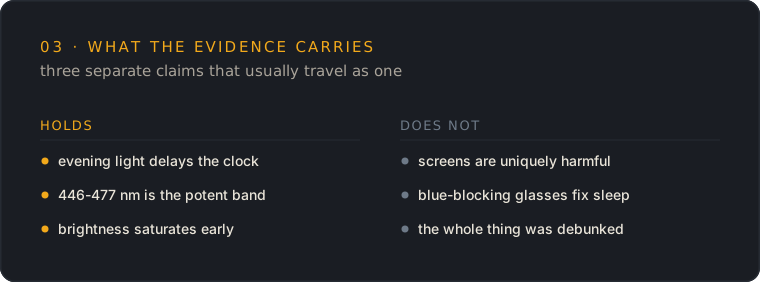
- Three separate claims usually travel as one sentence. Evening light delays the body clock: established. Short-wavelength light is the most potent part of the spectrum for that: established. Blue-blocking glasses fix your sleep: not established.
- The famous experiment gave 12 adults four hours of reading before bed for five nights running, in a room lit to about 3 lux. On the screen they took 25.7 minutes to fall asleep against 15.75 with a printed book, lost melatonin by 55%, and their clock ran an hour and a half late.
- Intensity matters more than colour. The dose–response curve saturates early: about 100 lux of ordinary room light already produces half the maximal phase delay that roughly 9000 lux produces.
- A Cochrane review of blue-light filtering lenses found 17 randomised trials, no trial at low risk of bias throughout, and six sleep trials splitting three against three. The certainty of the sleep evidence was rated very low.
- So the reversal is itself overstated. What collapsed was the glasses and the idea that screens are a special category of light. What did not collapse is the physiology, which was measured before anybody had a product to sell.
Around 2015 the internet learned that screens ruin your sleep, and amber-tinted glasses became a nightstand accessory. Around 2023 the internet learned that this was all a myth, and the same glasses became a punchline. Both waves arrived with confident headlines, and both were wrong, because «blue light ruins sleep» is three separate claims stapled together. One is rock solid, one is solid but misread, and one fell apart. Taking them apart takes ten minutes and is worth every one.
The experiment everyone was citing
The 2015 study behind the first wave was run by Anne-Marie Chang and colleagues, then at Brigham and Women’s Hospital in Boston, and published in PNAS. Twelve healthy young adults lived in a laboratory for fourteen days. On five consecutive evenings they read an e-reader for about four hours before bed; on five others, in randomised order, they read a printed book for the same four hours. The room was lit to about 3 lux both times, dimmer than most people’s bedrooms.
The design is what makes this study beautiful. Both weeks, the activity was identical: reading a book, alone, in silence. No group chats, no autoplay, no doomscroll. Nothing differed between the weeks except the glow. Whatever happened, the light did it.
What differed: on the device, participants took 25.65 minutes to fall asleep against 15.75 minutes with the printed book. Evening melatonin was suppressed by 55%, where the printed book suppressed none. The dim-light melatonin onset, the marker for where the internal clock sits, arrived at 22:31 after the screen week and 21:01 after the print week, an hour and a half apart. They got 109 minutes of REM sleep instead of 121, and they were less alert the following morning.
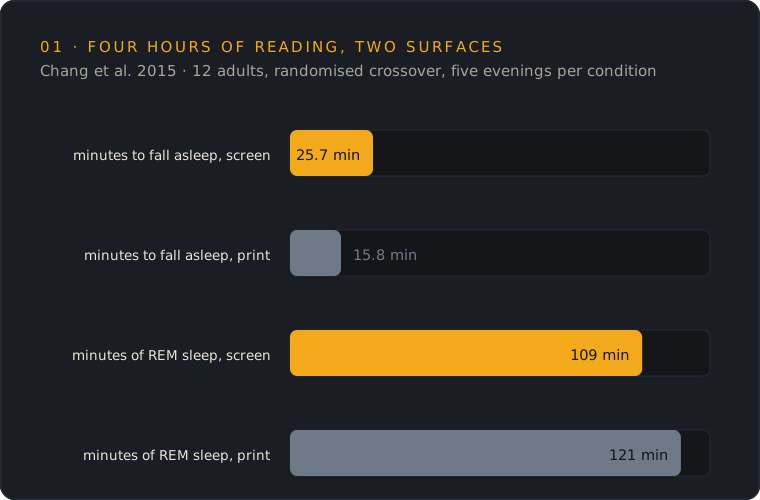
But before panicking, look at the recipe that produced those numbers: four hours of screen time, ending at bedtime, five nights straight, in a room dimmer than a candlelit dinner, so the tablet was practically the only light source in the world. Twenty minutes of scrolling in a normally lit living room is a different experiment entirely, and this study never claimed otherwise. Also note the punchline scale: 55% of the melatonin gone, and the actual cost was… ten extra minutes falling asleep.
It is worth being clear about what a sample of twelve buys you, because the number looks small and the design is not. Each person did both conditions, so every participant is their own comparison, and everything else was held fixed: same room, same bedtime, same meals, same light level. That removes most of the noise that makes field studies of screens so hard to read, and it is why the differences reached significance at all with a dozen people. What it costs is generalisation. Twelve young healthy adults in a sleep laboratory are not a population.
The knob that matters most is brightness
The clearest single result in this area is twenty-five years old and has nothing to do with screens. Jamie Zeitzer and colleagues, working with Charles Czeisler at Harvard Medical School, gave 23 volunteers a single 6.5-hour light exposure in the early biological night, varying the intensity, and mapped the response.
Both the phase shift and the melatonin suppression followed a logistic curve, and it saturates early. Half of the maximal phase delay produced by roughly 9000 lux of bright light was already produced by about 100 lux, which is dim room lighting. One per cent of the light, half of the effect.
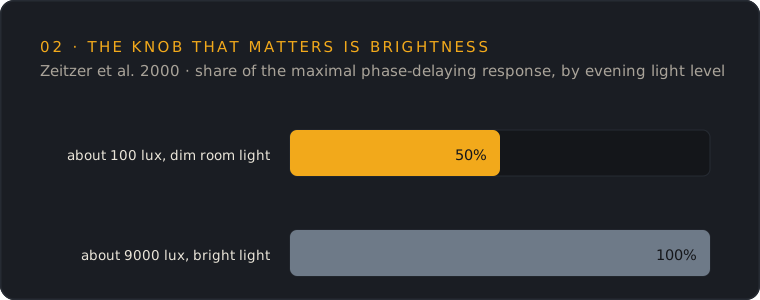
Sit with that, because it flips the entire debate. If your bedside lamp already delivers half the maximum possible clock-delay, then fiddling with your phone’s colour temperature is adjusting the seasoning on a meal that is already cooked. The ceiling light you flick on to find your keys is doing damage of the same order as the phone you then check under it.
The practical shape of that curve is worth holding onto. Going from a dark room to a dim lamp costs you a lot; going from a dim lamp to a floodlit kitchen costs you comparatively little more, because you are already near the top. Most household decisions about evening light happen at the bottom of the curve, where the slope is steep, and most product decisions are marketed at the top, where it is flat.
Blue is the potent band, and that part held
The part people now dismiss as marketing is the part with the oldest and cleanest evidence. George Brainard and colleagues at Thomas Jefferson University in Philadelphia exposed 72 adults to monochromatic light in the middle of the night, across wavelengths from 420 to 600 nanometres, at multiple intensities each: 627 separate melatonin suppression tests in total.
The resulting action spectrum fitted an opsin template and identified 446 to 477 nanometres as the most potent region. That is blue. The work also predicted a photopigment nobody had found yet, distinct from the ones used for vision, which is melanopsin. This was published in 2001, back when fluorescent tubes were the product on the market.
So «blue light shifts the clock» is not marketing; it is one of the cleanest results in the field, older than the products built on it. The broken step is the inference: blue is the most potent, therefore removing blue removes the problem. The spectrum data say blue is the strongest instrument in the orchestra. They do not say the orchestra falls silent without it, and the brightness curve above explains why it does not.
What the glasses trials found
The product that grew out of all this has been tested, and the tests were collected in 2023 by Sumeer Singh and colleagues at the University of Melbourne for a Cochrane review, the kind of review whose method is fixed in advance and whose grading of evidence is public.
They found 17 randomised trials comparing blue-light filtering spectacle lenses with ordinary ones. Sample sizes ran from five to 156 people and follow-up from less than a day to five weeks. Not one trial was at low risk of bias across all seven domains; about two thirds were at high risk because outcome assessors were not masked. Only about a third had been pre-registered.
The trials could not even be pooled; they measured different things on different people. On sleep, six trials split three to three, improvement versus nothing. Cochrane’s verdict, in its wonderfully dry house style: we do not know whether the lenses help, and it rates its certainty «very low». Eye strain, the other selling point, showed no benefit at all.
Worth noticing what is missing from that list. Nobody had measured, in a randomised trial reported well enough to pool, whether these lenses change melatonin, contrast sensitivity, colour discrimination or macular health, because no included trial reported those outcomes. The review is not saying the lenses failed on those measures. It is saying the measurements do not exist, which is a different and in some ways worse position for a product that has been on sale for a decade.
The hormone is not the outcome
One more result is worth putting next to the others, because it separates two things that are usually assumed to move together. In 2025 a group led by Seiji Nishino at Stanford ran a crossover trial in Japan: 39 boys aged 10 to 12 who already wore glasses for myopia wore either partial blue-blocking lenses or ordinary clear ones for three hours before bed, two weeks each, in their own homes.
Salivary melatonin did not change. Sleep timing did: bedtime and sleep onset advanced by roughly six minutes, with the effect larger in the second week. That is a small shift, in one narrow group, but the pattern is instructive. Melatonin is a marker researchers can measure, not the thing anybody cares about, and the two can move apart.
It cuts the other way too. A study can show a 55% drop in melatonin, as the eReader study did, and the sleep consequence is ten minutes of latency. Impressive-sounding hormonal numbers and modest behavioural ones routinely come from the same experiment.
Why the reversal is also overstated
Then the pendulum overswung. The debunking wave took «the glasses don’t work» and inflated it into «the whole blue-light thing was a myth». That does not follow. A cheap product failing its small, sloppy trials says nothing about the underlying physiology, which was nailed down decades earlier with blood draws every hour and volunteers living in laboratories for a fortnight. A well-measured mechanism and a badly measured gadget are not evidence against each other.
And one thing none of this research touches: content. Every experiment deliberately held the activity constant, reading versus reading. None of them measured what a work email at 23:40 does to your brain, or a feed engineered to serve you one more video. Whatever that costs your sleep, it is not in these numbers, and no amber lens filters it.
Some of the confusion is a translation problem between fields. Circadian researchers ask whether a light exposure shifts a marker rhythm, and it usually does, in a measurable and repeatable way. Readers ask whether their sleep will be worse tonight, which is a different question with a much noisier answer. A headline that turns the first into the second is overstating; a headline that says the first never happened is understating. Most coverage of this topic has done one or the other, and often the same outlet has done both within a decade.
There is one more asymmetry worth naming. The physiology was established with expensive, tightly controlled laboratory work: blood draws every hour, monochromatic light sources, participants living on site for a fortnight. The consumer claim was tested with small trials of a cheap product, many of them unmasked and unregistered. A well-measured mechanism and a badly measured intervention are not evidence against each other.
What to do with this instead
The shift: the variable with the strongest evidence is how much light reaches your eyes in the late evening, not what colour it is or which device it came from.
First move: if you are going to change one thing, change the brightness of the room rather than the colour temperature of the screen. The dose–response curve is steepest at the bottom, which is where a dimmer switch operates.
Second move: treat duration as part of the dose. The results above come from four hours of exposure ending at bedtime, repeated across five nights. Nothing here supports the same numbers for a few minutes.
Third move: if you already own blue-blocking glasses, there is no reason to throw them out; there is also no trial evidence good enough to tell you they are doing anything for your sleep. Cochrane’s own word for the state of that evidence is uncertain.
None of this is advice for a sleep disorder; insomnia and circadian rhythm disorders are clinical problems with their own treatments, and the studies here are about healthy volunteers and light. How a laboratory result becomes something sold on a shelf is traced in our essay on the self-improvement genre.
The wider evidence on daytime tiredness is gathered on the energy hub, and a sleep claim built on one precise-sounding number, the military method and its 96 per cent, is checked in a separate entry.
The boring bottom line
Evening light delays your clock, blue is the most potent part of the spectrum for doing it, and both of those were measured properly before anyone had glasses to sell. Unsupported is the shopping list that got attached: that screens are a distinct category of hazard, and that filtering the blue out solves it.
The single most useful number here is the oldest one. About 100 lux, an ordinary lit room, already gives you half the phase delay that 9000 lux gives. Before worrying about the colour of the screen, look at the ceiling.
Sources
- Chang, A.-M., Aeschbach, D., Duffy, J. F., & Czeisler, C. A (2015). Evening use of light-emitting eReaders negatively affects sleep, circadian timing, and next-morning alertness. Proceedings of the National Academy of Sciences. 112(4), 1232-1237. The study the whole conversation rests on. Its design holds the activity constant and varies only the light, which is what makes its numbers mean something. doi:10.1073/pnas.1418490112
- Zeitzer, J. M., Dijk, D.-J., Kronauer, R., Brown, E., & Czeisler, C (2000). Sensitivity of the human circadian pacemaker to nocturnal light: Melatonin phase resetting and suppression. The Journal of Physiology. 526(3), 695-702. The paper that settles which knob matters most. The curve saturates early, so ordinary room light is already most of the way to bright light. doi:10.1111/j.1469-7793.2000.00695.x
- Brainard, G. C., Hanifin, J. P., Greeson, J. M., Byrne, B., Glickman, G., & Gerner, E., et al (2001). Action spectrum for melatonin regulation in humans: Evidence for a novel circadian photoreceptor. The Journal of Neuroscience. 21(16), 6405-6412. The measurement behind the phrase blue light. It is a real biological fact about wavelength, established before anyone was selling glasses. doi:10.1523/JNEUROSCI.21-16-06405.2001
- Singh, S., Keller, P. R., Busija, L., McMillan, P., Makrai, E., & Lawrenson, J. G., et al (2023). Blue-light filtering spectacle lenses for visual performance, sleep, and macular health in adults. Cochrane Database of Systematic Reviews. 8, CD013244. Seventeen trials of the product sold as the solution, and not one of them had a low risk of bias across all seven domains. doi:10.1002/14651858.CD013244.pub2
- Maeda-Nishino, N. J., Yoshimoto, R., Ono, T., Chiba, S., & Nishino, S (2025). Partial blue light blocking glasses at night advanced sleep phase and reduced daytime irritability, disruptive behavior and improved morning mood, but did not alter salivary melatonin secretion in Japanese male schoolchildren. PLOS ONE. 20(10), e0332877. A rare trial in real homes rather than a laboratory, and its result separates the two things people assume go together: the sleep timing moved and the hormone did not. doi:10.1371/journal.pone.0332877