Every claim here is checked against the primary research. How we check.
TL;DR
- The backwards law has a real experiment behind it: women induced to value happiness reacted less positively to a happy film, mediated by disappointment in their own feelings.
- It is not a law. Pursuing happiness predicted lower well-being in the United States, nothing in Germany, and higher well-being in Russia and East Asia.
- The book’s self-esteem verdict repeats a 2003 review. A 2022 revisit of the longitudinal evidence finds self-esteem beneficial across six life domains, at about .10 per domain.
- The line about aggressive people having high self-esteem traces to a noise-blast experiment on students where «self-esteem proved irrelevant to aggression»; narcissism plus insult drove it.
- Accepting discomfort and acting on values is a real therapy with real effects, and it does not beat standard cognitive behavioural therapy.
Verdict
Keep the operation, drop the self-esteem chapter. One of the book’s ideas has an experiment and a boundary; one is a verdict that expired; the rest are not the kind of thing that can be checked.
Which parts can be tested
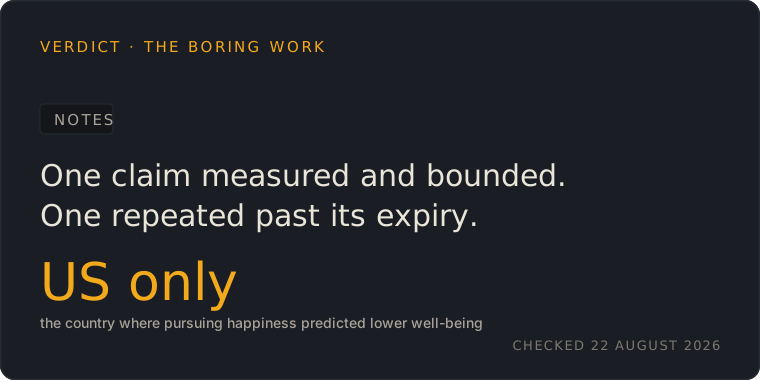
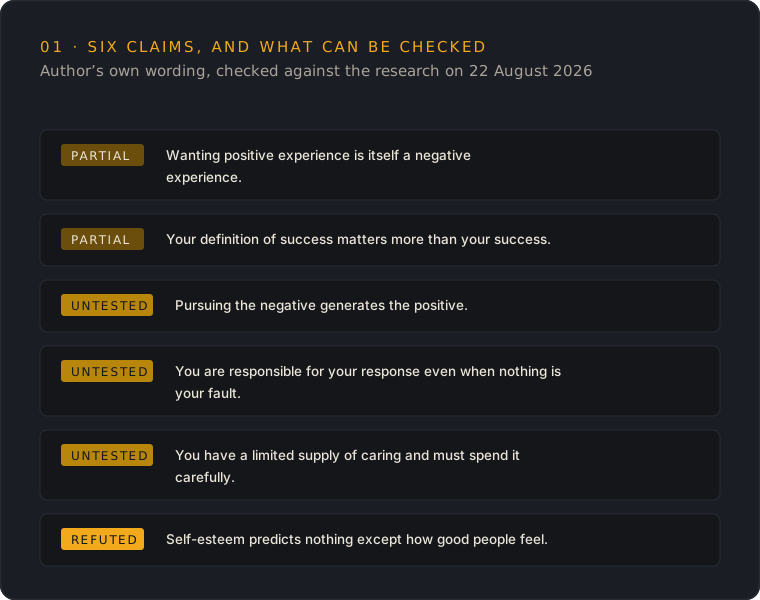
A confession before we begin: most of this book cannot be fact-checked, and that is not a criticism. Stories about Bukowski, a panda of despair, and a man who lied his way through life are parables. Musings on mortality are philosophy. Data cannot touch them, and pretending otherwise would be a category error. But buried in the profanity are four claims about how minds actually work — and all four have been to the laboratory.
Four things can be tested, and all four are stated by the author in public text he wrote himself, so this page quotes him rather than paraphrasing the book. The claims: that wanting positive experience is itself negative; that pursuing discomfort produces the good outcome; that self-esteem predicts nothing but mood; and that responsibility can be separated from fault.
The backwards law has an experiment
The book’s opening argument, in the author’s own words: «Wanting positive experience is a negative experience; accepting negative experience is a positive experience. It’s what the philosopher Alan Watts used to refer to as “the backwards law” — the idea that the more you pursue feeling better all the time, the less satisfied you become» (Manson, 2016).
Alan Watts was a philosopher — nobody measured his «backwards law» until 2011. Then someone did, elegantly: women were experimentally primed to value happiness highly, then shown a feel-good film. The primed group enjoyed it less — sabotaged by disappointment at their own insufficient joy (Mauss et al., 2011).
That is a genuine experimental test of a philosophical slogan, and it worked. The paradox in the title is exact: valuing happiness cost people most «just when happiness is within reach». Later work extended it to clinical territory: valuing happiness was elevated in a sample with remitted major depression compared with controls, holding current symptoms constant (Ford et al., 2014). Both are female or US samples, and nothing here is a statement about anyone’s mental health or treatment.
Where the law stops being a law
Four years later the same research group tested whether the effect travels. Across four regions differing in collectivism, «motivation to pursue happiness predicted lower well-being in the United States, did not predict well-being in Germany, and predicted higher well-being in Russia and in East Asia» (Ford et al., 2015).
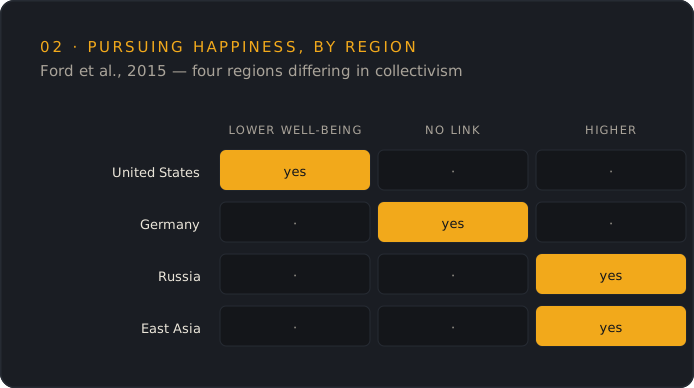
The explanation is the gem of this whole page. Where a culture defines happiness as a private achievement — something you chase alone, like a promotion — chasing it isolates you, and the paradox bites. Where happiness means time with people, chasing it works, because the chase itself is the destination. The backwards law is not a bug in human nature. It is a bug in one culture’s definition of happiness.
So the backwards law is not a law about human minds. It is a description of what happens when a culture teaches people to treat happiness as a private target, which is exactly the culture the book was written in and for, and which the book presents as human nature.
A verdict from 2003, quoted in 2016, overturned in 2022
The book’s position on self-esteem is stated most plainly in a later article by the author: that research on self-esteem «only strongly correlates with one thing: how good people feel, in general», and that after decades of work it «seems to reliably predict» nothing more than that (Manson, 2019).
To be fair to Manson, that was a faithful summary of the famous 2003 review that deflated the self-esteem movement (Baumeister et al., 2003). The trouble is chronological: he quoted a 2003 verdict in 2016, and in 2022 the verdict was overturned on appeal.
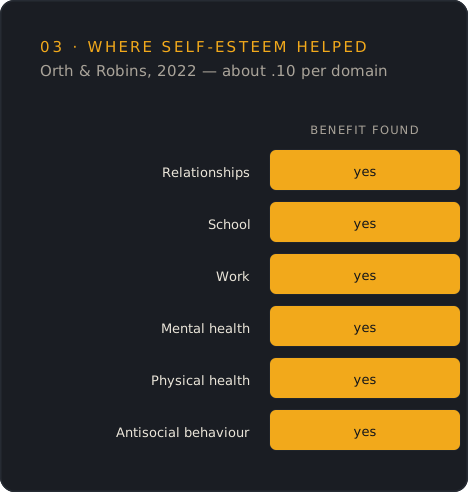
Nineteen years later, two of the field’s longitudinal specialists revisited the question with data that controls for prior levels of the outcome. «The findings suggest that self-esteem is beneficial in all these domains» (relationships, school, work, mental health, physical health and antisocial behaviour) «and that these benefits hold across age, gender, and race/ethnicity». The meta-analytic estimates «average .10 across domains» and are described as «comparable in size to estimates for other hypothesized causal factors such as self-efficacy, positive emotionality, attachment security, and growth mindset» (Orth & Robins, 2022).
A meta-analysis of longitudinal data had already pointed the same way for one domain: self-esteem predicted later depression at β = −.16, significantly stronger than depression predicting later self-esteem at −.08 (Sowislo & Orth, 2013).
None of this makes self-esteem a lever anyone knows how to pull, and .10 is a small number. It does refute the specific claim being made. The wider question, whether trying to raise self-esteem is a good idea, has its own page on this site and is not settled here.
Two things are worth separating here, because they get argued as one. Whether self-esteem does anything is a question about prospective effects, and the answer now is «a little, in several places». Whether programmes designed to raise self-esteem work is a different question with a worse answer, and that was the question the backlash of the 2000s took aim at. The book inherits the backlash and states it as the first answer.
The line about violent people
A claim that travels with this argument is that violent criminals have unusually high self-esteem. It is worth tracing, because the source says something narrower and more interesting.
Trace it back and the source turns out not to involve criminals at all. It was a lab game: students, after being insulted or praised, could blast another person with unpleasant noise. The paper’s own words: «Self-esteem proved irrelevant to aggression.» What made people vicious was narcissism plus insult (Bushman & Baumeister, 1998). Confident people are not dangerous. Fragile grandiosity, freshly bruised, is.
Eleven years later the same first author looked again, reanalysing old data and running new experiments plus a field study. «High narcissists were more aggressive than others but only when provoked by insult or humiliation and only toward the source of criticism. The combination of high self-esteem and high narcissism produced the highest levels of aggression», and the results were reported as inconsistent with low self-esteem causing aggression either (Bushman et al., 2009).
The distinction that survives is between self-esteem and narcissism, and it has a developmental counterpart. In 565 children followed across four waves, «narcissism was predicted by parental overvaluation, not by lack of parental warmth», while «self-esteem was predicted by parental warmth, not by parental overvaluation» (Brummelman et al., 2015). Two different things, two different origins, and the book collapses them.
Responsibility without fault
The strongest idea in the book is the one with the least evidence. On a page the author labels as an excerpt from it, he separates fault from responsibility: you may not be at fault for what happened to you, and you are still responsible for what you do next (Manson, 2017).
Nobody has tested that formulation. The nearest measured construct is locus of control, and a meta-analysis of work outcomes found that «internal locus was positively associated with favorable work outcomes, such as positive task and social experiences, and greater job motivation» (Ng et al., 2006). Those data are correlational, so they cannot tell you whether adopting the stance produces the outcome or whether people whose lives are going well feel more in control.
Untested is the honest mark. It is also, on this page, the least damaging one: this is a way of framing a situation rather than a factual claim about the world, and a reader can adopt it without needing a study to license it.
There is a version of the responsibility claim that would be testable, and nobody has run it: take two groups facing the same setback, teach one to separate fault from response, and measure what happens over the following months. Until that exists, the honest status of the book’s best idea is that it is a good idea, argued well, with no evidence attached.
Values, and the therapy that shares them
The book’s second half argues that the definition of success matters more than success, and that bad values produce a bad life regardless of achievement. As stated, no study can touch it, but its two components, accepting unpleasant experience and acting on chosen values, are the core of an existing therapy, which means they have been measured.
Across 39 randomised trials with 1,821 patients, that therapy «outperformed control conditions (Hedges’ g = 0.57) at posttreatment and follow-up», beating waiting list at 0.82, psychological placebo at 0.51 and treatment as usual at 0.64 (A-Tjak et al., 2015). A later review of 20 meta-analyses covering 12,477 participants found it «generally superior to inactive controls … treatment as usual, and most active intervention conditions (excluding CBT)» (Gloster et al., 2020).
Note the parenthesis carefully: «excluding CBT». The book’s philosophy is real enough to exist as a clinical therapy with solid trials — and that therapy performs on par with, not better than, boring old cognitive behavioural therapy. Which is the perfect verdict for this book: genuinely good, and not the revolution its tone implies.
Who should read it
Read it if the framing helps you, and it helps a lot of people. Its contribution is not a fact about psychology but an operation: choose which problems you want, and treat your values as things to be questioned rather than defended. That operation appears in almost no other book in this genre, and it survives everything on this page, because it was never a claim about data in the first place.
Do not repeat the self-esteem chapter as fact. It reproduces a 2003 verdict that longitudinal data have since revised, and the striking line about violent people rests on a laboratory noise-blast study in which self-esteem turned out to be irrelevant.
And hold the backwards law lightly. It is real, it is measured, and it appears to be a feature of one way of thinking about happiness rather than a fact about being human. For the wider evidence on what predicts feeling good, see the piece on happiness myths; for the pattern of big claims shrinking on contact with data, the piece on self-improvement and the check on growth mindset.
The boring bottom line
The backwards law was measured five years before the book and holds, in the United States. In Russia and East Asia, pursuing happiness predicts higher well-being, and the difference is explained by whether the pursuit is social. That makes it a local effect wearing the clothes of a law.
The self-esteem chapter repeats a review from 2003 that was revisited in 2022 with longitudinal data: small benefits, about .10, across six domains. The famous line about aggressive people comes from an experiment in which self-esteem was irrelevant and narcissism did the work. And the book’s underlying method (accept the unpleasant, act on your values) exists as a therapy that beats waiting lists and ties with cognitive behavioural therapy.
Sources
- Manson, M (2016). The feedback loop from hell — the author's own text of the book's opening argument. markmanson.net. Read on 22 August 2026. Quoting the author's own page rather than the book means the claim under test is his wording. markmanson.net
- Manson, M (2019). How to build self-esteem (and does it even matter?). markmanson.net. Read on 22 August 2026. Published three years after the book and repeating its verdict, which is why it can be tested against the later evidence. markmanson.net
- Manson, M (2017). The responsibility/fault fallacy — excerpt from The Subtle Art of Not Giving a F*ck. markmanson.net. Read on 22 August 2026. The page carries the author's own note that it is an excerpt, which is why this claim is quoted rather than paraphrased. markmanson.net
- Mauss, I. B., Tamir, M., Anderson, C. L., & Savino, N. S (2011). Can seeking happiness make people unhappy? Paradoxical effects of valuing happiness. Emotion. 11(4), 807-815. The first direct experimental test of the idea the book attributes to Alan Watts. doi:10.1037/a0022010
- Ford, B. Q., Shallcross, A. J., Mauss, I. B., Floerke, V. A., & Gruber, J (2014). Desperately seeking happiness: Valuing happiness is associated with symptoms and diagnosis of depression. Journal of Social and Clinical Psychology. 33(10), 890-905. Extends the finding to clinical outcomes. Nothing on this page is advice about depression or its treatment. doi:10.1521/jscp.2014.33.10.890
- Ford, B. Q., Dmitrieva, J. O., Heller, D., Chentsova-Dutton, Y., Grossmann, I., Tamir, M., et al (2015). Culture shapes whether the pursuit of happiness predicts higher or lower well-being. Journal of Experimental Psychology: General. 144(6), 1053-1062. The boundary condition that turns a «law» into a local effect. doi:10.1037/xge0000108
- Baumeister, R. F., Campbell, J. D., Krueger, J. I., & Vohs, K. D (2003). Does high self-esteem cause better performance, interpersonal success, happiness, or healthier lifestyles?. Psychological Science in the Public Interest. 4(1), 1-44. The source of the position the book repeats, included as the object of examination rather than as support. doi:10.1111/1529-1006.01431
- Orth, U., & Robins, R. W (2022). Is high self-esteem beneficial? Revisiting a classic question. American Psychologist. 77(1), 5-17. The 2003 verdict revisited on longitudinal data. The effects are small and they are not zero. doi:10.1037/amp0000922
- Sowislo, J. F., & Orth, U (2013). Does low self-esteem predict depression and anxiety? A meta-analysis of longitudinal studies. Psychological Bulletin. 139(1), 213-240. Directly relevant to the claim that self-esteem predicts nothing but mood. doi:10.1037/a0028931
- Bushman, B. J., & Baumeister, R. F (1998). Threatened egotism, narcissism, self-esteem, and direct and displaced aggression: Does self-love or self-hate lead to violence?. Journal of Personality and Social Psychology. 75(1), 219-229. The origin of the line about aggressive people and self-esteem — and it says something narrower than the line does. doi:10.1037/0022-3514.75.1.219
- Bushman, B. J., Baumeister, R. F., Thomaes, S., Ryu, E., Begeer, S., & West, S. G (2009). Looking again, and harder, for a link between low self-esteem and aggression. Journal of Personality. 77(2), 427-446. The eleven-years-later follow-up, and the precise shape of the finding is narrower than either popular version. doi:10.1111/j.1467-6494.2008.00553.x
- Brummelman, E., Thomaes, S., Nelemans, S. A., Orobio de Castro, B., Overbeek, G., & Bushman, B. J (2015). Origins of narcissism in children. Proceedings of the National Academy of Sciences. 112(12), 3659-3662. Separates the thing worth having from the thing that causes the trouble. doi:10.1073/pnas.1420870112
- Ng, T. W. H., Sorensen, K. L., & Eby, L. T (2006). Locus of control at work: A meta-analysis. Journal of Organizational Behavior. 27(8), 1057-1087. The nearest measured construct to the book's responsibility claim; the data are correlational, which is why that claim stays untested rather than confirmed. doi:10.1002/job.416
- A-Tjak, J. G. L., Davis, M. L., Morina, N., Powers, M. B., Smits, J. A. J., & Emmelkamp, P. M. G (2015). A meta-analysis of the efficacy of acceptance and commitment therapy for clinically relevant mental and physical health problems. Psychotherapy and Psychosomatics. 84(1), 30-36. A therapy built on accepting unpleasant experience and acting on values — the book's two ideas, in a clinical form. doi:10.1159/000365764
- Gloster, A. T., Walder, N., Levin, M. E., Twohig, M. P., & Karekla, M (2020). The empirical status of acceptance and commitment therapy: A review of meta-analyses. Journal of Contextual Behavioral Science. 18, 181-192. The ceiling for the book's mechanism: real, and not better than the standard alternative. doi:10.1016/j.jcbs.2020.09.009