Anna Lembke is a psychiatrist at Stanford who has spent thirty years treating people addicted to heroin, alcohol, gambling and, lately, their phones. Her book says your brain works like a playground teeter-totter: push the pleasure side down, and the pain side swings up to balance it. Good image. Mostly true. But the molecule on the cover, dopamine, turns out to be the wrong hero for this story, and the book’s most famous numbers were measured inside the brain of a rat.
Nothing here is medical advice, and no protocol, duration or list of things to give up appears on this page from us. Addiction, depression and anxiety are clinical matters; see the final section.
What the book claims
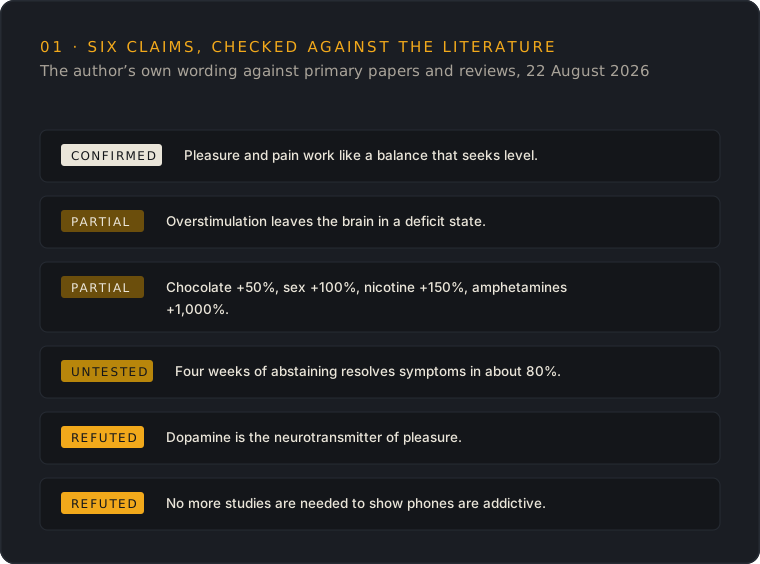
Start with the book’s big idea, in the author’s own words: «One of the most fascinating findings in neuroscience in the last 75 years is that the same areas of the brain that process pleasure also process pain and that pleasure and pain work like a balance… if you imagine that in your brain, there’s a teeter-totter… one of the governing principles regulating this balance is that it wants to remain level, which is what neuroscientists call homeostasis» (Lembke, 2021).
And the chemistry: dopamine is «probably the most important neurotransmitter in our experience of pleasure, motivation and reward… the final common pathway for all pleasurable, intoxicating, rewarding experiences».
The teeter-totter is real, and it is fifty years old
Here is the twist: the teeter-totter is not a fascinating new finding. It has a name, opponent-process theory, and a birthday, 1974, the year Nixon resigned. Two psychologists proposed that every strong feeling triggers its own opposite, and that the opposite gets stronger every time you repeat the experience (Solomon & Corbit, 1974). First cigarette: buzz, then a little flatness. Thousandth cigarette: barely a buzz, lots of flatness. The see-saw learns.
By 2001 the theory had grown up. In addiction, researchers found, the see-saw does not just tilt back level; the whole thing sinks into the ground. The resting point itself drops, so «normal» starts to feel like withdrawal, and stress hormones join the party alongside the reward circuits (Koob & Le Moal, 2001). That sunken see-saw is what Lembke calls the «dopamine deficit state».
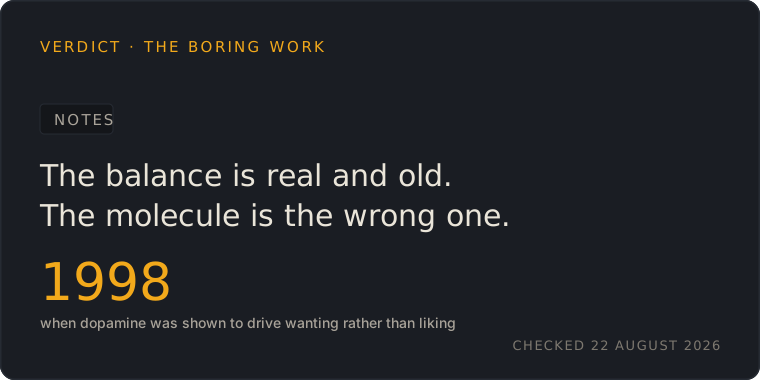
So the book’s central image checks out. Two footnotes, though. First, it is not recent neuroscience; it is older than the pocket calculator. Second, the science behind it was built on rats given cocaine and humans with diagnosed addiction, which is a rather different crowd from a reader who checks Instagram at dinner.
Dopamine is not the pleasure chemical
Now for the molecule itself. In 1998, two researchers ran an experiment that should have killed the phrase «dopamine, the pleasure chemical» forever. They asked a simple question: if dopamine creates pleasure, then a brain with almost no dopamine should feel almost no pleasure. Right?
Wrong. Rats stripped of up to 99% of their dopamine still enjoyed sugar exactly as before, still made the same happy licking faces at sweet water, still grimaced at bitter. What they lost was something else entirely: the drive to go and get the sugar. The researchers’ famous conclusion: dopamine is needed for «wanting» things, not for «liking» them (Berridge & Robinson, 1998).
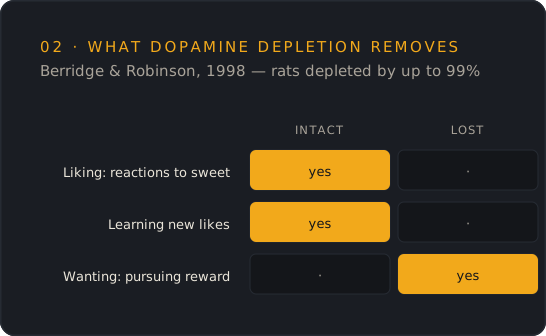
Sit with that for a second, because it explains addiction better than anything in the book. Wanting and liking are different circuits. Addiction is what happens when the wanting circuit screams while the liking circuit has gone silent: craving a fifth hour of scrolling that you are not even enjoying. Everyone who has ever kept eating chips they did not want understands this distinction in their stomach.
The book also calls dopamine the «final common pathway» of every addictive pleasure. A 2015 review of forty years of evidence says: for stimulants like cocaine, yes; for alcohol, maybe; for cannabis and opiates, «little evidence, if any» that they raise dopamine at all (Nutt et al., 2015). Heroin, the most addictive substance we know, barely registers on the dopamine meter. Some final common pathway.
Whose brain the percentages describe
Now the numbers you have seen on every podcast thumbnail: «chocolate increases dopamine above baseline about 50%. Sex is about a 100%. Nicotine is about 150%. And amphetamines is about 1,000%.»
Give the author full credit here: in the same interview she introduces the figures by saying «[an] experiment has been done in rats, for example, putting a probe in their brain, measuring the amount of dopamine released in response to different types of substances». She names the species and the method.
The source is a 1988 study whose title states the design in full: drugs abused by humans preferentially increase synaptic dopamine concentrations in the mesolimbic system of freely moving rats (Di Chiara & Imperato, 1988).
Then the numbers left home and lost their passport. The caveat is one sentence; the list is four juicy percentages. The percentages get screenshotted, the sentence does not. By the time the list lands in your feed, it reads like someone measured your brain eating chocolate, which no one has ever done. To get those numbers for a human, you would need to open the skull and insert a probe, and ethics boards frown on that. Percentages travel light; they leave their methods at the border.
«About 80% of people»
The book’s most consequential number arrives with its own label attached, and the label is accurate. Asked what clinicians should do differently, the author says too much stimulation can reset the brain and «put it into a dopamine deficit state, which is akin to a clinical depression or a clinical anxiety», and that the first intervention is to «ask the patient to experiment with a dopamine fast, a period of 4 weeks». Then: «In my clinical experience, about 80% of people will be improved or even completely freed of their symptoms of depression and anxiety» by the fast alone (Lembke, 2023).
«In my clinical experience» is the most important phrase in that quote, and to her credit she says it plainly. But think about what it means. No control group, so we cannot tell the fast apart from four weeks of simply passing time, or from the effect of an hour with a doctor who listens. No randomisation: the patients who tried it are the ones willing to try. Nobody neutral measured «improved». It is a doctor’s honest impression of her own patients, which in medicine is where research starts, not where it ends.
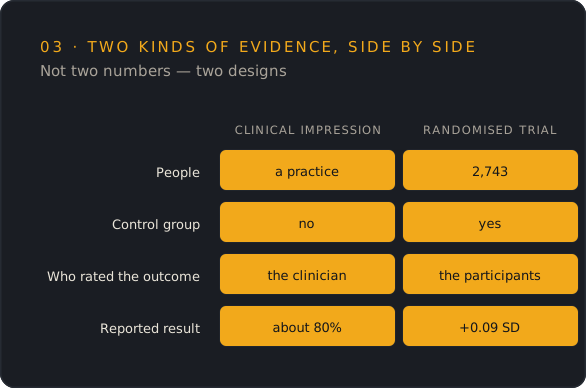
For scale rather than for equivalence: the nearest randomised test of abstaining from a digital activity for four weeks paid 2,743 people to deactivate Facebook and found the well-being index improved «by 0.09 standard deviations», which the authors call «about 25-40 percent of the effect of psychological interventions including self-help therapy, group training, and individual therapy» (Allcott et al., 2020). Different population, different outcome measure, different claim, which is precisely why it is not a rebuttal. It is the only number of its kind anyone has.
None of this proves the four-week reset fails. It means the experiment that would tell us has never been run. An impression from one consulting room, however experienced the doctor, cannot substitute for it, and she does not claim otherwise.
The phone claim
On the phone question the author’s position is explicit: «I do believe that smartphones are addictive. They’ve been engineered to be addictive and … we don’t … need more studies to show that that’s true. All you need to do is go outside and look around.»
The studies exist. Reviewing them, two researchers found that «although the majority of research in the field declares that smartphones are addictive or takes the existence of smartphone addiction as granted, we did not find sufficient support from the addiction perspective to confirm the existence of smartphone addiction at this time». Their reading is that the observed behaviours «could be better labeled as problematic or maladaptive smartphone use», whose consequences «do not meet the severity levels of those caused by addiction» (Panova & Carbonell, 2018).
Both statements are quoted here without comment on motive. One says the question is settled by looking around; the other reports what happened when people looked at the measurements.
How the field defines a behavioural addiction
There is a reason researchers are cautious here, and it is not squeamishness. «Recent publications have suggested that nearly all daily life activities might lead to a genuine addiction», and the mechanism producing that result is methodological: take the criteria for substance dependence, apply them to any activity, and the activity qualifies (Billieux et al., 2015).
A group of researchers therefore proposed «an operational definition of behavioural addiction together with a number of exclusion criteria, to avoid pathologizing common behaviours», warning that unchecked expansion would leave «both the relevance and the credibility of the field of addictive disorders» in question (Kardefelt-Winther et al., 2017).
And a scale check. Gaming disorder is the one behavioural addiction with formal diagnostic status; pooling 53 studies and 226,247 people across 17 countries gives a worldwide prevalence of «3.05%», falling to «1.96%» under stricter sampling, with the choice of screening questionnaire accounting for «77% of the variance» (Stevens et al., 2021).
A few per cent, and most of the disagreement between studies comes from which questionnaire was handed out. That is the measured shape of a real behavioural addiction, and it does not resemble a world in which everyone is a little addicted to everything.
One more thing worth naming: the brain-disease framing the book treats as settled is itself contested in print. Its standard statement is a 2016 review (Volkow et al., 2016); a published critique argues that «the BDMA is not supported by animal and neuroimaging evidence to the extent its advocates suggest; it has not helped to deliver more effective treatments for addiction» (Hall et al., 2015). Both are positions, and a reader deserves to know there are two.
Who this book is for
Read it for the balance model and for a vocabulary about excess that is more useful than the alternatives on the shelf. Read the patient stories as what they are: a clinician’s account of thirty years in a consulting room, which no dataset replaces.
Do not read it as a description of your own brain chemistry. The percentages are from rats, the word «dopamine» in the title names the wrong process, and the headline result is one doctor’s tally of her own patients, as she says herself.
Neighbouring pages: whether willpower depletes, whether sugar restores it, what happens to an old habit, and The Willpower Instinct.
The boring bottom line
A book named after a molecule gets the molecule wrong, and gets the mechanism right by borrowing a theory older than most of its readers. Its arresting numbers were measured with a probe in a rat, which the author says and the internet drops. Its headline clinical result carries the phrase «in my clinical experience», which is both honest and a statement that the study has not been done.
The useful residue is the balance: pleasure and its counterweight, and the fact that repeating a pleasure moves the baseline. That idea has fifty years behind it, and it never needed the word dopamine at all. The same migration of a physiological model into popular language happens elsewhere; see polyvagal theory for the pattern in another organ.
When to see a professional
Addiction, depression and anxiety are diagnosed and treated by clinicians. Nothing on this page is advice, and no protocol, duration or list of substances or behaviours appears here as a recommendation; the four-week period mentioned above is a quotation from the author, not a suggestion from us. If any of this describes your situation, that is a conversation for a doctor. Stopping some substances abruptly can be medically dangerous, which is another reason this page carries no instructions of any kind; if you are already in treatment, nothing written here is a reason to change it.
Sources
- Lembke, A (interviewed by NPR) (2021). In 'Dopamine Nation,' Overabundance Keeps Us Craving More. NPR, Shots — Health News. The author attributes the percentage figures to rats in this interview. The claim graded on this page is what happens to those numbers once they leave it. npr.org
- Lembke, A (interviewed by Maslowski, M B) (2023). Interview With the Author of Dopamine Nation: Finding Balance in the Age of Indulgence. Psychiatry Advisor. The author labels the figure as clinical experience in the same sentence. That labelling is accurate and this page treats it as such. psychiatryadvisor.com
- Solomon, R L; Corbit, J D (1974). An opponent-process theory of motivation: I. Temporal dynamics of affect. Psychological Review 81(2):119-145. Identifier verified in Crossref and PubMed. Cited to date the idea: 1974, not a discovery of the last few years. doi:10.1037/h0036128
- Koob, G F; Le Moal, M (2001). Drug addiction, dysregulation of reward, and allostasis. Neuropsychopharmacology 24(2):97-129. Note the population this model was built on: drug addiction. It describes a chronic deviation in dependence, not the state of somebody who spends too long on their phone. doi:10.1016/S0893-133X(00)00195-0
- Berridge, K C; Robinson, T E (1998). What is the role of dopamine in reward: hedonic impact, reward learning, or incentive salience?. Brain Research Reviews 28(3):309-369. Published in 1998, twenty-three years before the book. This is the correction that matters most on this page. doi:10.1016/S0165-0173(98)00019-8
- Nutt, D J; Lingford-Hughes, A; Erritzoe, D; Stokes, P R A (2015). The dopamine theory of addiction: 40 years of highs and lows. Nature Reviews Neuroscience 16(5):305-312. Directly relevant to the claim that dopamine is the final common pathway for everything rewarding: for several major dependencies, it is not. doi:10.1038/nrn3939
- Di Chiara, G; Imperato, A (1988). Drugs abused by humans preferentially increase synaptic dopamine concentrations in the mesolimbic system of freely moving rats. Proceedings of the National Academy of Sciences 85(14):5274-5278. Identifier verified in Crossref and PubMed. Cited to establish the species and the method behind the percentages, which is the whole point of mentioning it. doi:10.1073/pnas.85.14.5274
- Volkow, N D; Koob, G F; McLellan, A T (2016). Neurobiologic Advances from the Brain Disease Model of Addiction. New England Journal of Medicine 374(4):363-371. Identifier verified. Presented as a position, paired below with a published critique of the same model so the reader sees both. doi:10.1056/NEJMra1511480
- Hall, W; Carter, A; Forlini, C (2015). The brain disease model of addiction: is it supported by the evidence and has it delivered on its promises?. The Lancet Psychiatry 2(1):105-110. Included so that the model the book takes as settled appears here as what it is: a position with a serious published opposition. doi:10.1016/S2215-0366(14)00126-6
- Panova, T; Carbonell, X (2018). Is smartphone addiction really an addiction?. Journal of Behavioral Addictions 7(2):252-259. The direct test of the phone claim: the studies exist, and reviewing their methods is what produces this conclusion. doi:10.1556/2006.7.2018.49
- Billieux, J; Schimmenti, A; Khazaal, Y; Maurage, P; Heeren, A (2015). Are we overpathologizing everyday life? A tenable blueprint for behavioral addiction research. Journal of Behavioral Addictions 4(3):119-123. Explains the machinery that produces new addictions on demand: take the criteria for substance dependence and apply them to any activity. doi:10.1556/2006.4.2015.009
- Kardefelt-Winther, D; Heeren, A; Schimmenti, A; van Rooij, A; Maurage, P; Carras, M; et al. (2017). How can we conceptualize behavioural addiction without pathologizing common behaviours?. Addiction 112(10):1709-1715. The most practically useful paper here: it says what would have to be true before an ordinary behaviour counts as an addiction. doi:10.1111/add.13763
- Stevens, M W; Dorstyn, D; Delfabbro, P H; King, D L (2021). Global prevalence of gaming disorder: A systematic review and meta-analysis. Australian & New Zealand Journal of Psychiatry 55(6):553-568. The only behavioural addiction with formal diagnostic status, and its prevalence is a few per cent. Also note the instrument effect: which questionnaire you use explains most of the disagreement. doi:10.1177/0004867420962851
- Allcott, H; Braghieri, L; Eichmeyer, S; Gentzkow, M (2020). The Welfare Effects of Social Media. American Economic Review 110(3):629-676. Cited in one paragraph as the nearest randomised comparison for a month of abstaining from a digital activity. Effect sizes read from the paper itself. doi:10.1257/aer.20190658