TL;DR
- The engine of «Happier» is the happiness pie — 50% genes, 10% circumstances, 40% left to your own activities (Lyubomirsky, Sheldon & Schkade, Review of General Psychology, 2005). Two of those three authors later wrote that the diagram «appears to have outlived its usefulness» and that the 40% «was likely an over-estimate» (Sheldon & Lyubomirsky, The Journal of Positive Psychology, 2021).
- An independent audit found «little empirical evidence» for the split at all (Brown & Rohrer, Journal of Happiness Studies, 2020), and meta-analytic heritability of well-being is 36%, not 50% (Bartels, Behavior Genetics, 2015, n = 55,974).
- The lottery-winner study the book uses to prove adaptation never showed adaptation: 22 winners, 22 controls and 29 paralysed accident victims, measured once, with the paralysed group at 2.96 against controls’ 3.82 (Brickman, Coates & Janoff-Bulman, JPSP, 1978).
- The gratitude journal works, and works small: g = 0.19 across 24,804 people in 28 countries (Choi et al., PNAS, 2025). Positive psychology interventions as a class fall from r = .29 to about r = .10 once small-sample bias is corrected (White, Uttl & Holder, PLOS ONE, 2019).
- The book’s target (present pleasure plus future meaning at once) held up (Huta & Ryan, Journal of Happiness Studies, 2010). Treating happiness itself as the score backfires (Hansenne, Psychologica Belgica, 2021, N = 683).
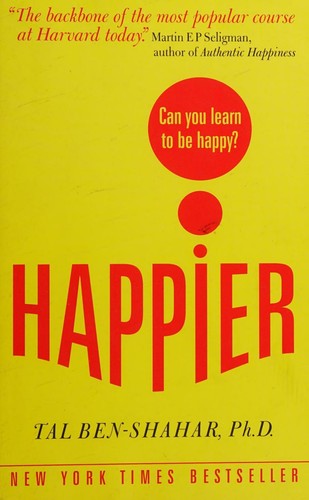
Verdict
Read our notes instead. «Happier» has a good definition and a bad engine. The definition — happiness as present benefit plus future benefit, and the useful question being «how can I become happier» rather than «am I happy» — has survived testing better than most of positive psychology. The engine, the claim that a large specified fraction of your happiness sits waiting for volitional activity, has been retired by the researchers who built it.
The book is short, readable in an evening, and not dangerous. It is also a 2007 lecture course transmitting the field’s confidence at the moment it was highest and least earned. Our other reviews of self-help books apply the same triage.
The claim on trial
Ben-Shahar stakes everything on one claim. Happiness is «the end toward which all other ends are means» — the currency in which every other good, money and status included, should be denominated. It is a two-dial quantity: present benefit, which he calls pleasure, and future benefit, which he calls meaning. The hamburger model sorts lives by which dials are up. The exercise is worth doing because happiness, in his account, is substantially under your control.
That last part is the falsifiable core, and the book says where it comes from. It cites Lykken and Tellegen, Psychological Science, 1996 for the genetic set point, argues that «our genes define a range not a set point», then hands the argument to Lyubomirsky, Sheldon and Schkade, whose decomposition — «a genetically determined set point for happiness, happiness-relevant circumstantial factors» and happiness-relevant activities — supplies the third category that, in the book’s own quotation, «offers the best opportunities» for lasting change. Three things to check: does the decomposition hold, does adaptation work as described, do the activities move the number.
The 40 per cent its own authors withdrew
The pie chart is why a reader closes «Happier» believing a large, quantified amount of happiness is available to effort. Brown and Rohrer, Journal of Happiness Studies, 2020 took the 2005 paper apart and found «little empirical evidence for the variance decomposition suggested by the happiness pie» — and that even a valid split would not tell you whether an individual can move their own chronic happiness, because a between-person variance decomposition is not a within-person budget. The 50% slice is separately wrong: Bartels, Behavior Genetics, 2015 meta-analysed 30 twin-family studies whose estimates ranged from 0% to 64% and reported a weighted heritability of 36% (95% CI 34–38) across 55,974 people.
Then the authors. In Sheldon and Lyubomirsky, The Journal of Positive Psychology, 2021, two of the three people who drew the chart write that «the pie chart diagram appears to have outlived its usefulness», concede of the 40% that «we agree that this figure was likely an over-estimate», and add that intentional-activity effects «tend to be smaller than we initially believed». They still defend the idea that deliberate activity matters. They no longer defend the number or the picture.
This is not a formal retraction. It is rarer: the original authors saying in print that the popular version of their own finding should be retired. Almost nothing written about «Happier» mentions it.
The lottery winners never said what everyone says they said
«Happier» reports that lottery winners return to their prior happiness within about a month. The source is Brickman, Coates and Janoff-Bulman, Journal of Personality and Social Psychology, 1978, and the paper does not contain that result.
The study interviewed 22 Illinois lottery winners, 22 controls drawn from the phone book, and 29 people paralysed in accidents, at a single point in time. Nobody was measured before and after. Present happiness came out at 4.00 for winners and 3.82 for controls on a 0–5 scale, not a significant difference, F(1, 47) = 0.27. The paralysed group came out at 2.96, significantly below controls, F(1, 47) = 7.16, p < .01. Winners also rated seven mundane pleasures lower than controls did, p < .011, which was the paper’s actual point. A cross-sectional study of 73 people with no baseline, in which the disabled group was measurably less happy, became the field’s proof that everyone adapts.
The longitudinal work says something more interesting than either version. Lucas, Journal of Personality and Social Psychology, 2007 followed two nationally representative panels (N = 39,987 and N = 27,406) and tracked the 679 and 272 people who acquired a long-term disability, on average seven years either side of onset in the larger study. Disability produced drops of 0.40 to 1.27 SD «followed by little adaptation over time». Lucas et al., Psychological Science, 2004 tracked 24,000+ Germans for 15 years: the unemployed moved back toward baseline but never reached it, even after re-employment.
The correction cuts both ways. Adaptation is weaker than the book says — bad news for «circumstances barely matter, so work on yourself», and equally bad news for anyone assuming a bad job will fade.
What the exercises deliver
The book’s flagship practice is the gratitude journal (five things a day) sourced to Emmons and McCullough, Journal of Personality and Social Psychology, 2003, and heavily tested since.
Davis et al., Journal of Counseling Psychology, 2016 meta-analysed 32 samples: against a measurement-only control, gratitude improved psychological well-being at d = 0.31; against an alternative activity, d = 0.17 (95% CI 0.09–0.24) across 20 studies; against a psychologically active comparison, roughly d = 0.03, indistinguishable from zero. Cregg and Cheavens, Journal of Happiness Studies, 2021 pooled 27 studies and 3,675 participants and found g = −0.29 on depression and anxiety at post-test, −0.23 at follow-up, larger against waitlists than active controls. The largest estimate is preregistered: Choi et al., PNAS, 2025, 145 papers, 163 samples, 24,804 participants in 28 countries, pooled g = 0.19 (0.15–0.22), robust to publication bias. A real effect at a cost of two minutes a day, and not the effect the genre advertises.
The same shrinkage applies to the whole category. Sin and Lyubomirsky, Journal of Clinical Psychology, 2009 pooled 51 interventions and 4,266 individuals and reported mean r = .29 for well-being and r = .31 for depression — the numbers that licensed a decade of confident advice. White, Uttl and Holder, PLOS ONE, 2019 re-analysed the same literature accounting for small-sample bias and found well-being effects of approximately r = .10, with depression effects «variable, dependent on outliers, and generally not statistically significant». Folk and Dunn, Annual Review of Psychology, 2024 looked only at preregistered experiments and found «surprisingly little support for many widely recommended strategies», naming random acts of kindness, while sociability and cash transfers to poorer people held up.
One clean positive at the same citation standard: Heintzelman et al., Journal of Experimental Psychology: Applied, 2020 ran a 12-week structured programme against a waitlist control, N = 155, with gains maintained at six months. Structured multi-week programmes do something. Single exercises read out of a book do less.
The currency problem
There is a risk in the book’s framing that the 2007 literature could not have known about. Making happiness the measure of everything means holding it in view and checking the balance.
Mauss et al., Emotion, 2011 found that people who valued happiness more reported less of it under low-stress conditions, and that inducing people to value happiness made them react less positively to a happy film, mediated by disappointment at their own feelings. Both studies used female-only samples, so treat the original with the caution any two-study 2011 finding deserves. It replicated. Hansenne, Psychologica Belgica, 2021, N = 683, found valuing happiness associated with lower life satisfaction (β = −.30), lower subjective happiness (β = −.32), lower psychological well-being (β = −.37) and more depressive symptoms (β = +.39), while prioritising positivity (arranging your days around activities that tend to be pleasant, without auditing the result) went the other way on every measure.
The distinction is narrow and load-bearing. Organising your week to contain more good hours is supported. Grading the week afterwards against a happiness target is the failure mode, and «Happier» hands you the ledger.
What survived
The two-dial target. Huta and Ryan, Journal of Happiness Studies, 2010 ran four studies (n = 300, 321, 102 and 114 undergraduates) and found people high in both hedonic and eudaimonic pursuits scored higher on most well-being measures than people high in only one, beating the purely eudaimonic on positive affect and the purely hedonic on meaning and vitality. That is the hamburger model, tested, and broadly confirmed. Baumeister et al., The Journal of Positive Psychology, 2013 supply the reason it matters: across 397 adults, happiness and meaningfulness had different and sometimes opposing predictors, with meaning tracking giving, past-and-future thinking and higher stress. Two dials, because they do not move together.
The correlational half of «happiness causes success» also survives. Lyubomirsky, King and Diener, Psychological Bulletin, 2005 (the paper the book quotes) showed happy people do better across marriage, friendship, income, work and health, and argued for a causal path. Walsh, Boehm and Lyubomirsky, Journal of Career Assessment, 2018 revisited it and concluded the evidence holds. That is the same group grading its own work, and Folk and Dunn are far less enthusiastic about the intervention studies the causal claim needs.
Credit is also due for a number the book does not contain. The 3:1 positivity ratio from Fredrickson and Losada, American Psychologist, 2005 was demolished by Brown, Sokal and Friedman, American Psychologist, 2013 and then withdrawn: the 2013 correction notice, American Psychologist, 68(9), 822 states that «the modeling element of this article is formally withdrawn as invalid and, along with it, the model-based predictions about the particular positivity ratios of 2.9 and 11.6». «Happier» cites Fredrickson’s 1998 broaden-and-build work and never reaches for the ratio. Reviews that accuse this book of running on the retracted number are wrong.
Who should read it
Read it if you are stuck in a job or a degree you cannot justify and want clean vocabulary for the trade-off between what is good now and what is good later. The hamburger model is a decent sorting tool with Huta and Ryan behind it, more than most popular frameworks have.
Skip it if you want to know how much happiness is available to you: the answer it gives is 40%, withdrawn by its own authors. Skip it if you are looking for treatment, or if you have read any post-2015 well-being book — the survival rate of the 2007 material is low.
The retracted and retired numbers in this field travel far: «Secrets of the Millionaire Mind» runs on affirmations, and «Notes from a Friend» on state change.
One thing to try
Schedule, do not score. The evidence separates two things that feel identical from the inside: prioritising positivity, arranging your calendar to contain more activities that tend to be good, and valuing happiness, checking afterwards whether you got enough. In Hansenne’s 683 participants the first predicts higher life satisfaction and fewer depressive symptoms; the second predicts the opposite.
Concretely: once a week, put two things in the calendar as appointments — one for present benefit, one for future benefit. Sociability held up best under preregistration in Folk and Dunn’s review, so make one of them involve another person. Then do not rate the week: no entry about whether it worked, no score out of ten, no adjusted target. If you want something written, use the five-item gratitude list and expect g = 0.19.
Get the book
Find «Happier» on Amazon — as an Amazon Associate, The Boring Work earns from qualifying purchases (disclosure).
The boring bottom line
«Happier» asks the right question and answers it with a number that no longer exists. The 40% was «likely an over-estimate» according to the people who published it, the chart has «outlived its usefulness» according to the same people, and the decomposition had thin evidence to begin with. The lottery study anchoring its account of adaptation was 73 people measured once, and its paralysed participants were significantly less happy than controls.
What is left is worth about an hour. Track two dials rather than one, because pleasure and meaning have different predictors and combining them beats either alone. Keep the gratitude list at its true size, g = 0.19. Put good things in the calendar and stop grading them. And treat any book that names a specific percentage of your happiness as under your control as a book written before 2019.
When to see a professional
This is general information about a book and the research behind it, not medical or mental-health advice. Gratitude journalling is not a treatment for depression or anxiety: the meta-analysis that looked hardest at that question found small effects and told readers to use better-evidenced interventions instead. If low mood, anxiety, hopelessness or loss of interest has lasted more than two weeks, or is affecting work, sleep or relationships, speak to a physician or a licensed psychologist or psychiatrist. If you are having thoughts of harming yourself, contact your local emergency number or crisis line now.
Sources
- the 50/10/40 model «Happier» builds on. Review of General Psychology. doi:10.1037/1089-2680.9.2.111
- little empirical evidence for the variance decomposition, which would not answer the question anyway. Journal of Happiness Studies. doi:10.1007/s10902-019-00128-4
- the authors retire the diagram and concede the 40% was likely an over-estimate. The Journal of Positive Psychology. doi:10.1080/17439760.2019.1689421
- 30 twin-family studies; weighted heritability 36% (34–38), n = 55,974. Behavior Genetics. doi:10.1007/s10519-015-9713-y
- the set-point source cited in the book. Psychological Science. doi:10.1111/j.1467-9280.1996.tb00355.x
- 22 winners, 22 controls, 29 paralysed; cross-sectional; victims significantly less happy. Journal of Personality and Social Psychology. doi:10.1037/0022-3514.36.8.917
- panels of 39,987 and 27,406; drops of 0.40–1.27 SD with little adaptation. Journal of Personality and Social Psychology. doi:10.1037/0022-3514.92.4.717
- 24,000+ Germans over 15 years; no full return even after re-employment. Psychological Science. doi:10.1111/j.0963-7214.2004.01501002.x
- the original gratitude-journal experiment the book cites. Journal of Personality and Social Psychology. doi:10.1037/0022-3514.84.2.377
- d = 0.17 against alternative activities, about 0.03 against psychologically active controls. Journal of Counseling Psychology. doi:10.1037/cou0000107
- 27 studies, 3,675 participants; g = −0.29 post-test, −0.23 at follow-up. Journal of Happiness Studies. doi:10.1007/s10902-020-00236-6
- preregistered; 24,804 participants, 28 countries; g = 0.19 (0.15–0.22). PNAS. doi:10.1073/pnas.2425193122
- 51 interventions, 4,266 individuals; r = .29 and .31. Journal of Clinical Psychology. doi:10.1002/jclp.20593
- corrected well-being effect approximately r = .10. PLOS ONE. doi:10.1371/journal.pone.0216588
- little support for several widely recommended strategies; sociability and cash transfers hold up. Annual Review of Psychology. doi:10.1146/annurev-psych-022423-030818
- N = 155 randomised trial; gains maintained at six months. Journal of Experimental Psychology: Applied. doi:10.1037/xap0000254
- two female-only studies; valuing happiness lowered happiness in positive conditions. Emotion. doi:10.1037/a0022010
- N = 683; opposing coefficients for valuing happiness and prioritising positivity. Psychologica Belgica. doi:10.5334/pb.1036
- four studies (n = 300, 321, 102, 114); high on both beats high on either. Journal of Happiness Studies. doi:10.1007/s10902-009-9171-4
- 397 adults; happiness and meaning have different and sometimes opposing predictors. The Journal of Positive Psychology. doi:10.1080/17439760.2013.830764
- the meta-analytic review quoted in «Happier». Psychological Bulletin. doi:10.1037/0033-2909.131.6.803
- the same group's decade-later re-review, concluding the evidence holds. Journal of Career Assessment. doi:10.1177/1069072717751441
- the source of the 2.9013 positivity ratio. American Psychologist. doi:10.1037/0003-066X.60.7.678
- the mathematical demolition. American Psychologist. doi:10.1037/a0032850
- the modelling and the 2.9 and 11.6 ratios formally withdrawn as invalid. American Psychologist. doi:10.1037/a0034435