TL;DR
- The engine under this 112-page book is neuro-linguistic programming, and NLP has been reviewed four times by people who went looking for its evidence. Witkowski went to NLP’s own research database, pulled the 33 studies published in indexed journals, and found 18 non-supportive against 9 supportive. Almost no review of Robbins names this.
- «Change your physiology and you change your state» has an honest scientific version, and it is much smaller than the book’s. A 17-lab registered replication put the facial feedback effect at 0.03 rating units where the original reported 0.82. A 2022 study of 3,878 people in 19 countries then found a real but small effect — under two of three conditions.
- Power posing, the closest cousin of the book’s posture advice, collapsed outright. The original had 42 participants. Its first author now writes: «I do not believe that “power pose” effects are real.»
- The firewalk is a thermal conductivity demonstration, not a belief demonstration. More than 30 people were treated for burns at a Robbins event in Dallas in June 2016 and five taken to hospital; more than 20 were treated at his San Jose firewalk in 2012.
- Verdict: read our notes. The one tool here that survives contact with the literature is the if-then plan, worth d = 0.65 across 94 independent tests — and it is not the tool the book leads with.
Verdict
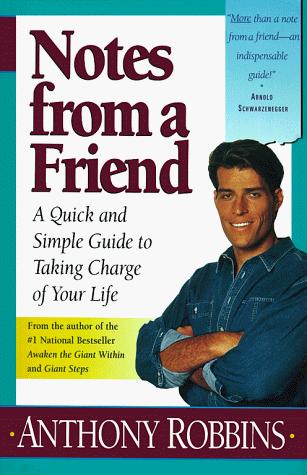
Read our notes. «Notes from a Friend» is a 112-page condensation, published by Simon & Schuster in 1995, of material Robbins had already sold at length. It was written to be handed out to people in trouble, and it reads that way. Its central line — «YOUR PAST DOES NOT EQUAL YOUR FUTURE» — is a plain claim that a bad situation is not an identity, and there is nothing wrong with it.
What fails is the machinery beneath it. We are scoring the claim, not the man. The book asserts a causal chain, that chain has been tested, and most of it does not hold at the strength claimed. One link does, and it gets the same citation standard as the failures. For the rest of the shelf, see our book reviews.
The claim on trial
The claim the book encodes is a sequence: change your physiology, change the questions you ask, change your beliefs, take massive action — and rapid, durable change follows. Robbins states the last step directly, promising results from «massive, consistent action with pure persistence and a sense of flexibility in pursuing your goals».
That is falsifiable in four places. Does the physiology step move state? Does the belief and language step move outcomes? Does the signature demonstration prove what it is said to prove? And does anything in this method produce change that survives the week after you read it?
The NLP foundation
Robbins did not invent the underlying model, and does not claim to. His own site names the source: NLP «was created by Richard Bandler and John Grinder in the 1970s», and «Tony has adapted many NLP training techniques into his system, neuro-associative conditioning» (tonyrobbins.com). The lineage is stated openly.
The lineage has been audited. Sharpley reviewed 15 studies of NLP’s preferred-representational-system claim and found little supportive evidence (Sharpley, Journal of Counseling Psychology, 1984). Three years later he added data from seven further studies and asked in his title whether NLP was producing non-supportive data or was untestable (Sharpley, Journal of Counseling Psychology, 1987).
The strongest audit is Witkowski’s, because of where he looked. Rather than search PsycINFO, he took the Neuro-Linguistic Programming Research Data Base (a register built and maintained by NLP’s own supporters, holding 315 articles by 287 authors published 1974–2009) and analysed it in December 2009. Of those 315, 63 had appeared in journals on the ISI Master Journal List, and 33 were empirical tests of NLP tenets: 9 supported them, 18 did not, 6 were uncertain (Witkowski, Polish Psychological Bulletin, 2010). Weighting by journal quality made the non-supportive set heavier still. The paper’s own published abstract transposes two of those percentages; the body of the paper carries the counts.
Then medicine checked. A systematic review screened 1,459 titles and found 10 experimental studies of NLP applied to health outcomes — five randomised controlled trials, five pre-post designs. Its conclusion: «There is little evidence that NLP interventions improve health-related outcomes.» The authors were careful, and so are we: they said this reflects the limited quantity and quality of NLP research rather than robust evidence of no effect (Sturt et al., British Journal of General Practice, 2012). Their recommendation was that the NHS should not commission NLP outside research.
That is the finding almost every review of this book misses. The theory is not merely uncited. It is a branch of a model examined by counselling psychology, by its own advocates’ database, and by general practice, and it came back thin each time.
Change your physiology, change your state
Strip the NLP vocabulary and this instruction becomes a testable proposition from emotion science: bodily posture and facial movement feed back into felt emotion. That literature deserves a fair reading, not a victory lap.
The best-known demonstration had people hold a pen in their teeth, forcing a smile, and rate cartoons as funnier than people holding it in their lips. Seventeen laboratories ran a vetted, preregistered protocol on 1,894 participants. The original had reported a difference of 0.82 units on a 10-point scale. The meta-analytic estimate came out at 0.03 units, 95% CI [−0.11, 0.16]. Every individual lab’s interval overlapped zero (Wagenmakers et al., Perspectives on Psychological Science, 2016).
That is not the end of it. A meta-analysis of 286 effect sizes from 138 facial-feedback studies found the overall effect significant but small, and stronger in some circumstances than others; three publication-bias tests found bias in the affective-judgment studies but not the emotional-experience ones (Coles, Larsen & Lench, Psychological Bulletin, 2019). An adversarial collaboration then built a protocol designed to give the hypothesis its best shot. Across 3,878 participants in 19 countries, facial mimicry and deliberate facial action both amplified and initiated happiness — while the unobtrusive pen-in-mouth manipulation stayed inconclusive (Coles et al., Nature Human Behaviour, 2022).
So: deliberately arranging your face does nudge felt emotion, a little, when you know you are doing it. That is a defensible sentence. «Change your physiology and you instantly change your state» is not.
The posture half went worse. The famous power-posing result rested on 42 participants and reported effects on testosterone, cortisol and risk taking (Carney, Cuddy & Yap, Psychological Science, 2010). A larger preregistered replication reported, in its own subtitle, no effect on hormones and risk tolerance in a large sample of men and women (Ranehill et al., Psychological Science, 2015). A p-curve analysis of the wider literature found it carried no evidential value (Simmons & Simonsohn, Psychological Science, 2017). Then the original’s first author published a statement listing the flaws in her own study (sample size, sequential testing, unblinded experimenters) and wrote: «I do not believe that “power pose” effects are real» (Dana Carney, «My position on “power poses”»). Standing up straight may still be worth doing. It is not a hormonal lever. The full fifteen-year record is in does power posing work.
The firewalk
The firewalk is not in this short book, but it is the demonstration the whole system is sold on, and it is the clearest test of «belief changes physics». It does not.
Leikind and McCarthy examined firewalking directly and concluded that it «commonly involves hot materials of low heat capacity and poor thermal conductivity», that the trance-like states of walkers «contribute to the firewalkers’ subjective experience but are not required for a successful walk», and that «elementary knowledge of physics and psychology is sufficient to explain the known observations» (Leikind & McCarthy, Experientia, 1988). It was written up for physics teachers the following year for the same reason: it is a conductivity lesson (Taylor, The Physics Teacher, 1989).
Physics is also why the failure mode is burns rather than mystery. On the night of 23 June 2016, outside the Kay Bailey Hutchison Convention Center in Dallas, more than 30 people were treated for burns to their feet and lower extremities after the firewalk that opens Robbins’ four-day seminar, and five were taken to hospital. The figures came from Dallas Fire-Rescue spokesman Jason Evans. Robbins Research International’s response was that someone unfamiliar with the firewalk had called 911 «erroneously reporting hundreds of people requiring medical attention for severe burns», and that only five of 7,000 participants requested examination beyond what was available on site. The same report records that in 2012 more than 20 people were treated for foot burns at Robbins’ firewalk in San Jose, many of them second- and third-degree (NBC News, 24 June 2016).
What produces fast change
Here is where the book earns something. Its goal chapter tells you to make goals specific and write them down, and that instruction is supported: specific, difficult goals produce higher performance than vague «do your best» ones, a result Locke and Latham consolidated across a 35-year programme (Locke & Latham, American Psychologist, 2002). Its chapter on the questions you ask yourself is, stripped of the NLP framing, an instruction to reappraise — and cognitive reappraisal is one of the better-evidenced emotion-regulation moves there is, reliably engaging prefrontal control regions and modulating the amygdala across pooled neuroimaging studies (Buhle et al., Cerebral Cortex, 2013).
The tool the book does not lead with is the one with the best numbers. An implementation intention specifies when, where and how — «if situation Y is encountered, then I will do X». Across 94 independent tests, it produced a medium-to-large effect on goal attainment, d = 0.65 (Gollwitzer & Sheeran, Advances in Experimental Social Psychology, 2006). It works because it moves the decision out of the moment when you are least able to make it.
That matters because motivational states decay and people fail to see it coming. Loewenstein’s account of visceral influences describes how states (hunger, fear, arousal, and by extension the charge of a crowded room) dominate behaviour while they last, and how badly people predict their own behaviour from outside those states (Loewenstein, Organizational Behavior and Human Decision Processes, 1996). The restraint bias names the error: people who believe they have high impulse control expose themselves to more temptation and give in more (Nordgren, van Harreveld & van der Pligt, Psychological Science, 2009). Feeling unstoppable is the condition under which people plan badly.
Does a paid motivational seminar produce measurable lasting change? We searched PubMed on 11 August 2026. «Motivational seminar»[tiab] and «motivational seminars»[tiab] return 0 records. «Large group awareness training»[tiab] returns 3 records, the newest from 2007, none of them a controlled outcome trial of a modern commercial seminar. The nearest evidence is old and indirect: Lieberman assessed more than 300 participants in large-group awareness training and found a small number of stress reactions and no psychiatric casualties (Lieberman, American Journal of Psychiatry, 1987), and Klar and colleagues found that people signing up for such a programme were significantly more distressed than peer and normative community samples before they attended (Klar et al., Journal of Consulting and Clinical Psychology, 1990). That is a checked negative, not a refutation. Untested is not the same as disproved. But a system sold for four decades on transformation has not, as far as these indexes show, been measured for it.
Who should read it
Someone in a bad week who will not read 400 pages, and who needs to be told that a setback is not a verdict. The book is short, cheap, written in plain language, and its core instruction (stop rehearsing the problem, ask what you can do today, then do something) is not harmful advice. Klar’s finding that people who sign up for this kind of programme arrive already more distressed than their peers is worth holding alongside that: the audience is real, and it is not being cynical to want something that fits in a coat pocket.
Skip it if you want a method rather than a mood. And read the theory chapters as rhetoric: the claims about beliefs rewriting outcomes and physiology flipping state arrive with no citations because the underlying literature would not support them.
For the same state-change logic sold at a higher price, see «Secrets of the Millionaire Mind»; for the positive-psychology numbers this genre repeats, «Happier».
One thing to try
Take the one thing you have been meaning to do and convert it into a single if-then sentence with a time and a place. «If it is 7:30 a.m. and I have poured coffee, then I will open the spreadsheet and enter yesterday’s spending.» Write it once. Do not add a second one this week. That is the d = 0.65 intervention, and it costs nothing.
Get the book
Find «Notes from a Friend» on Amazon — as an Amazon Associate, The Boring Work earns from qualifying purchases (disclosure).
The boring bottom line
The claim on trial was that state, beliefs and language determine outcomes, and that a specific sequence produces rapid, durable change. The sequence’s theoretical parent has been reviewed four times and comes back thin. The physiology step is real at a fraction of the advertised size and only under some conditions. The signature demonstration is a conductivity fact that has burned people at the author’s own events. What remains is the last step (act, specifically) and that step has a number, d = 0.65, which did not come from this book. Read our notes, then write one if-then sentence.
When to see a professional
This page is general information about a book and the research around it. It is not medical, psychological or financial advice. If low mood, hopelessness, panic or thoughts of self-harm have lasted more than two weeks or are worsening, that is a matter for a GP or a licensed clinical psychologist or psychiatrist, not a motivational booklet. If the trouble is debt or arrears, the right help is a non-profit debt-advice service or a regulated adviser paid for advice rather than for products. Nothing here is a recommendation to start, stop or change any medication or any investment. If you are in immediate danger, contact your local emergency number.
Sources
- Sharpley, C. F. Predicate matching in NLP: A review of research on the preferred representational system. Journal of Counseling Psychology, 31(2), 238–248, 1984.
- Sharpley, C. F. Research findings on neurolinguistic programming: Nonsupportive data or an untestable theory? Journal of Counseling Psychology, 34(1), 103–107, 1987.
- Witkowski, T. Thirty-Five Years of Research on Neuro-Linguistic Programming. NLP Research Data Base. State of the Art or Pseudoscientific Decoration? Polish Psychological Bulletin, 41, 2010.
- Sturt, J. et al. Neurolinguistic programming: a systematic review of the effects on health outcomes. British Journal of General Practice, 62(604), e757–e764, 2012.
- Wagenmakers, E.-J. et al. Registered Replication Report: Strack, Martin, & Stepper (1988). Perspectives on Psychological Science, 11(6), 917–928, 2016.
- Coles, N. A., Larsen, J. T. & Lench, H. C. A meta-analysis of the facial feedback literature. Psychological Bulletin, 145(6), 610–651, 2019.
- Coles, N. A. et al. A multi-lab test of the facial feedback hypothesis by the Many Smiles Collaboration. Nature Human Behaviour, 6, 1731–1742, 2022.
- Carney, D. R., Cuddy, A. J. C. & Yap, A. J. Power Posing. Psychological Science, 21(10), 1363–1368, 2010.
- Ranehill, E. et al. Assessing the Robustness of Power Posing. Psychological Science, 26(5), 653–656, 2015.
- Simmons, J. P. & Simonsohn, U. Power Posing: P-Curving the Evidence. Psychological Science, 28(5), 687–693, 2017.
- Carney, D. R. My position on «power poses». Haas School of Business, University of California, Berkeley.
- Leikind, B. J. & McCarthy, W. J. Firewalking. Experientia, 44(4), 310–315, 1988.
- Taylor, C. Firewalking: A lesson in physics. The Physics Teacher, 27(3), 166–168, 1989.
- NBC News. Dozens treated for burns after «firewalk» exercise at Tony Robbins event, 24 June 2016.
- Gollwitzer, P. M. & Sheeran, P. Implementation Intentions and Goal Achievement: A Meta-analysis of Effects and Processes. Advances in Experimental Social Psychology, 38, 69–119, 2006.
- Locke, E. A. & Latham, G. P. Building a practically useful theory of goal setting and task motivation: A 35-year odyssey. American Psychologist, 57(9), 705–717, 2002.
- Buhle, J. T. et al. Cognitive Reappraisal of Emotion: A Meta-Analysis of Human Neuroimaging Studies. Cerebral Cortex, 24(11), 2981–2990, 2013.
- Loewenstein, G. Out of Control: Visceral Influences on Behavior. Organizational Behavior and Human Decision Processes, 65(3), 272–292, 1996.
- Nordgren, L. F., van Harreveld, F. & van der Pligt, J. The Restraint Bias. Psychological Science, 20(12), 1523–1528, 2009.
- Lieberman, M. A. Effects of large group awareness training on participants’ psychiatric status. American Journal of Psychiatry, 144(4), 460–464, 1987.
- Klar, Y. et al. Characteristics of participants in a large group awareness training. Journal of Consulting and Clinical Psychology, 58(1), 99–108, 1990.
- Robbins Research International. «5 (NLP) Neuro-Linguistic Programming Techniques», tonyrobbins.com.