TL;DR
- «Flow» named something real and then built a testable mechanism on top of it. The naming survived. The mechanism did not.
- The book’s core prediction (flow peaks when perceived challenge and perceived skill are both high and matched) failed a preregistered test with an AI covertly tuning difficulty to targeted skill ratios (Cutting et al., Royal Society Open Science, 2023, n = 311): no significant effect on enjoyment or engagement.
- Meta-analysis finds challenge-skill balance correlates with flow at about r = .56 across 28 studies (N = 9,620), but the correlation gets weaker in experience-sampling designs — the method Csikszentmihalyi invented (Fong et al., The Journal of Positive Psychology, 2015).
- Where the ridge sits: flow is higher when perceived skill exceeds challenge, not where the two lines cross (Wojtasiński et al., Journal of Happiness Studies, 2025, n = 528).
- Flow and performance share about 10% of variance, pooled r = 0.31, and no study in the meta-analysis could establish which causes which (Harris et al., International Review of Sport and Exercise Psychology, 2021).
- The moral claim fails hardest: slot-machine players report genuine flow-like absorption, and that absorption tracks depression and problem-gambling scores (Dixon et al., Journal of Gambling Studies, 2018).
Verdict
Read our notes instead. The concept is real and useful — decades of sampling keep finding the thing the book pointed at. But «Flow» is not a book about a phenomenon; it is a book about a mechanism. The mechanism is the challenge-skill balance, and that mechanism has now failed under preregistered test with objective difficulty control. The advice that follows from it (tune the difficulty and flow arrives) is the part that aged worst, because it is the part most people took away.
You lose almost nothing by skipping the 300 pages. The 1990 text spends a great deal of its length on ethnographies, evolutionary speculation and a closing argument about the meaning of life, none of which was ever the empirical content. See our other reviewed titles for the same triage applied elsewhere.
The claim on trial
Csikszentmihalyi’s claim is unusually specific for a popular psychology book, which is to its credit. Flow occurs when an activity’s perceived challenge and the person’s perceived skill are both above that person’s own average and approximately matched. Challenge above skill produces anxiety. Skill above challenge produces boredom. The narrow diagonal between them is the «flow channel», and staying inside it is the antecedent that produces the state.
This is falsifiable in three separate ways, and the book deserves credit for that. First, if you manipulate difficulty against skill, flow should move. Second, if you sample people’s experience across a day, flow should be highest in the balanced cells and lower in the imbalanced ones. Third, if you plot experience against challenge and skill as surfaces, there should be a ridge along the balance line and a drop-off on either side.
All three have been tested. The first works under narrow lab conditions and fails under preregistered ones. The second and third fail.
The prediction that failed
Start with the strongest support, so the failure means something. Keller and Bless, Personality and Social Psychology Bulletin, 2008 manipulated Tetris difficulty to either fit or mismatch participants’ skill, and the fit condition did increase both flow and intrinsic motivation. That is a clean experiment. It is also a single, highly constrained task with an unusually legible difficulty dial, which is exactly the kind of setting where a difficulty effect is easiest to produce.
Now the preregistered replication attempt at scale. Cutting et al., Royal Society Open Science, 2023 used a Monte-Carlo-Tree-Search AI to covertly hold game difficulty at targeted ratios of each player’s measured skill — so participants could not tell they were being tuned, and the tuning was objective rather than self-reported. Preregistered, n = 311. Different difficulty-skill ratios had no significant impact on enjoyment or engagement. Not a small effect. No significant effect.
The follow-up isolates why. Deterding and Cutting, Proceedings of the ACM on Human-Computer Interaction, 2023, preregistered, n = 309, found that the objectively balanced condition was perceived as the most balanced (the manipulation worked, people noticed it) and yet it did not affect behaviour, and no consistent inverted-U appeared. So the balance is detectable and psychologically inert. That is a worse result for the theory than a failed manipulation would have been.
Field data agrees. Løvoll and Vittersø, Social Indicators Research, 2014 ran two experience-sampling studies with 698 and 260 reports. Challenge, skill and their interaction explained about 9% and 14% of experience variance. The Experience Fluctuation Model (the eight-channel version of the flow diagram) explained between 2% and 12.7%. And no flow indicator peaked in the balance condition. Their title asks whether balance can be boring; their data says it sometimes is.
Even the meta-analysis that looks supportive contains the crack. Fong et al., The Journal of Positive Psychology, 2015 pooled 28 studies, N = 9,620, and found challenge-skill balance correlated with flow at roughly r = .56. Respectable. But the correlation was significantly weaker in experience-sampling designs, weaker in work and education contexts than in leisure and sport, and weaker for state flow than trait flow. The pattern is consistent: the effect shrinks as the method gets more rigorous and moves within-person. Experience sampling is the method Csikszentmihalyi himself pioneered, and it is the method least kind to his mechanism.
Finally, where the peak is. Wojtasiński et al., Journal of Happiness Studies, 2025 applied response surface analysis to 528 board gamers — the right statistical tool for a claim about a ridge along a diagonal. Flow was higher when perceived skill exceeded challenge than when challenge exceeded skill, and higher when both were high. Both halves matter. The asymmetry contradicts the boredom prediction: being over-skilled is not where flow goes to die. And the ridge does not sit on the balance line, which is the geometric core of the model.
The arrow may run backwards
«Flow» treats the state as productive: it makes the activity worth doing and it makes you better at it. The second half is thinner than the book implies. Harris et al., International Review of Sport and Exercise Psychology, 2021 pooled 22 studies and found flow-performance correlations of r = 0.31, 95% CI [0.24, 0.38] — about 10% shared variance. More damaging, they report that no included study used a design capable of establishing direction. Twenty-two studies, zero causal designs.
There is direct evidence the arrow points the other way. Palomäki et al., Computers in Human Behavior, 2021 ran a longitudinal steering-game design (18 participants, 720 trials) and found self-reported flow was far more strongly associated with deviation from expected performance than with objective performance level. Doing better than you thought you would produces the feeling. The effect strengthened with task experience, which is what you would predict if flow is partly a readout of a positive prediction error rather than an engine of skill. Small sample, but a within-person design with enough trials to see the shape.
Two more structural problems. Abuhamdeh, Frontiers in Psychology, 2020 counted 42 studies published across five years and found flow operationalized in 24 distinct ways — some as absorption, some as enjoyment, some as the challenge-skill ratio itself, which makes the central hypothesis partly circular. Cross-study results are largely non-comparable. And Alameda et al., Cortex, 2022 systematically reviewed the neuroscience and concluded the evidence for a distinct flow state is sparse and inconclusive. There is no neural signature holding the construct together while the behavioural definitions drift.
What survived
Quite a lot, and it would be dishonest to pretend otherwise.
The phenomenon is real. Across decades of experience sampling, in leisure, sport, work and education, people reliably report episodes of absorbed, effortless, self-forgetting engagement with altered time perception. That cluster shows up whichever way you slice the sample. Csikszentmihalyi named it, built an instrument to catch it in the wild, and made it a legitimate research object. The 2015 meta-analysis finding r ≈ .56 between balance and flow is not nothing — it is a real association that weakens under scrutiny, not an artefact that vanishes.
The directional half of the model also holds up in ordinary use. Tasks far beyond your skill are unpleasant. Tasks far beneath it are dull. Nobody needed a book to know that, but the book was right about it, and the 2025 response surface data confirms both extremes are worse than the middle-and-high region. What failed is the sharp prediction — that the peak sits precisely at balance, and that moving the dial toward balance moves the state.
The practical residue survives too, and it survives for reasons independent of the mechanism. Clear goals. Immediate feedback. One task at a time. A difficulty you are not actively bored by. Those are defensible on their own evidence and their own logic; they just are not consequences of the flow channel. You can keep the operating instructions and discard the diagram.
The part the book got morally wrong
The 1990 text does not treat flow as a state. It treats it as the good life — the closing chapters argue that a life organized around flow is a life of meaning, and that the capacity to enter flow is close to a virtue. This is where the book is not merely wrong but wrong in a way that matters.
Dixon et al., Journal of Gambling Studies, 2018 measured what multiline slot-machine players experience during play and found genuine flow-like absorption — the real thing on the standard measures, not a metaphor. They called it «dark flow». It was associated with depression. The follow-up, Dixon et al., Journal of Behavioral Addictions, 2019, tested 129 high-frequency slots players in a casino lobby and found dark flow correlated strongly with session enjoyment and with both problem-gambling scores and depression. The people getting the most absorption out of the machine were the people the machine was hurting most.
A slot machine is, on the book’s own criteria, an excellent flow activity: clear goal, immediate unambiguous feedback, and a difficulty dial set precisely at zero-skill so that outcome uncertainty never lets attention drift. It satisfies the recipe and produces the state. And it is a device engineered to extract money from depressed people.
Flow is a state, not a virtue. It reports that attention is fully occupied by something with tight feedback. It reports nothing about whether that something is worth your life. Any account that treats absorption as self-justifying will endorse the slot machine, the infinite scroll and the twelve-hour raid with the same enthusiasm as the violin. The book supplies no filter, because the book assumed no filter was needed.
Who should read it
Read the full text if you work on games, learning systems or motivation research and need to know the primary source rather than the secondhand version — the difficulty-curve literature is built on this book, and the preregistered failures only make sense if you know what they were testing. Read it if you enjoy 1970s-80s ethnography of rock climbers, surgeons and factory workers, which is good writing.
Skip it if you want to work better. The operational content compresses to one paragraph, and that paragraph does not depend on the theory. Skip it if you are looking for evidence that flow will make you more productive — the pooled correlation with performance is 0.31 with no causal design behind it.
Two books lean on this one: «Making Time» borrows flow to explain time distortion, and «Total Immersion» is what challenge-skill calibration looks like in a sport where it can be measured.
One thing to try
Stop calibrating difficulty and start changing the task. Liu et al., Journal of Vocational Behavior, 2023 meta-analysed 113 samples, N = 60,110, on work-related flow and found proactive behaviour showed the strongest association with it, ρ = 0.55 — stronger than job characteristics. What the person does to shape the work outperformed how the work was configured for them.
So the concrete version: once a week, pick one recurring task and change something about it yourself rather than waiting for someone to set it at the right level. Redefine what «done» looks like so the goal is unambiguous before you start. Build a feedback signal that arrives in minutes rather than at the end of a quarter — a test that runs, a number that moves, a person who reads it that afternoon. Ask for the piece of work you are not yet quite qualified for. That is the proactive-behaviour cluster, and it has a larger association with work flow than any amount of difficulty tuning. It also has the advantage of being something you control.
Get the book
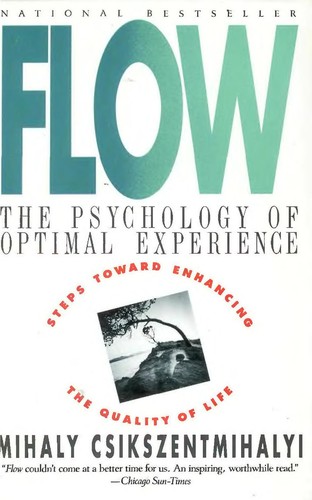
Find «Flow: The Psychology of Optimal Experience» on Amazon — as an Amazon Associate, The Boring Work earns from qualifying purchases (disclosure).
The boring bottom line
«Flow» found a real thing and explained it with a model that does not survive its own preferred method. The challenge-skill balance correlates with flow, weakly and inconsistently, and the correlation degrades as measurement improves — smaller in experience sampling, smaller at work, smaller for the state than the trait. When an AI holds difficulty at targeted skill ratios and 311 preregistered participants play, nothing happens to enjoyment. When you look for the peak with the right surface analysis, it is not on the balance line; it is where skill runs slightly ahead. When you check whether flow drives performance, you find 10% shared variance and not a single design that can tell you which way the arrow points.
Keep four sentences from the book: clear goal, fast feedback, one thing at a time, not boring. Change the work yourself instead of waiting for it to be calibrated. And remember that the state the book equates with the good life is the same state a slot machine sells, at scale, to people who are already depressed.
Sources
- 28 studies, N = 9,620; r ≈ .56, weaker in experience-sampling, work and education, and state flow. The Journal of Positive Psychology. doi:10.1080/17439760.2014.967799
- Tetris difficulty fit versus mismatch increased flow and intrinsic motivation. Personality and Social Psychology Bulletin. doi:10.1177/0146167207310026
- 698 and 260 experience-sampling reports; 9% and 14% of variance explained; no flow indicator peaked at balance. Social Indicators Research. doi:10.1007/s11205-012-0211-9
- preregistered, n = 311; no significant effect of difficulty-skill ratio. Royal Society Open Science. doi:10.1098/rsos.220274
- preregistered, n = 309; balance perceived but behaviourally inert, no consistent inverted-U. Proceedings of the ACM on Human-Computer Interaction. doi:10.1145/3611065
- n = 528; flow higher when skill exceeds challenge and when both are high. Journal of Happiness Studies. doi:10.1007/s10902-024-00846-4
- pooled r = 0.31 [0.24, 0.38], 22 studies, no causal designs. International Review of Sport and Exercise Psychology. doi:10.1080/1750984X.2021.1929402
- 18 participants, 720 trials; flow tracked deviation from expected performance more than objective level. Computers in Human Behavior. doi:10.1016/j.chb.2021.106891
- 42 studies, 24 distinct operationalizations of flow. Frontiers in Psychology. doi:10.3389/fpsyg.2020.00158
- neuroscientific evidence for a distinct flow state sparse and inconclusive. Cortex. doi:10.1016/j.cortex.2022.06.005
- 113 samples, N = 60,110; proactive behaviour ρ = 0.55, stronger than job characteristics. Journal of Vocational Behavior. doi:10.1016/j.jvb.2023.103891
- flow-like absorption during slot play associated with depression. Journal of Gambling Studies. doi:10.1007/s10899-017-9695-1
- 129 high-frequency players; dark flow correlated with enjoyment, problem-gambling scores and depression. Journal of Behavioral Addictions. doi:10.1556/2006.8.2019.38