TL;DR
- The garden story is invented. Pareto never counted peas. The pea-pod line appears in a 2007 bestseller and had been circulating in business since about 2001.
- The name is a mistake, and the man who made it confessed in print. Joseph Juran coined «the Pareto principle» in 1951 and published «The Non-Pareto Principle; Mea Culpa» in 1974.
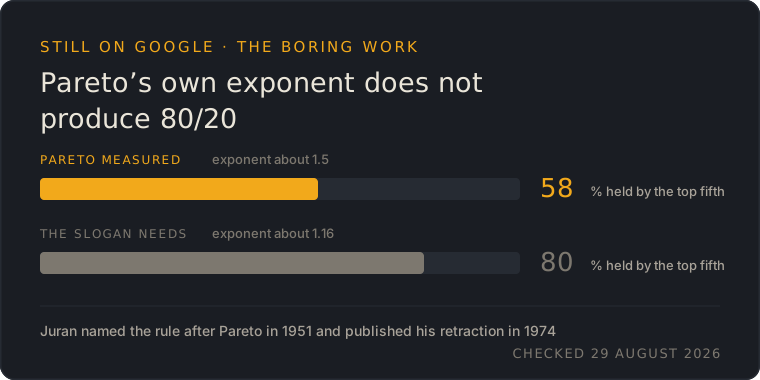
- Pareto’s own number does not produce 80/20. He measured an exponent of about 1.5, which puts 58 per cent of income in the top 20 per cent, not 80.
- To get an exact 80/20 you need an exponent near 1.16. Nobody has ever attributed that figure to Pareto, because it is not his.
- What survives is real and much vaguer: plenty of distributions are lopsided. The specific ratio is not a law, it is whatever your data happen to be.
Some time in the late 1930s, a young industrial engineer sat up until three in the morning breaking a cipher for fun.
Joseph Juran had gone to General Motors headquarters to swap notes on industrial engineering. Over lunch, the managers there told him they had accidentally invented an unbreakable code: a miswired plug board had turned their punch-card machines into an encryption device, and they had been amusing themselves with it while waiting for the machines to grind through hundreds of thousands of employee records. Juran laughed at them. He worked on exactly this in the Signal Corps Reserve. They handed him an enciphered message. He broke it by three in the morning.
«They were stunned by the news that the unbreakable had been broken,» he wrote later, «and for the rest of the visit the agreeable aura of a miracle man followed me about. As a by-product, some hitherto secret doors were opened up to me.»
Behind one of those doors was a man named Merle Hale, who ran the executive salary programme. Hale showed Juran a study comparing GM’s salary spread against a mathematical model built by an Italian economist. The fit was close. Juran filed the name away.
That is the actual origin of the 80/20 rule: a favour returned for a party trick. No garden. No peas.
Mea culpa, in his own words
In 1951, writing the first edition of the Quality Control Handbook, Juran needed a short name for something he had noticed everywhere: defects, absenteeism, car accidents, costs. Line them up by frequency and a few items always accounted for most of the total. He called it the Pareto principle.
By 1974 he had been challenged on it enough times to publish a correction, and its title is not subtle: «The Non-Pareto Principle; Mea Culpa» (Juran, 1974). Read the opening:
«Years ago I gave the name «Pareto» to this principle of the «vital few and trivial many». On subsequent challenges, I was forced to confess that I had mistakenly applied the wrong name to the principle. This confession changed nothing: the name «Pareto principle» has continued in force, and seems destined to become a permanent label for the phenomenon.»
He is precise about what went wrong. Pareto studied the distribution of wealth. He did not generalise it into a universal law covering defects and absenteeism. Juran did that. In his own words: «The Pareto principle as a universal was not original with Pareto. Where then did the universal originate? To my knowledge, the first exposition was by myself.»
And then the line that makes the whole thing faintly tragic: «Had I been structured along different lines, assuredly I would have called it the Juran principle. However, I was not structured that way.»
There is a second confession buried in the same paper. The cumulative curves Juran printed in the 1951 handbook, the ones every Pareto chart descends from, were not Pareto’s either. «The cumulative curves used in Quality Control Handbook, First Edition, should have been properly identified with Lorenz» (Lorenz, 1905).
| What people credit to Pareto | Who it actually belongs to |
|---|---|
| The idea that a few causes dominate | Observed by many, first written up as a universal by Juran |
| The 80/20 ratio | Nobody in particular. Not a figure Pareto derived |
| The cumulative curve on the chart | Max Lorenz, 1905 |
| The name | Juran, 1951, and retracted by him in 1974 |
| Counting peas in a garden | A 2007 bestseller |
Pareto’s own number gives 58/20
Here is the part that can be checked with a calculator, and it is the strongest evidence that the ratio was never his.
What Pareto published, in Cours d’économie politique (1896-97), was a distribution law. If N is the number of people earning above some income x, then N = A/x^α. The whole content of the claim sits in α, the exponent that sets how steeply the tail falls away. Pareto examined income statistics from several countries and reported that α differed «but little from 1.5». A contemporary reviewer in the Economic Journal walked through exactly this material the same year (Flux, 1896).
Now put 1.5 into the distribution and ask what share the top slice holds. For a Pareto distribution, the top fraction p holds p^((α−1)/α) of the total.
| Top share of earners | Share of income, at Pareto’s α = 1.5 |
|---|---|
| Top 1% | 21.5% |
| Top 5% | 36.8% |
| Top 10% | 46.4% |
| Top 20% | 58.5% |
| Top 30% | 66.9% |
| Top 50% | 79.4% |
Pareto’s own exponent produces a 58/20 rule. If the principle had been named honestly off his numbers, offices worldwide would be talking about the 58/20 rule, which is a sentence nobody would ever repeat.
Run it backwards and the gap gets sharper. To make the top 20 per cent hold exactly 80 per cent, you need α ≈ 1.16. That number appears nowhere in Pareto’s work. It is not a measurement of anything. It is the exponent you are forced into if you decide in advance that the answer should be 80 and 20, two round numbers that happen to sum to 100, which is a coincidence with no mathematical meaning whatsoever.
One caveat belongs here, because it is the strongest thing anyone can say for the other side. Some accounts report that Pareto’s British income-tax figures came out near 80 and 20 specifically. That is possible: a single dataset can land anywhere, and the exponent that fits British tax records in the 1890s need not be the one that fits Prussia or Peru. But it does not rescue the rule. A ratio that appears in one table and not in the general law is a data point, not a principle, and Pareto’s own summary of the general law was 1.5.
The peas that never existed
The garden story is the most-repeated version of the origin, and it is the youngest part of the whole structure.
The claim is that Pareto noticed 20 per cent of the pea pods in his garden were producing 80 per cent of the peas, and generalised from there. It appears in Tim Ferriss’s The 4-Hour Workweek in 2007, on page 68, and had been circulating in business writing since roughly 2001. It appears in no biography, no contemporary account, and nothing Pareto wrote.
What makes this funny is that Juran predicted it. In the same 1974 paper, thirty-three years before Ferriss:
«On various occasions contemporary authors, when referring to the Pareto principle, have fabricated some embellishments and otherwise attributed to Vilfredo Pareto additional things which he did not do. My motive in offering the present paper is in part to minimize this tendency to embroider the work of a distinguished Italian economist.»
He wrote a paper specifically to stop people inventing things about Pareto, and the most successful invention arrived afterwards.
Even the land figure has no page number
The respectable version of the origin story is that Pareto observed 80 per cent of Italy’s land being held by 20 per cent of the population. This one is repeated by encyclopaedias, consultancies and business schools, and it is better sourced than the peas without being well sourced.
The tell is in the citations. Some place it in Cours d’économie politique, published 1896-97. Others date it to 1906, a different decade and a different book. Almost none give a page. A claim that cannot agree with itself about which volume it came from is a claim nobody has opened the volume to check.
What is not in doubt is the shape of Pareto’s finding: income was concentrated, the concentration followed a regular mathematical form, and he thought the form was stable across countries. Whether he ever expressed it as a tidy 80-and-20 about land is a separate question, and the confident sources answering it have not looked.
So is anything left?
Yes, and it is worth defending, because the useful part survives the demolition.
Lopsided distributions are everywhere. A few products do generate most of the revenue. A few bugs do cause most of the crashes. A few streets do produce most of the calls. Juran’s insight was real: it is worth finding out which few, before spreading effort evenly across the many. That is a good instinct and it does not need a dead economist’s name on it.
What does not survive is the ratio as a law. The exponent varies by country, by era and by domain, which means the split does too: 70/30, 90/10, 95/5, sometimes 50/50 and no story at all. Modern work on income data finds the slope varying enough between countries and periods that Pareto’s «universal» constant does not hold (Clementi & Gallegati, 2005).
There is a further problem underneath. Establishing that data follow a power law at all is much harder than it looks. Fitting a straight line to a log-log plot, which is what most business analysis does, produces badly wrong exponents and gives no indication of whether the distribution is a power law in the first place (Clauset, Shalizi & Newman, 2009). Applied properly, many datasets confidently described as power laws do not survive the test.
So the honest formulation is: check your own distribution, expect it to be uneven, and do not assume the numbers 80 and 20 before you look.
Verdicts
«Pareto discovered the 80/20 rule»: R — Refuted, by the man who named it after him, in print, in 1974.
«Pareto observed it in his garden»: R — Refuted. The story postdates his death by roughly eighty years.
«80 per cent of outcomes come from 20 per cent of causes» as a law: H — Untested. The ratio is an artefact of one exponent among many, and the exponent it needs is not the one Pareto measured.
«Outcomes are often concentrated in a minority of causes»: C — Confirmed, in the weak, useful, unquantified form Juran meant.
Why the wrong version travels better
Every element that makes this story wrong also makes it repeatable.
A named foreigner sounds like provenance. Two round numbers are easier to hold than an exponent. A garden gives you a picture, and a picture survives retelling in a way that N = A/x^α never will. And the whole package flatters the person deploying it, because invoking a rule is more authoritative than saying «some things matter more than others», which is what it means.
Juran saw this happening in real time and could not stop it. He published the correction in a quality-control journal, which is the correct venue and the wrong audience. The misnomer had already left for the business world, where it remains, on slides, in books, and now with peas.
The shift: stop treating 80/20 as a finding and start treating it as a prompt to go and measure your own split.
First move: compute the real ratio before quoting one. Sort your items by contribution, take a running total, and read off where it crosses 80 per cent. It is a two-minute job in a spreadsheet and it will rarely say 20.
Second move: notice that Pareto’s own exponent gives 58/20. If the rule were his, the number on the poster would be different.
Third move: keep Juran’s actual advice, which needs no ratio at all. Find the few causes doing the heavy lifting, and stop spreading attention evenly over the rest.
The systems built on top of the rule are compared in GTD, Deep Work and time blocking, and the best known of them gets its own audit in our notes on «Getting Things Done». Other productivity rules traced back to their source are in the register of checked claims, among them the two-minute rule.
The boring bottom line
The 80/20 rule is named after a man who did not formulate it, using a ratio his own mathematics does not produce, illustrated with a curve drawn by somebody else, and introduced by an origin story invented about eighty years after he died. The person who attached his name to it published a formal apology in 1974 and it made no difference at all.
Underneath the wreckage sits something modest and true: contributions are usually uneven, and it pays to find out which ones matter. Juran called that the vital few. He was right about the thing and wrong about the label, and the label is what survived.
Measure your own distribution. It owes you no round numbers.
Sources
- Juran, J. M (1974). The Non-Pareto Principle; Mea Culpa. Quality Progress / Juran Institute archive. The confession, in the namer's own words: 'I had mistakenly applied the wrong name to the principle.' Also states the universal was not Pareto's, that the curves belong to Lorenz, and warns against authors fabricating embellishments about Pareto. juran.com
- Pareto, V (1896). Cours d'economie politique, Tome Premier. F. Rouge, Lausanne. The actual source. A distribution law N = A/x^alpha with alpha reported as differing 'but little from 1.5'. No 80/20 ratio, no garden. archive.org
- Flux, A. W (1896). Review: Cours d'Economie Politique, Tome Premier, by Vilfredo Pareto. The Economic Journal. A contemporary review walking through the income-distribution material the year it appeared. doi:10.2307/2956507
- Lorenz, M. O (1905). Methods of measuring the concentration of wealth. Publications of the American Statistical Association. 9(70), 209-219. The cumulative curve behind every Pareto chart. Juran's 1974 paper says it should have been credited here. doi:10.1080/15225437.1905.10503443
- Clauset, A., Shalizi, C. R., & Newman, M. E. J (2009). Power-law distributions in empirical data. SIAM Review. 51(4), 661-703. Least-squares fitting on log-log plots produces substantially inaccurate exponents and cannot say whether the data obey a power law at all. doi:10.1137/070710111
- Clementi, F., & Gallegati, M (2005). Pareto's law of income distribution: Evidence for Germany, the United Kingdom, and the United States. Econophysics of Wealth Distributions (New Economic Windows). The slope varies enough across countries and periods that Pareto's universal constant does not hold. doi:10.1007/88-470-0389-x_1
- Ferriss, T (2007). The 4-Hour Workweek. Crown, p. 68. 'Eighty percent of Pareto's garden peas were produced by 20% of the peapods he planted.' The pea story appears in no biography and nothing Pareto wrote; it had been circulating in business writing since about 2001.