TL;DR
- Pavlina’s claim: seven principles underlie all growth, and four are arithmetic. His words — «Truth, love, and power are the primary principles. The other principles are secondary because they can be derived from the first three.» Oneness = truth + love. Authority = truth + power. Courage = love + power.
- The three fundamentals are folk names for constructs that do have numbers: need for cognition (r = .20 with achievement, N = 53,258), relatedness in self-determination theory, self-efficacy (r = .38 with work performance, N = 21,616). None of that is evidence for the model.
- Searched PubMed and Crossref on 11 August 2026: no record of Steve Pavlina as an author, no study of the model, no reliability data, no trial. Eighteen years on, untested — not the same as refuted.
- His one testable public claim has now failed. He argued the body adapts to reach REM inside 20-minute naps; in a 2026 polysomnography study of 40 adults, the Uberman schedule cut slow-wave and REM sleep across 24 hours and beat a single 2-hour sleep only at making people less vigilant.
- A framework that can redescribe every problem predicts none. The compass works as a checklist. It is not a finding.
Verdict
Read the notes, not the book. Confidence: high on the evidence question, moderate on how useful the checklist is.
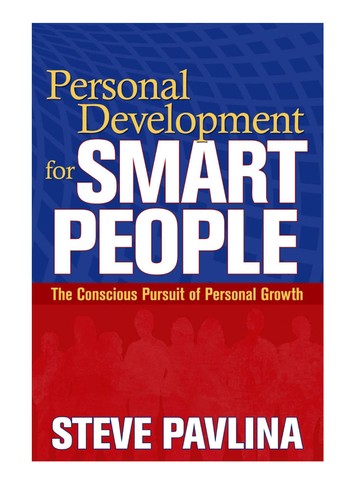
«Personal Development for Smart People» is better written and more honest about effort than most of its shelf, and its three fundamental categories are not arbitrary — each gestures at a construct psychologists have spent decades measuring.
The rest asks you to accept that the categories are universal, that the other four follow by addition, and that any problem can be rewritten as misalignment with one of them. Pavlina offers no data for that, because there is none. The framework was reasoned out, not found. Take the three words. Leave the cosmology.
The claim on trial
Stated so it can fail: all genuine growth reduces to seven principles; truth, love and power are fundamental and the other four derive from them by combination; and because the principles are universal rather than empirical, the framework applies to any domain of any life.
He states it without hedging. On his own page for the book the principles «function as a powerful growth compass», and «because the principles are universal, it doesn’t matter if you’re dealing with a health problem, financial problem, relationship problem, spiritual problem, or just general laziness». Then the deciding sentence: «I guarantee that your specific problem can be redefined as a problem of alignment with one or more of these universal principles.»
That is not a prediction. It is a guarantee about the framework’s own flexibility. Any scheme with three broad categories can redescribe any problem; that follows from the categories being broad, not from the world having three parts. The guarantee that nothing falls outside the model is the admission that nothing counts against it.
What the three fundamentals map onto
Truth. The nearest measured relatives are need for cognition, introduced by Cacioppo and Petty, Journal of Personality and Social Psychology, 1982, and actively open-minded thinking. Both predict things: Liu and Nesbit, Review of Educational Research, 2023 pooled 136 effect sizes, N = 53,258, and put need for cognition at r = .20 (95% CI .18–.22) with academic achievement. Small, consistent, real.
The interesting part is where truth-seeking stops. Stanovich and Toplak, Journal of Intelligence, 2023, summarising 25 years on their own open-mindedness scale, report that it predicts performance on heuristics-and-biases tasks and the avoidance of conspiracy belief — but not the avoidance of myside bias, which they call «virtually the quintessence of the AOT concept». The maximally open-minded still reason in favour of their own side. Self-insight is likewise moderate: Zell and Krizan, Perspectives on Psychological Science, 2014 pooled 22 meta-analyses and put the mean correlation between self-rated ability and measured performance at .29, better for narrow, familiar, objectively scored domains. Pavlina’s audit asks you to rate your career and relationships out of ten — the broad end, where insight is weakest.
Love. The serious version is relatedness, one of three basic needs in self-determination theory, from Ryan and Deci, American Psychologist, 2000. Van den Broeck, Ferris, Chang and Rosen, Journal of Management, 2016 meta-analysed 99 studies and 119 samples and found each need carries unique predictive weight rather than collapsing into one. The hardest outcome attached to connection is mortality: Holt-Lunstad, Smith and Layton, PLoS Medicine, 2010, 148 studies, 308,849 participants, OR = 1.50 (95% CI 1.42–1.59) for survival.
Power. This is self-efficacy, from Bandura, Psychological Review, 1977. Stajkovic and Luthans, Psychological Bulletin, 1998 pooled 114 studies, N = 21,616, and reported a weighted average correlation of .38 with work performance. Pavlina’s chapter is consistent with that — but the arrow has since reversed. Sitzmann and Yeo, Personnel Psychology, 2013 found the within-person self-efficacy-to-performance correlation of .23 fell to a non-significant ρ = .06 once the individual’s trajectory was controlled, while past performance predicting later self-efficacy held at ρ = .30: self-efficacy is «primarily a product of past performance rather than the driving force affecting future performance». Vancouver and Kendall, Journal of Applied Psychology, 2006 found it predicting less study time and worse exam results.
The three point at real things, but not as the book says. Truth-seeking has a blind spot at exactly the point of self-interest. Power is downstream of results more than upstream. Only relatedness behaves as advertised.
The derivation is the part with nothing behind it
Pavlina’s announcement of the book in July 2008 lays out the arithmetic, then defines intelligence as «one’s degree of alignment with truth, love, and power», adding «we aren’t talking about IQ here».
This is where the framework moves from unproven to unprovable — though it need not have. Additions of this kind make a real prediction if you want them to. If courage is love plus power, people high in relatedness and high in self-efficacy should be more courageous than either predicts alone: an interaction term, testable in an afternoon on an existing dataset. Nobody has run it.
On 11 August 2026 I searched PubMed for «Steve Pavlina» (0 records) and for «personal development» with «universal principles» in title or abstract (0 records). Crossref returns 72 items for the author string «Pavlina» with personal development; every one belongs to a different person, Pavlina being a common Czech and Bulgarian given name. No published paper reports the model’s items, its factor structure, its reliability, or whether two people shown the same problem classify it under the same principle — the cheapest study in the world, never run.
Untested is not refuted. But compare next door: mindset theory made a similar claim and was tested, and Macnamara and Burgoyne, Psychological Bulletin, 2023 pooled 63 studies, N = 97,672, finding d = 0.05 — 0.02 and non-significant in the six best-designed. Pavlina’s model has never been at risk.
The polyphasic sleep experiment
One claim in Pavlina’s public writing is specific, physiological and falsifiable, which makes it the fairest test of his method of reasoning. In October 2005 he began the Uberman schedule: six 20-to-30-minute naps every four hours, about two hours of sleep a day. His mechanism: «polyphasic sleep conditions your body to learn to enter REM sleep immediately when you begin sleeping instead of much later in the sleep cycle». He dismissed the safety literature on the same page: long-term effects «aren’t well known. That’s irrelevant to me though because I find that being a long-term vegan, I can’t rely much on long-term studies done on non-vegans anyway.» At thirty days he called it «a huge success»; he quit at five and a half months, not for health reasons, he said, but because «the rest of the world is monophasic». He later described week one: «I felt like a zombie. At one point I just sat on the couch staring at a wall for 90 minutes, unable to form any thoughts.»
The mechanism has now been measured. Koa and Lo, SLEEP, 2026 ran 40 healthy adults aged 18–35 on either a single 2-hour sleep opportunity or Uberman’s six 20-minute ones, with polysomnography during every one, against a rested group of 20 given 8 hours. Both short-sleep groups were sleepier, less vigilant and lower in mood than the rested group. Despite the identical total opportunity, the polyphasic group did worse than the monophasic short sleepers on vigilance, particularly in the morning: they slept less of the time they lay down, took longer to fall asleep, and spent more of it in N1 and N2, less N3. Uberman, the authors report, «drastically» shortened slow-wave and REM duration across 24 hours. The predicted adaptation runs backwards.
The accompanying editorial by Rosenblum and Dresler, SLEEP, 2026 notes that until this study, data on radical polyphasic schedules consisted of case studies of single volunteers watched for days or weeks — Pavlina’s log being a specimen, minus the polysomnograph. The National Sleep Foundation panel, Weaver, Sletten, Foster and colleagues, Sleep Health, 2021, found no evidence of benefit and advised against such schedules.
Dose-response work explains why his self-report misled him. Van Dongen, Maislin, Mullington and Dinges, Sleep, 2003 put 48 adults on 4, 6 or 8 hours in bed for 14 days. Restriction to 4 or 6 hours produced cumulative, dose-dependent deficits on every cognitive task, while subjective sleepiness rose sharply and then barely moved. Pavlina’s evidence for adaptation was that he felt fine — the exact measure that experiment showed to be unreliable. Our notes on «Why We Sleep» cover a sleep book overstating its case the other way.
What belongs to the book, and what came later
Pavlina is now known in some quarters for «subjective reality» and manifestation material, and it is tempting to read that back into the 2008 book. Be careful. That writing predates the book on his blog — in March 2007 he referred to «my recent ramblings on subjective reality and polarity», and the post before his September 2008 sample-chapter announcement was titled «Physical vs. Non-Physical Reality». His site today sells a 60-day course built on subjective reality, promising manifestation guided by synchronicities. The book’s own text on this point I could not verify; without a searchable copy, I will not tell you what is in its pages.
What can be said is what the evidence on positive future thinking shows. Oettingen and Mayer, Journal of Personality and Social Psychology, 2002 separated expectations from fantasies across four samples (job-hunting graduates, students with a crush, undergraduates facing an exam, hip-replacement patients) with outcomes measured weeks to two years later. Positive expectations predicted more effort and success; positive fantasies predicted less of both, mediated by reduced effort. Believing you can probably do it helps. Enjoying the imagined finish does not.
Does a self-derived framework have any value
The honest answer: as a thinking tool, sometimes. A three-slot checklist beats no checklist. Running through «am I avoiding a fact, avoiding a person, or avoiding an action» surfaces a candidate faster than staring at the problem.
What would have to be true for it to be more. First, the categories would have to carve reliably: give 100 people the same 20 described problems and show they sort them into the same principles above chance. Second, the derivation would have to earn its keep: measured courage would have to be predicted by the interaction of relatedness and self-efficacy, not just their sum. Third, principle-based diagnosis would have to beat an active control in a trial — the standard SDT interventions meet, at d+ = .23 across 65 tests in Sheeran and colleagues, Journal of Consulting and Clinical Psychology, 2020, and across 73 studies in Ntoumanis and colleagues, Health Psychology Review, 2021.
None of the three exists for the seven principles. Until one does, the framework is a vocabulary, worth what it costs to learn.
Who should read it
People who want a short, non-cynical vocabulary for their own stuck points and will not mistake a vocabulary for a mechanism. Also people studying how self-help frameworks get built: this one shows its working, with the derivation published for anyone to attack.
Anyone who wants the content with numbers should read Ryan and Deci 2000, then Sitzmann and Yeo 2013 for what happened to the confidence-causes-success story. Both are shorter than the book. Our other book reviews apply the same test.
The sleep claim here connects to «Why We Sleep», and for another framework derived from first principles with a seminar attached, see «Secrets of the Millionaire Mind».
One thing to try
Use the compass, but invert the audit. Instead of rating life areas out of ten (the broad, low-insight end where Zell and Krizan put self-perception at r = .29) pick one stuck thing from this week. Write one sentence per fundamental: the fact I am not looking at, the conversation I am not having, the action I am not taking. Then do the smallest version of whichever sentence was hardest to write, within seven days. Borrow the structure; discard the claim.
Get the book
Find «Personal Development for Smart People» on Amazon — as an Amazon Associate, The Boring Work earns from qualifying purchases (disclosure).
The boring bottom line
Pavlina built a tidy model out of three good instincts and declared it universal. Those instincts correspond to need for cognition, relatedness and self-efficacy — decades of measurement behind each, and documented limits the book does not mention. The four derived principles correspond to nothing anyone has measured. The guarantee that any problem can be redefined in the model’s terms is its selling point and its weakness.
Where he did make a testable claim (in public, with a schedule and a mechanism) the test arrived eighteen years later and went against him. That does not make the seven principles wrong. It shows what happens when a framework derived by reasoning meets a polysomnograph.
When to see a professional
This page is general information, not medical advice. Deliberate sleep restriction is not a neutral experiment. If you sleep under six hours a night, fall asleep during the day, or are considering a polyphasic schedule, talk to a physician or board-certified sleep specialist rather than a blog log. Anyone who drives, operates machinery, provides clinical care or works shifts should treat this as a safety matter. If low mood or persistent anxiety is why the framework appealed, a licensed clinical psychologist or psychiatrist is the right first stop.
Sources
- Steve Pavlina, book page for «Personal Development for Smart People»
- Steve Pavlina, «Pre-order Personal Development for Smart People», July 2008
- Steve Pavlina, «Polyphasic Sleep», October 2005
- Steve Pavlina, «Polyphasic Sleep Log – Days 25-30 (Final Update)», November 2005
- Steve Pavlina, «Polyphasic Sleep: The Return to Monophasic», April 2006
- Steve Pavlina, «Polyphasic Sleep – One Year Later», March 2007
- Cacioppo and Petty, Journal of Personality and Social Psychology, 1982
- Liu and Nesbit, Review of Educational Research, 2023
- Stanovich and Toplak, Journal of Intelligence, 2023
- Zell and Krizan, Perspectives on Psychological Science, 2014
- Ryan and Deci, American Psychologist, 2000
- Van den Broeck, Ferris, Chang and Rosen, Journal of Management, 2016
- Holt-Lunstad, Smith and Layton, PLoS Medicine, 2010
- Bandura, Psychological Review, 1977
- Stajkovic and Luthans, Psychological Bulletin, 1998
- Sitzmann and Yeo, Personnel Psychology, 2013
- Vancouver and Kendall, Journal of Applied Psychology, 2006
- Macnamara and Burgoyne, Psychological Bulletin, 2023
- Koa and Lo, SLEEP, 2026
- Rosenblum and Dresler, SLEEP, 2026
- Weaver, Sletten, Foster et al., Sleep Health, 2021
- Van Dongen, Maislin, Mullington and Dinges, Sleep, 2003
- Oettingen and Mayer, Journal of Personality and Social Psychology, 2002
- Sheeran, Wright, Avishai et al., Journal of Consulting and Clinical Psychology, 2020
- Ntoumanis, Ng, Prestwich et al., Health Psychology Review, 2021