TL;DR
- The NASA study is real, and it is not what it is quoted as. Twenty-one long-haul pilots, mid-flight, already fatigued: twelve got a planned 40-minute rest and slept an average of 25.8 minutes, nine did not.
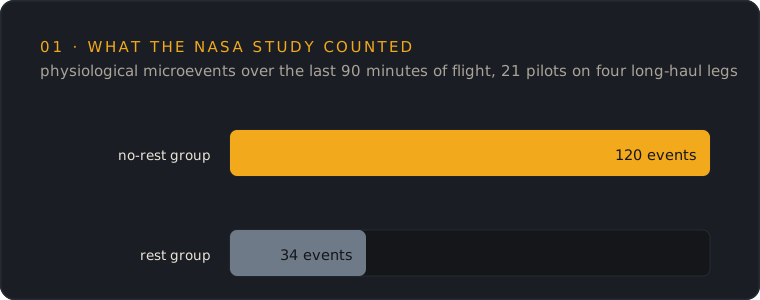
- The percentages in that report describe the group that did not nap. After the rest period the no-rest crews had 30% more lapses on the reaction-time task, and over the last 90 minutes of flight they logged 120 physiological microevents against the rest group’s 34.
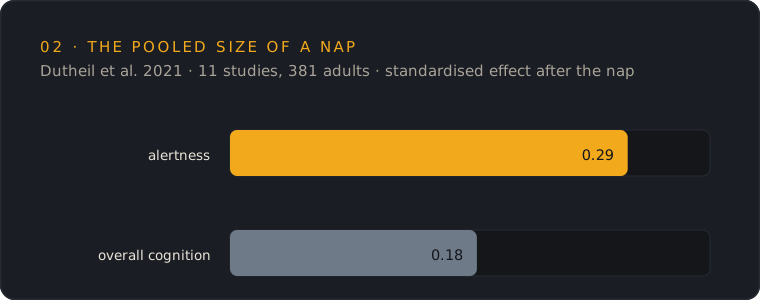
- In ordinary people, the pooled effect of a nap is 0.18 overall and 0.29 for alertness: a fifth of a standard deviation, mostly on how awake you feel.
- Weekend recovery is partial. Across six weeks of five-hour weeknights, vigilant attention and spatial orientation stayed impaired after two full recovery nights, while several other cognitive domains were never affected at all.
- Naps of 30 and 60 minutes produce sleep inertia that resolves within about half an hour. Polyphasic schedules have a consensus verdict from 40,672 screened records: no evidence of benefit.
Somewhere over the Pacific in 1993, a commercial airline pilot closed his eyes mid-flight, on purpose, with NASA’s blessing and electrodes glued to his scalp. That experiment became the most misquoted number in productivity culture: «a 26-minute NASA nap boosts performance by 34%». Add two more famous claims, that you can repay sleep debt on the weekend and that napping causes dementia, and you have three numbers that all come from real studies, and all say something narrower and stranger than the sentences they turned into.
What the NASA study did
Start with what NASA did. In 1994, Mark Rosekind’s team at NASA Ames, together with sleep scientist David Dinges, ran an experiment on real scheduled long-haul flights. During the calm cruise phase, some crew members got a planned 40-minute rest in their seat; others flew on as usual, as the control group.
Twelve crew members were in the rest group and nine in the no-rest group. They wore electrodes throughout: continuous recording of brain waves and eye movements, plus a reaction-time task run at fixed points across each flight.
The resting pilots conked out on 93% of their chances, falling asleep in under six minutes and sleeping 25.8 minutes on average. That is the entire origin of the sacred «26-minute nap»: it is not an optimal dose calculated by NASA, it is how long exhausted pilots slept when handed 40 minutes. Reading it as a prescription is like measuring how much water marathon runners gulp at the finish line and calling it the scientifically optimal drink.
And remember who these people were: crews on multi-leg international routes, hopping time zones, sleeping badly in hotels, tested across night flights. The study never compared a rested person with a napped person. It compared exhausted with exhausted-plus-a-nap, at the tail end of a working day that had crossed an ocean.
Where the 34% comes from
The reaction-time task counts lapses: responses slower than half a second, which is what a brief absence looks like when you measure it. Before the rest period the two groups were indistinguishable. After it, in the report’s own words, there were 30% more lapses during the two in-flight trials, in the group that had not rested. The figure in the report labels the gaps at the trial points 30% and 34%.
So the famous 34% is not a productivity boost. It measures how much worse the pilots who did not nap became at catching half-second lapses in reaction time, at one point, in one cockpit. The study contains no measure of productivity whatsoever. The number spread with its direction flipped: not «napping made them 34% better», but «not napping made them that much worse».
The scary part of the report is not the percentage. In the final 90 minutes of flight, the brains of the no-rest crews produced 120 «microevents», tiny EEG signatures of a brain starting to fall asleep, versus 34 in the rested group. Twenty-two of those happened during the last half hour: descent and landing. Pilots’ brains were briefly switching off while approaching the runway. The napped crews had all their microevents safely before descent began.
One more line from that report deserves to travel with the others: the nap did not affect layover sleep or the cumulative sleep debt. It bought alertness for the landing. It did not repay anything.
There is also a design feature that makes this study unusually credible for its size. The pilots were not asked how alert they felt and believed; electrodes recorded what their brains did, minute by minute, while they flew a real aeroplane. Field studies with that level of physiological measurement barely exist, which is why a paper with 21 participants is still the reference point three decades later.
What a nap does for everybody else
Frédéric Dutheil and colleagues at the University Hospital of Clermont-Ferrand pooled the nap studies with cognitive outcomes: 11 studies, 381 participants, mean nap length 55 minutes, almost all in laboratories. Overall cognitive performance improved after the nap by a standardised effect of 0.18, with alertness at 0.29.
Two details in that analysis are worth having. Nap duration did not predict the size of the benefit, and neither did the interval between the nap and the test. What did matter was timing of day: naps before one in the afternoon produced better results than later ones.
The gap between that tiny 0.18 and the pilots’ dramatic result is the entire moral of this article. A nap is not an upgrade; it is a repair. The deeper your sleep hole and the duller your task, the more a nap gives back. A well-rested person doing interesting work has almost nothing to collect.
One thing the pooled analysis cannot settle is what napping does over months rather than minutes, because almost every study in it measures a single nap in a laboratory on the same afternoon. The habit and the event are different objects, and only the event has been tested properly.
There is a practical consequence in the timing result. If the benefit is larger before one in the afternoon, then the nap that fits most working days, the one taken after lunch or later to rescue a flagging afternoon, is on the weaker end of the evidence. The pilots napped when the schedule allowed, which is also how most people will do it.
The cost on the other side
Ruth Leong and colleagues at the National University of Singapore ran the direct comparison: 32 young adults with short habitual sleep, four conditions in random order (no nap, or naps of 10, 30 and 60 minutes with polysomnography) and a test battery at five points up to four hours later.
All three nap lengths raised positive mood and reduced sleepiness for up to four hours. Only the 30-minute nap improved memory encoding. Vigilance gains were moderate and processing speed did not move at all. And sleep inertia, the grogginess on waking, appeared after the 30- and 60-minute naps, resolving within 30 minutes.
Their conclusion is the useful one: no length wins outright, and 30 minutes is the best trade-off between practicability and benefit. Which means the honest version of nap advice includes a half-hour afterwards in which you are worse than you were before.
What the weekend repays and what it does not
Now the weekend question. «Sleep debt» sounds like a bank balance: sleep in on Saturday, account settled. To test it, researchers locked 15 adults into a six-week schedule of five-hour weeknights and eight-hour weekends, running ten cognitive tests every evening.
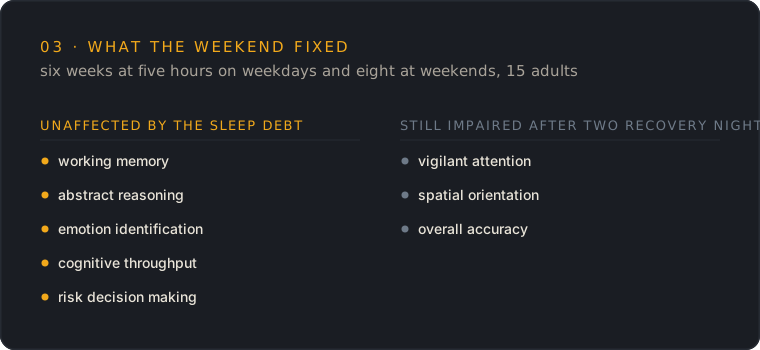
Most of what was measured never moved. Sensorimotor speed, spatial learning and memory, working memory, abstraction and mental flexibility, emotion identification, abstract reasoning, cognitive throughput and risk decision making all came through six weeks of short nights without significant impairment.
Two things did decline, and they declined progressively: overall accuracy across domains, and vigilant attention, the latter with a standardised coefficient of −0.688. Neither was restored by two nights of weekend recovery sleep.
That is a far more precise picture than either the «sleep loss melts your brain» camp or the «I’ll catch up Sunday» camp. Short sleep does not make you globally stupid. It sandpapers away one specific ability, staying alert to a boring stream of events, and that is exactly the ability two nights of weekend sleep failed to restore. Fifteen people is small, but almost nobody else has run the experiment past two weeks.
The word debt is doing something misleading here, and the pattern of results shows how. A financial debt is one quantity: repay it and the balance is zero. What six weeks of short nights produced was not one quantity but a split: several capacities untouched, two degraded, and only one kind of recovery tested. If sleep loss were a single account, the domains would move together. They do not.
Naps and dementia, in both directions
Headlines linking daytime naps to Alzheimer’s disease come from cohort studies, and the good ones now measure both directions at once. Peng Li and colleagues at Brigham and Women’s Hospital used 1,401 participants in the Rush Memory and Aging Project, with napping recorded by actigraphy rather than self-report, followed for up to 14 years.
The result cuts both ways at once. Yes, heavy nappers went on to develop Alzheimer’s more often. But once the disease began, it more than doubled the yearly growth in napping, and the correlations ran in a loop: more napping predicted worse cognition a year later, and worse cognition predicted more napping a year later.
The authors call this a «potential bidirectional relationship», which is the polite scientific way of saying: we cannot tell whether the napping feeds the disease or the disease feeds the napping. No finding in that paper suggests that choosing to nap in your forties moves your risk in either direction.
Polyphasic sleep
Finally, the extreme sport of nap optimism: polyphasic sleep, the internet legend that you can slice sleep into six 20-minute pieces, live on two hours a day, and work at the level of Leonardo. A National Sleep Foundation panel screened 40,672 records to see what evidence exists.
They found no evidence supporting benefits, and adverse associations with physical health, mental health and performance. The recommendation is explicit: do not adopt a schedule that significantly reduces sleep per 24 hours or fragments it into multiple episodes.
Note what that verdict rests on. Twenty-two papers is a thin literature, and the panel says so. It is thin because the schedules are hard to keep and hard to study, not because anyone has demonstrated they work.
What to do with this instead
The shift: naps are a countermeasure for accumulated fatigue, not a performance upgrade. The size of the benefit tracks the size of the deficit.
First move: read the NASA number correctly. Twenty-one pilots, mid-flight, already tired; the percentage describes how much worse the crews got who did not nap, and the same report says the nap did nothing for cumulative sleep debt.
Second move: budget for the inertia. After a 30- or 60-minute nap there is roughly half an hour of being worse than before, which matters if you nap immediately before the thing you were napping for.
Third move: expect the weekend to return some of it, not all. In the only six-week study of this kind, sustained attention was still impaired after two full recovery nights, while most other cognitive domains were never affected.
None of this is guidance for a sleep disorder or for anyone whose work depends on being alert at a fixed hour; the shift-work literature is its own field with its own rules, and persistent daytime sleepiness is a medical question rather than a scheduling one. For the wider pattern of a field study becoming a life rule, see how the self-improvement genre handles a single study. The military sleep method is another sleep number that left its study behind, and the notes on Why We Sleep check which claims from the best-known sleep book held up.
The boring bottom line
The NASA nap is real and it is a fatigue countermeasure for pilots at the end of a long-haul flight. Its headline percentage measures how much worse the crews who did not nap became, and the report says plainly that the nap did not touch their accumulated sleep debt.
For a rested person the pooled benefit of a nap is 0.18, mostly on alertness, with half an hour of grogginess on the other side of the longer ones. Weekends return part of what short nights cost, and sustained attention is the part they do not return.
Sources
- Rosekind, M. R., Graeber, R. C., Dinges, D. F., Connell, L. J., Rountree, M. S., Spinweber, C. L., & Gillen, K. A (1994). Crew factors in flight operations IX: Effects of planned cockpit rest on crew performance and alertness in long-haul operations. NASA Technical Memorandum 108839. The source of the famous nap numbers. It is a field study of 21 pilots on real flights, and the percentages in it describe how much worse the no-rest group performed, not how much better anyone became. ntrs.nasa.gov
- Rosekind, M. R., Smith, R. M., Miller, D. L., Co, E. L., & Gregory, K. B., et al (1995). Alertness management: Strategic naps in operational settings. Journal of Sleep Research. 4(S2), 62-66. The same team's own framing of their result, written for people who run shift operations rather than for people optimising a morning. doi:10.1111/j.1365-2869.1995.tb00229.x
- Smith, M. G., Wusk, G. C., Nasrini, J., Baskin, P., & Dinges, D. F., et al (2021). Effects of six weeks of chronic sleep restriction with weekend recovery on cognitive performance and wellbeing in high-performing adults. Sleep. 44(8). One of very few studies to run longer than two weeks. Its central finding is what the weekend did not fix. doi:10.1093/sleep/zsab051
- Dutheil, F., Danini, B., Bagheri, R., Fantini, M. L., & Pereira, B., et al (2021). Effects of a short daytime nap on the cognitive performance: A systematic review and meta-analysis. International Journal of Environmental Research and Public Health. 18(19), 10212. The pooled size of the nap effect in ordinary people. It is a fifth of a standard deviation, mostly on how awake you feel. doi:10.3390/ijerph181910212
- Leong, R. L. F., Lau, T., Dicom, A. R., Teo, T. B., & Ong, J. L., et al (2023). Influence of mid-afternoon nap duration and sleep parameters on memory encoding, mood, processing speed, and vigilance. Sleep. 46(4). The study that compares nap lengths directly and prices the inertia. Its conclusion is that no length wins outright. doi:10.1093/sleep/zsad025
- Weaver, M. D., Sletten, T. L., Foster, R. G., Gozal, D., & Klerman, E. B., et al (2021). Adverse impact of polyphasic sleep patterns in humans: Report of the National Sleep Foundation sleep timing and variability consensus panel. Sleep Health. 7(3), 293-302. Forty thousand records screened and twenty-two papers left standing. The panel's recommendation is not to do it. doi:10.1016/j.sleh.2021.02.009
- Li, P., Gao, L., Yu, L., Zheng, X., & Ulsa, M. C., et al (2023). Daytime napping and Alzheimer's dementia: A potential bidirectional relationship. Alzheimer's & Dementia. 19(1), 158-168. The paper that measures both directions at once, which is what any nap-and-dementia headline needs and never has. doi:10.1002/alz.12636