TL;DR
- Pychyl’s central claim (procrastination is voluntary delay against your own intention, driven by short-term mood repair rather than bad scheduling) is now the mainstream research position. He is one of the people who made it so.
- Unlike almost every book in this genre, his headline tool has been tested on procrastinators. In a 152-student experiment, people who formed an if-then plan were nearly eight times more likely to keep an appointment they had agreed to.
- His second tool (stay with the bad feeling instead of escaping it) got a randomized test nine years after the book: 148 students, nine weeks of emotion-regulation training, procrastination down, and the effect ran through gains in regulation skill.
- The untested part is «just get started». We searched Crossref, Europe PMC and the open web in August 2026 and found no experiment checking whether starting a task changes how aversive it feels.
- The one randomized intervention Pychyl’s own lab ran (193 students, four weeks) raised future-self-continuity and did not cleanly lower procrastination. Verdict: read it, and skip the willpower chapter.
Verdict
Read it. That is not a verdict this site hands out often, and it is worth being explicit about why this book earns it while the genre’s bestseller does not.
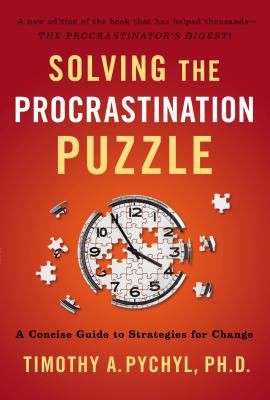
«Solving the Procrastination Puzzle» is 128 pages, published in 2013 by Timothy Pychyl, who had by then spent eighteen years running a procrastination research group at Carleton University. The relevant test is not whether the book is charming. It is whether a researcher writing for a general audience recommends what has been measured, or starts selling a proprietary system once the trade-paperback contract is signed.
He mostly does not. Of the four practical moves the book pushes hardest, two have direct randomized evidence pointed at procrastination itself, one has partial evidence that arrived after publication, and one has none. For comparison, Neil Fiore’s «Unschedule» has no controlled evaluation at all — see our notes on «The Now Habit». Fiore invented a method and asked you to trust it. Pychyl relays methods other people had already put through experiments, which is duller and more honest.
The caveats cluster in one place: the supporting science of the early 2010s that the book leaned on has aged much worse than the advice it was used to justify.
The claim on trial
Stated as something that could fail: procrastination is the voluntary delay of an intended action despite expecting to be worse off for the delay; it is caused by the pull of immediate mood repair, not by poor time management; therefore the effective interventions are emotional rather than organizational.
The definitional half is standard. The mechanism half is the claim that can break, and it has held.
The largest synthesis in the field, Steel, Psychological Bulletin, 2007, pooled 691 correlations and found the strong and consistent predictors to be task aversiveness, task delay, low self-efficacy, impulsiveness and low conscientiousness — with rebelliousness and sensation seeking, the folk explanations, near zero. Task aversiveness sits at the front of that list, which is the mood story in correlational form.
The experimental spine is older and cleaner. In three studies, Tice, Bratslavsky and Baumeister, Journal of Personality and Social Psychology, 2001 told some participants their current mood was chemically frozen and could not be improved. Frivolous procrastination vanished in that condition. Remove the possibility of mood repair and the motive for delay goes with it.
The framework the book runs on was published the same year, by the author: Sirois and Pychyl, Social and Personality Psychology Compass, 2013. It is a theoretical review, not new data — the book and the paper are one argument in two registers. What accumulated underneath it since is independent. Using an event-based diary with 75 students across 501 completed task episodes, Wieland et al., Frontiers in Psychology, 2021 found that within-person devaluation of a task predicted actual delay, while general procrastination tendency measured at baseline did not predict delay on any specific task. That is Pychyl’s model, tested at the level of the moment.
One correction to the absolute form of «not a time-management problem». Häfner, Oberst and Stock, Educational Studies, 2014 randomly assigned 96 students to a brief time-management training or a control condition; the trained group spread work evenly instead of clustering at the deadline. Scheduling is not the whole cause and it is not inert either.
Does the researcher prescribe what was tested
This is the question worth answering, so here is the audit, tool by tool.
- Implementation intentions. The book’s most specific instruction is to pre-commit the cue: if situation X arises, then I do Y. Gollwitzer and Sheeran, Advances in Experimental Social Psychology, 2006 meta-analysed 94 independent studies with more than 8,000 participants and found a medium-to-large effect on goal attainment, d = 0.65. Aimed directly at procrastinators, Owens, Bowman and Dill, Journal of Applied Social Psychology, 2008 had 152 students agree to report for an experiment; half formed an if-then plan. Those who did were nearly eight times more likely to turn up. The limits: the outcome was attendance at one appointment, not a term’s coursework, and the plan did not help high procrastinators more than low ones — that interaction was not significant.
- Stay with the feeling rather than escape it. The book asks you to treat the urge to delay as an emotional event to be tolerated. That is a testable therapeutic move, and it was tested: Schuenemann et al., Frontiers in Psychology, 2022 randomized 148 university students to nine weeks of online emotion-regulation training or a waitlist. Procrastination fell in the trained group, and mediation analysis showed the reduction ran through the increase in regulation skills. This is as close as anyone has come to a controlled test of the book’s theory of change, and it came nine years late.
- Self-forgiveness after a lapse. The book’s evidence here is the author’s own: Wohl, Pychyl and Bennett, Personality and Individual Differences, 2010, in which students who forgave themselves for procrastinating before a first exam procrastinated less before a second. It is a small longitudinal self-report study with no random assignment and no manipulation, and it cannot show that raising self-forgiveness lowers delay. The related correlational work, Sirois, Self and Identity, 2014, is a mediation model across four samples, which has the same limit. The causal evidence finally arrived in 2025: Lu et al., Mindfulness, 2025 randomized 459 people to a 14-day online self-compassion programme or a waitlist and found a significant reduction in bedtime procrastination, holding at one-month follow-up. Waitlist control, self-report, one narrow behaviour — but it is a manipulation, and it points the way the book said it would.
- «Just get started». No trial. Details below.
Three of four is a good record. It also means the book’s value is mostly as an accurate, compact briefing on other people’s experiments — which is what a short book by a researcher should be.
The one tool with no trial
The book’s most quotable move is the promise that once you begin, the task turns out not to be as bad as you expected, and that motivation follows action rather than preceding it.
In August 2026 we searched Crossref, Europe PMC and the general web for a direct test — an experiment or within-person study measuring anticipated task aversiveness before starting against experienced aversiveness after starting, in the context of delay. The result is a flat negative: no experiment, no randomized comparison of a «start for five minutes» instruction against any control, no pre-post measurement of aversiveness across the act of starting. The claim is plausible and untested, which leaves it, for now, an assertion.
What exists is adjacent, and worth stating precisely because it gets mis-cited as the evidence. The closest test is momentary rather than experimental: across 501 real task episodes, Wieland et al., Frontiers in Psychology, 2021 found that delay began when task value dropped and task aversiveness rose within the same person, while trait procrastination did not predict delay on a specific task. That confirms the diagnosis — avoided tasks feel bad beforehand, and the feeling is situational rather than characterological. It does not show that starting fixes the feeling, because nobody measured the ratings again once the task was underway. Pychyl’s own earlier experience-sampling work reported the same pattern, and we are not linking it here because we could not reach a copy at a stable source to check it against.
«Just get started» is also circular exactly where it is needed: initiation is the behaviour being explained. The if-then plan is the part that answers it, by moving the decision to start out of the moment when your mood gets a vote.
What has not held
The willpower chapter. The book treats self-control as a depletable resource, replenished by sleep, exercise and positive mood — the strength model that dominated psychology when it was written. Then came Hagger et al., Perspectives on Psychological Science, 2016, a preregistered multilab replication across 23 laboratories and 2,141 participants, which found the ego-depletion effect small with a confidence interval that included zero. Read that chapter as history. Nothing else in the book depends on it.
The prevalence figure. The widely repeated claim that roughly 20 percent of adults are chronic procrastinators traces to Harriott and Ferrari, Psychological Reports, 1996: 211 adults recruited at four public meetings, of whom 42 described themselves as chronic procrastinators. That is a 1996 convenience sample answering a self-report questionnaire. «Fairly common» is defensible; a population prevalence estimate is not.
The internet chapter. Its base is Lavoie and Pychyl, Social Science Computer Review, 2001: a survey posted on the web, completed by 308 self-selected respondents, 50.7 percent of whom reported frequent internet procrastination. A self-selected online survey about internet use is the weakest design in the book’s citation list.
Pychyl’s own intervention trial. This is the finding that most complicates a clean recommendation, and we have not seen it reported elsewhere. In Blouin-Hudon and Pychyl, Applied Psychology, 2016, 193 undergraduates were randomly assigned to four weeks of future-self mental imagery or to present-focused meditation. The imagery condition did raise future-self-continuity and empathic perspective taking. On procrastination itself, the result was conditional: only empathic perspective taking significantly moderated change in procrastination over time. His own lab tested a mechanism central to his book, with random assignment and a decent sample, and did not get a clean reduction in the target behaviour. That should temper how confidently anyone repeats the «connect with your future self» advice.
Who should read it
Read it if you have been treating delay as a planning defect and want the short version of why that framing fails, from someone who ran the studies. At 128 pages it costs an evening, and the correct-per-page density is high for the category — higher than most of what we cover in our self-help books we have checked.
Skip it if you already accept that the urge to delay is an emotional event; the book will tell you that four more times. Skip it if your delay is severe enough to be costing you work, money or health, because the effective response then is treatment, not a paperback. Pooling 24 studies, k = 44, N = 1,173, van Eerde and Klingsieck, Educational Research Review, 2018 found a large reduction in procrastination from interventions overall, with cognitive-behavioural therapy outperforming other types and effects stable at follow-up. Restricting to randomized trials, Malouff and Schutte, Journal of Counseling and Development, 2019 pooled 12 RCTs with 646 participants and found Hedges’s g = 1.18 — inflated, on their own moderator analysis, by no-treatment controls. The best-powered trial of a dedicated treatment, Rozental et al., Journal of Consulting and Clinical Psychology, 2015, randomized 150 people to guided internet CBT, unguided internet CBT, or waitlist: between-group effects of d = 0.50 to 0.81, clinically significant change in 31 to 40 percent of the guided group. Guidance did not beat no guidance.
The bestseller that got there first is «The Now Habit», and «Get Out of Your Own Way at Work» catalogues the same avoidance at work. A newer bestseller on self-sabotage, and what research supports in it, is checked in The Mountain Is You.
One thing to try
Take one task you have moved to tomorrow at least twice. Write a single if-then sentence naming a situational cue and a physical first action: «If it is Wednesday and I have finished breakfast, then I open the file and write the first heading.» The cue must be something you will encounter; the action must be small enough to be unambiguous. Separately, write down what you expect the first ten minutes to feel like, and afterwards what they did feel like. The if-then plan is the part with 94 studies and d = 0.65 behind it. The before-and-after note is the part nobody has tested, which makes you the only person collecting data on it.
Get the book
Find «Solving the Procrastination Puzzle» on Amazon — as an Amazon Associate, The Boring Work earns from qualifying purchases (disclosure).
The boring bottom line
The researcher wrote a better self-help book than the bestsellers, and the reason is structural: he had less to sell. His diagnosis is the field’s consensus, his main tool carries an odds ratio near eight and a meta-analytic d of 0.65, and his emotional framing got a randomized confirmation in 2022. Against that, one chapter rests on a theory that failed replication across 23 labs, one statistic rests on 211 people at a public meeting, one prescription has never been tested, and his own lab’s randomized trial of the future-self mechanism came back conditional. Read it in an evening, use the if-then plan, treat the willpower pages as a museum exhibit, and do not confuse «this is what the research says» with «this has been shown to work on me».
When to see a professional
This is general information about a book and the research around it, not medical advice. Chronic delay is not only a character annoyance: in a prospective cohort of 3,525 Swedish university students, Johansson et al., JAMA Network Open, 2023 found that a one-standard-deviation increase in procrastination predicted higher symptoms of depression (β 0.13, 95% CI 0.09-0.17), anxiety (β 0.08) and stress (β 0.11) nine months later, along with disabling pain and worse lifestyle measures. The associations are small but consistent. If your delay is persistent, is damaging your work, studies, finances or relationships, or travels with low mood, anxiety or attention difficulties, see a clinician rather than buying another book. Cognitive-behavioural therapy has the strongest randomized support, including internet-delivered formats, and a professional can check whether depression, anxiety or ADHD is doing the driving.
Sources
- Steel P (2007). The nature of procrastination: a meta-analytic and theoretical review of quintessential self-regulatory failure. Psychological Bulletin 133(1):65-94.
- Tice DM, Bratslavsky E, Baumeister RF (2001). Emotional distress regulation takes precedence over impulse control. Journal of Personality and Social Psychology 80(1):53-67.
- Sirois FM, Pychyl TA (2013). Procrastination and the priority of short-term mood regulation: consequences for future self. Social and Personality Psychology Compass 7(2):115-127.
- Wieland LM, Ebner-Priemer UW, Limberger MF, Nett UE (2021). Predicting delay in goal-directed action: an experience sampling approach. Frontiers in Psychology 12:695927.
- Häfner A, Oberst V, Stock A (2014). Avoiding procrastination through time management: an experimental intervention study. Educational Studies 40(3):352-360.
- Gollwitzer PM, Sheeran P (2006). Implementation intentions and goal achievement: a meta-analysis of effects and processes. Advances in Experimental Social Psychology 38:69-119.
- Owens SG, Bowman CG, Dill CA (2008). Overcoming procrastination: the effect of implementation intentions. Journal of Applied Social Psychology 38(2):366-384.
- Schuenemann L, Scherenberg V, von Salisch M, Eckert M (2022). «I’ll worry about it tomorrow» — fostering emotion regulation skills to overcome procrastination. Frontiers in Psychology 13:780675.
- Wohl MJA, Pychyl TA, Bennett SH (2010). I forgive myself, now I can study: how self-forgiveness for procrastinating can reduce future procrastination. Personality and Individual Differences 48(7):803-808.
- Sirois FM (2014). Procrastination and stress: exploring the role of self-compassion. Self and Identity 13(2):128-145.
- Lu Y, Li X, Liu Y, Zeng X (2025). Effects and mechanisms of self-compassion on bedtime procrastination: a randomized controlled trial of an online self-help intervention. Mindfulness 16:3484-3495.
- Hagger MS, Chatzisarantis NLD, et al. (2016). A multilab preregistered replication of the ego-depletion effect. Perspectives on Psychological Science 11(4):546-573.
- Harriott J, Ferrari JR (1996). Prevalence of procrastination among samples of adults. Psychological Reports 78(2):611-616.
- Lavoie JAA, Pychyl TA (2001). Cyberslacking and the procrastination superhighway. Social Science Computer Review 19(4):431-444.
- Blouin-Hudon E-MC, Pychyl TA (2016). A mental imagery intervention to increase future self-continuity and reduce procrastination. Applied Psychology 66(2):326-352.
- van Eerde W, Klingsieck KB (2018). Overcoming procrastination? A meta-analysis of intervention studies. Educational Research Review 25:73-85.
- Malouff JM, Schutte NS (2019). The efficacy of interventions aimed at reducing procrastination: a meta-analysis of randomized controlled trials. Journal of Counseling and Development 97(2):117-127.
- Rozental A, Forsell E, Svensson A, Andersson G, Carlbring P (2015). Internet-based cognitive-behavior therapy for procrastination: a randomized controlled trial. Journal of Consulting and Clinical Psychology 83(4):808-824.
- Johansson F, Rozental A, Edlund K, et al. (2023). Associations between procrastination and subsequent health outcomes among university students in Sweden. JAMA Network Open 6(1):e2249346.