TL;DR
- The central claim is half right, and that half is well measured: at an identical power input of 1000 W, six competitive swimmers put 49 W into overcoming drag and wasted 32 W; five triathletes put in 35 W and wasted 45 W. Same engine, 23% more speed.
- Speed does not track drag on its own. In 25 competitive swimmers the only significant predictor of sprint velocity was the ratio of power to drag — v = 0.86·power/drag, 65% of the variance. Power alone, drag alone and body height predicted nothing.
- The stroke-lengthening prescription has a measured floor. Forcing stroke rate 10–20% below preferred at a fixed speed raised oxygen uptake 11–16% and perceived effort 15–30%. Raising stroke rate cost nothing.
- Elite racing runs the other way: in all four competitive strokes, higher velocity came from a higher stroke rate and a shorter distance per stroke.
- No controlled comparison of Total Immersion against conventional coaching exists in PubMed, Europe PMC, Crossref or ClinicalTrials.gov as of August 2026. Untested is not refuted.
Verdict
Read our notes instead. Terry Laughlin picked the right variable. «Total Immersion» is unusual among the books we cover in that its mechanism sits inside a measurable, forty-year-old research literature rather than a psychology lab, and that literature agrees with him about where an adult swimmer’s losses are. It disagrees about what to do next.
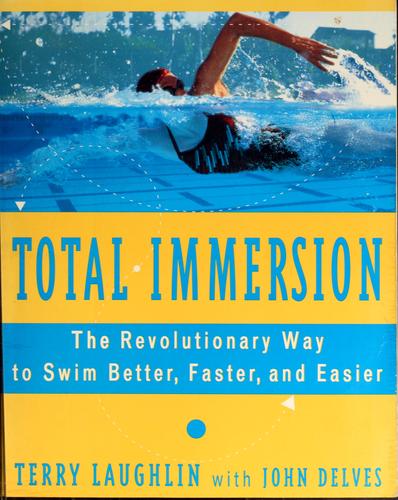
The book is subtitled «The Revolutionary Way to Swim Better, Faster, and Easier». The biomechanics was not new in 2004; the teaching sequence is the contribution. What aged badly is the prescription (keep lengthening the stroke, keep lowering the rate) because the one experiment that manipulated stroke rate directly found swimmers already at their cheapest stroke.
The claim on trial
Laughlin’s thesis: swimming speed is governed primarily by the resistance you present to the water, not by how hard you pull. Adults swim badly because they are shaped wrong, not because they are unfit. The fix is balance, streamlining, a longer stroke, a lower rate and «swimming taller», with technique before conditioning.
That decomposes into four testable parts. One, drag dominates the energy budget. Two, longer strokes at lower rates are faster or cheaper. Three, body position is the lever a beginner should pull. Four, this method delivers all of that better than ordinary coaching. The first and third survive. The second does not, in the form the book states it. The fourth has never been tested.
What drag costs
Start with the accounting. Metabolic power is divided twice: by gross mechanical efficiency, then by propelling efficiency — the fraction of mechanical output that overcomes drag rather than accelerating water backwards. Toussaint et al., Journal of Applied Physiology, 1988 measured both directly in four top-class swimmers: mechanical efficiency 8–12%, propelling efficiency 46–77%, total efficiency 5–8%. Between 92 and 95 cents of every metabolic dollar never becomes forward motion. That is the size of the problem the book points at, and it is real.
The cleanest test of technique versus fitness is Toussaint, Medicine and Science in Sports and Exercise, 1990: six competitive swimmers against five triathletes, compared by regression at an equal power input of 1000 W. Gross efficiency, stroke frequency and work per stroke did not differ. What differed was where the power went — 49 W against drag for the swimmers versus 35 W for the triathletes, and 32 W wasted moving water backwards versus 45 W. Propelling efficiency was 61 ± 6% against 44 ± 3%, distance per stroke 1.23 m against 0.92 m, speed 1.17 against 0.95 m·s⁻¹. Same engine, 23% faster, purely on where the output went. Toussaint and Beek, Sports Medicine, 1992 concur in review, adding that distance per stroke is a fair proxy for propelling efficiency.
The energetics literature says it more bluntly. Zamparo, Capelli and Pendergast, European Journal of Applied Physiology, 2011: an improvement in a swimmer’s best time is more easily obtained by reducing the energy cost of swimming than by an equal increase in maximal metabolic power. That is the technique-first argument in the words of the physiologists.
Now the correction. Schreven, Smeets and Beek, Frontiers in Sports and Active Living, 2022 tested 25 male competitive swimmers on arms-only 25 m sprints, measured active drag directly, and ran a model selection across two technique, three power and two anthropometric variables. Exactly one predictor survived: the ratio of power output to drag, v = 0.86·power/drag, accounting for 65% of the variance in speed. Not power alone, not the drag coefficient alone, not body height, not hand surface area. Drag is a denominator, not the equation — you cannot get fast by shrinking it while the numerator stays small. The review by Lopes et al., Frontiers in Physiology, 2022, covering 75 active-drag studies, agrees: the drag coefficient falls as technical efficiency rises, but frontal area and propulsion both stay in the picture.
The stroke-length prescription has a floor
Velocity is stroke rate multiplied by distance per stroke. That is arithmetic. The finding is what swimmers do with the two terms, and it does not match the book.
Craig and Pendergast, Medicine and Science in Sports and Exercise, 1979 measured swimmers at constant velocity with a wire-and-wheel system recording distance and time within the stroke cycle. In all four competitive strokes (front crawl, back crawl, butterfly, breaststroke) velocity rose by increasing stroke rate and decreasing distance per stroke. In front crawl the fastest swimmers did have the longest distance per stroke at slow rates, the part the book quotes. The part it does not: the faster men also showed a larger percentage drop in distance per stroke on the way to their maximum. Being able to lengthen is an asset. Refusing to shorten is not.
Craig et al., Medicine and Science in Sports and Exercise, 1985 compared the 1984 US Olympic Trials with 1976. In nine of the twelve events that got faster, the gain came from increased distance per stroke, and finalists generally out-stroked swimmers 3–7% slower. Good for the book. But the women’s 100 m butterfly and backstroke got faster purely through higher stroke rates, women overall depended more on rate than men, and in races of 200 m and longer distance per stroke fell with fatigue while the faster swimmers held or raised stroke rate to compensate. Distance per stroke is a marker of skill, not a target to maximise at all costs.
The decisive experiment is McLean et al., Medicine and Science in Sports and Exercise, 2010. Ten competitive swimmers swam in a flume at a fixed 1.0 m·s⁻¹ while stroke rate was set to −20%, −10%, 0%, +10% and +20% of their preferred rate, in random order, with oxygen uptake measured after steady state. Reducing stroke rate (lengthening the stroke, exactly what the book asks for) raised oxygen uptake by 11–16%, heart rate by 4–6% and perceived exertion by 15–30%. Increasing stroke rate did essentially nothing. The authors’ reading is the one that matters: these swimmers had already selected the longest stroke that did not cost extra oxygen. There is no free length above that point, and the book sends you looking for it anyway.
Alberty et al., Journal of Strength and Conditioning Research, 2011 hit the same wall from another angle. Ten well-trained swimmers held paced trials at their spontaneous stroke rate, then at a rate lowered by 5%. Time to exhaustion fell significantly and time in non-propulsive phases rose 8.6–13.2%. A five percent stretch introduced dead time into the cycle — the «over-gliding» coaches complain about, measured rather than asserted.
«Swimming taller» and body position
The body-position half of the method fares better. Zamparo et al., European Journal of Applied Physiology, 2009 quantified what balance drills address, in 72 swimmers aged 8–19: static position as underwater torque, dynamic position as projected frontal area. From youngest to oldest group, underwater torque rose by a factor of 3.84 in males and 2.27 in females, frontal area by 2.13 and 1.68, while propelling efficiency rose only 1.13 and 1.24. Energy cost rose accordingly. Position in the water is measurable, and it moves energy cost more than stroke efficiency does.
«Swimming taller» has a genuine mechanism behind it, and it is not the one usually given. Vennell, Pease and Wilson, Journal of Biomechanics, 2006 towed a mannequin and found total drag at the surface reaching 2.4 times the drag of the same body fully immersed, with wave drag making up 50–60% of the total at 1.7 m·s⁻¹ — far higher than earlier estimates. Wave drag depends on the Froude number, speed over the square root of gravity times body length, computed there for a body 2.34 m from toe to fingertip. A longer vessel at the same speed sits at a lower Froude number, so lengthening has a real payoff.
What does not exist is a measurement of a swimmer doing the drill and producing that reduction. Vennell’s data come from a towed mannequin in fixed postures, not a person extending a lead arm. «Swim taller» is a mechanism with a plausible sign and an unmeasured magnitude.
Has anyone tested the method
No. PubMed for «Total Immersion» in title or abstract with swimming returns three records (postural control after fin swimming, gastroenteritis from sea bathing, and a 1969 paper on cardiovascular responses to immersion) none about the coaching method. PubMed for Laughlin T as author with swimming returns zero. Europe PMC and Crossref return nothing evaluating the method. ClinicalTrials.gov returns zero registered studies. Searched August 2026.
There is no randomised or even matched comparison of Total Immersion against ordinary adult instruction, on any outcome, anywhere indexed. Untested is not refuted: the mechanism is well supported and the drills are cheap. But the branding claims a margin over conventional coaching that nobody has measured, and after thirty-five years of commercial operation that absence is itself informative.
Swimming as exercise
One claim in the book’s orbit needs no defence. Oja et al., British Journal of Sports Medicine, 2017 followed 80,306 British adults, mean age 52, and found swimming associated with a hazard ratio of 0.72 (95% CI 0.65 to 0.80) for all-cause mortality and 0.59 (95% CI 0.46 to 0.75) for cardiovascular mortality. In the same cohort, running and football showed no significant association. Chase, Sui and Blair, International Journal of Aquatic Research and Education, 2008 followed 40,547 men from 1971 to 2003 and reported lower all-cause mortality in swimmers than in sedentary men, walkers or runners.
Both are observational, and people who swim differ from people who do not in ways no adjustment fully removes. But the cohorts are large and the direction is consistent. A book that keeps adults in a pool for decades is defensible even when its stroke advice overshoots.
Who should read it
Read the full book if you are an adult who never had lessons and swims with legs sinking and head high. The balance and body-position material is the strongest part, it maps onto the underwater-torque and frontal-area findings above, and it is hard to self-diagnose.
Read the notes instead if you already swim continuous lengths without distress. Your remaining gains are in the power-to-drag ratio, and the book holds one of those two terms. Its answer to «go faster» is «glide longer», which the flume data says costs oxygen.
Skip it if you are training for a race, or coaching children. The 1979 and 1985 competition data are unambiguous that speed above your economical pace comes from stroke rate, and a method treating rate as the enemy leaves you at your current pace with better form. For more separation of method from marketing, see our other book reviews.
The challenge-skill idea behind the technique-first argument is tested in «Flow», and «Atomic Habits» covers why repetition alone does not produce skill.
One thing to try
Run the McLean protocol on yourself for one session. Swim a length at a comfortable pace; record strokes and time. Then swim it three more times at that same clock time: at your natural rate, deliberately longer and slower, and shorter and quicker. Record strokes and effort out of ten each way.
If the long-and-slow version feels harder at the same speed, you have found your floor and the book’s central drill asks you to swim below it. If it feels easier, you had slack in your stroke and the book is right about you. Either result beats the prescription, because it is yours. Terry Laughlin founded Total Immersion in 1989 and coached it until his death in 2017 at 66 (Slowtwitch, 2017); the drills are still taught unchanged, which is reason enough to check them against your own numbers.
Get the book
Find «Total Immersion» on Amazon — as an Amazon Associate, The Boring Work earns from qualifying purchases (disclosure).
The boring bottom line
Laughlin identified the right bottleneck. Ninety-two to ninety-five percent of a swimmer’s metabolic output never becomes forward motion, swimmers beat triathletes at identical power input purely on where that power goes, and cutting energy cost beats raising maximal metabolic power. All measured, all supporting technique first for adults.
Then he turned one true statement into a single dial and told everyone to turn it the same way. Sprint speed tracks the ratio of power to drag, not drag alone. Lengthening the stroke is free only down to your own floor, and 10–20% below it costs 11–16% more oxygen at the same speed. In competition, faster swimming comes from raising rate and accepting a shorter stroke. And the branded method has never been compared with ordinary coaching in any indexed study.
Keep the balance work, keep counting strokes as a diagnostic, and stop treating a low count as the goal.
When to see a professional
This page is general information about a book and the research around it, not medical advice. Swimming carries a drowning risk that does not exist on land. If you have a cardiac, respiratory, neurological or seizure condition, or are returning to exercise after illness, injury or a long layoff, talk to your doctor first — and say specifically that the activity is swimming, because a fainting episode in water is not the same event as one on a treadmill. Persistent shoulder pain that worsens with overhead movement belongs to a physiotherapist or sports-medicine clinician, not to a stroke correction from a book. If you cannot yet float and breathe comfortably, take lessons from a qualified instructor in a supervised pool, and keep a self-taught stroke out of open water, where cold shock and currents turn a technique problem into an emergency.
Sources
- Toussaint et al., Journal of Applied Physiology, 1988 — four top swimmers: mechanical efficiency 8–12%, propelling efficiency 46–77%, total efficiency 5–8%.
- Toussaint, Medicine and Science in Sports and Exercise, 1990 — six swimmers vs five triathletes at 1000 W: propelling efficiency 61 ± 6% vs 44 ± 3%, speed 1.17 vs 0.95 m·s⁻¹.
- Toussaint and Beek, Sports Medicine, 1992 — review of drag, propelling efficiency and power output in front crawl; distance per stroke as a skill proxy.
- Zamparo, Capelli and Pendergast, European Journal of Applied Physiology, 2011 — reducing energy cost improves best time more easily than an equal rise in maximal metabolic power.
- Zamparo et al., European Journal of Applied Physiology, 2009 — 72 swimmers aged 8–19: underwater torque, frontal area and energy cost during growth.
- Schreven, Smeets and Beek, Frontiers in Sports and Active Living, 2022 — 25 swimmers: power-to-drag ratio the sole predictor of sprint speed, 65% of variance.
- Lopes et al., Frontiers in Physiology, 2022 — systematic narrative review of 75 active-drag studies.
- Craig and Pendergast, Medicine and Science in Sports and Exercise, 1979 — in all four strokes, velocity rose with stroke rate and falling distance per stroke.
- Craig et al., Medicine and Science in Sports and Exercise, 1985 — 1984 vs 1976 US Olympic Trials: distance per stroke, stroke rate and fatigue.
- McLean et al., Medicine and Science in Sports and Exercise, 2010 — stroke rate cut 10–20% below preferred raised oxygen uptake 11–16% at fixed speed.
- Alberty et al., Journal of Strength and Conditioning Research, 2011 — a 5% imposed reduction in stroke rate cut time to exhaustion and raised non-propulsive phase duration 8.6–13.2%.
- Vennell, Pease and Wilson, Journal of Biomechanics, 2006 — surface drag up to 2.4× immersed drag; wave drag 50–60% of total at 1.7 m·s⁻¹.
- Oja et al., British Journal of Sports Medicine, 2017 — 80,306 adults: swimming, all-cause HR 0.72, cardiovascular HR 0.59.
- Chase, Sui and Blair, International Journal of Aquatic Research and Education, 2008 — 40,547 men, 1971–2003: lower all-cause mortality in swimmers than in sedentary men, walkers or runners.
- Slowtwitch, 2017 — Total Immersion founder Terry Laughlin dies at 66.