TL;DR
- Godin’s diagnosis aged well: assembling people around an idea no longer needs a title, a budget or a broadcaster. His mechanism did not.
- Across seven online domains, 73% to 95% of sharing cascades never got past the person who started them. Mean cascade size was 1.1 to 1.4 people, and 94% to 99% of adoptions happened within one step of a seed.
- «Find the leader and the tribe follows» is the influentials hypothesis. In 10,000-node simulations the multiplier on top-10% influentials «barely exceeds one»; in a 1.3-million-user Facebook experiment almost nobody was both highly influential and highly susceptible.
- One clean win. A committed 25% flipped an established group convention; below 25%, only 6% of the uncommitted switched. Behaviour spread to 53.8% of a clustered network versus 38.3% of a random one, four times faster.
- Nobody has measured the denominator. Kevin Kelly, who wrote «1,000 True Fans» the same year, later collected financial data from seven creators and reported «very few artists making their entire living selling directly to True Fans».
Verdict
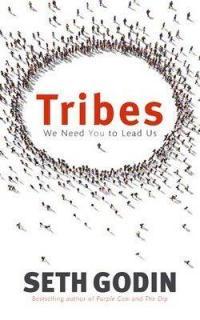
Read the notes. «Tribes» is a short book of aphorisms whose entire argument compresses to about a page, and that page is worth having. Seth Godin saw in 2008 that the cost of assembling a group around a shared idea had collapsed, that gatekeepers had lost their veto, and that the constraint had moved from permission to willingness. That call has held.
What the book does not contain is a mechanism, a failure rate, or a single number. It is exhortation illustrated by tribes that worked. Checked against the diffusion research that arrived after publication, the central engine (a leader gathers a tribe, the tribe carries the idea outward) fails hardest.
The claim on trial
Godin defines the unit precisely, which helps: «A tribe is a group of people connected to one another, connected to a leader, and connected to an idea», and «A group needs only two things to be a tribe: a shared interest and a way to communicate» (quotations as recorded in Derek Sivers’ notes on the book). Then the engine: «Tribes grow when people recruit other people. That’s how ideas spread as well.» Then the entry condition: «Leadership is a choice. It’s the choice to not do nothing.»
Three testable propositions: ideas travel person-to-person through connected groups rather than by broadcast; a committed leader is the causal ingredient; leading is a decision available to anyone who makes it. The book asserts all three and tests none.
A checked negative first. We searched Crossref on 10 August 2026 for empirical tests of Godin’s tribe model, for measured outcomes of tribe-building, and for any study counting attempted tribes rather than successful ones. Nothing came back. Untested is not refuted — but the argument must be assembled from its pieces, and the pieces are well studied.
How ideas spread online
This is the strongest evidence against the book. Across seven online domains (including a charity campaign with about 59,000 adopters, a video-sharing application with 374,000, 1.3 million video adoption events on Twitter and a 1.8 million-adopter news site) the share of cascades consisting of the seed alone, with no onward spread at all, ranged from 73% to 95%. Mean cascade size stayed between 1.1 and 1.4 people. Fewer than 1% of cascades exceeded seven nodes, and 94% to 99% of all adoptions occurred within one degree of a seed (Goel, Watts & Goldstein, ACM EC ’12, 2012).
The follow-up extended this to roughly a billion diffusion events on Twitter (news, video, images, petitions) with a formal measure of how «viral» a diffusion was. Structural virality was low and stayed low regardless of event size: «popularity is largely driven by the size of the largest broadcast» (Goel et al., Management Science, 2016). A separate Twitter study tracking 1.6 million users and 74 million URL diffusion events between 13 September and 15 November 2009 found an average cascade of 1.14 people and a median of 1 (Bakshy et al., WSDM ’11, 2011). Godin’s «tribes grow when people recruit other people» describes the tail, not the distribution.
Worse for the «remarkable things spread by themselves» half of Godin’s worldview: success in cultural markets is only loosely tied to quality. In an artificial music market with 14,341 participants downloading songs by unknown bands, social influence increased both inequality and unpredictability; the best songs rarely did badly and the worst rarely did well, but between those bounds any result was possible (Salganik, Dodds & Watts, Science, 2006). When the same team inverted the displayed popularity rankings for 12,207 participants, most songs’ false popularity became real (Salganik & Watts, Social Psychology Quarterly, 2008). On a news aggregator, 4,049 comments given one arbitrary up-vote ended with final mean ratings 25% higher than controls (Muchnik, Aral & Taylor, Science, 2013). Arbitrary early advantage compounds; remarkability is not doing the work Godin claims.
The influentials problem
«Connected to a leader» is the load-bearing phrase in Godin’s definition, and it restates the influentials hypothesis: seed the right people and the idea propagates. That hypothesis has been tested and it does not hold up. In threshold-model simulations over 10,000-node networks, with influentials defined as the top 10% of the influence distribution, their relative multiplier effect on cascade size «barely exceeds one» under most conditions and falls below one in many. Large cascades were driven «not by influentials but by a critical mass of easily influenced individuals» (Watts & Dodds, Journal of Consumer Research, 2007). What matters is the structure of the susceptible population, not the charisma of whoever went first.
The field evidence agrees. A randomised experiment on a representative sample of 1.3 million Facebook users, in which 7,730 adopters sent 41,686 notifications producing 976 peer adoptions, found that «highly influential individuals tend not to be susceptible, highly susceptible individuals tend not to be influential, and almost no one is both» (Aral & Walker, Science, 2012). A tribe of influentials is a tribe that does not convert. The Twitter study concluded that targeting ordinary users with average influence beats chasing top influencers on cost per acquisition.
A second awkward result: in a randomised trial across 9,687 users and their 1.4 million Facebook friends, passive broadcast features produced a 246% increase in peer influence, while adding active, personalised messages (the leader-driven recruitment Godin prescribes) added only 98% more, and broadcast produced more total adoption because people used it more (Aral & Walker, Management Science, 2011).
Where Godin is right
Two findings vindicate him, held to the same citation standard as the criticism. The first is the committed minority. In ten online groups of 20 to 30 people, 194 subjects in total, an established naming convention was overturned once the committed minority reached roughly 25%. Below that threshold an average of only 6% of the uncommitted switched by the final round; at or above it, the convention flipped (Centola et al., Science, 2018). «A small committed group can change the norm» is not motivational filler. It has a number attached, and the number is a share of a defined population — not an absolute headcount, which is where the popular reading of Godin goes wrong.
The second is that density beats reach. Across six trials with 1,528 participants in networks of 98 to 144 people, a health behaviour spread to 53.8% of clustered-lattice networks against 38.3% of matched random networks, and more than four times faster (Centola, Science, 2010). Behaviours needing social reinforcement travel better through overlapping ties than far-flung weak ones. Godin made that argument before the experiment existed.
Note what both results require: a bounded population and repeated exposure from several people you already know. Neither is a story about a leader with a manifesto reaching strangers.
Is leadership a choice
Partly, and the qualifier matters. Who ends up leading is predictable in advance from traits. A meta-analysis of 222 correlations from 73 independent samples found the Big Five multiply correlated .53 with leadership emergence, extraversion and conscientiousness at ρ = .33 each, neuroticism at −.24 (Judge et al., Journal of Applied Psychology, 2002). Traits and behaviours together account for at least 31% of the variance in leadership effectiveness (DeRue et al., Personnel Psychology, 2011). Some of it is not chosen at all: in a twin study of 119 monozygotic and 94 dizygotic pairs, 30% of the variance in leadership role occupancy was heritable (95% CI .14 to .44), the rest assigned to non-shared environment and essentially nothing to shared family environment (Arvey et al., The Leadership Quarterly, 2006). «Leadership is a choice» is true in that 70% of the variance sits outside the genes. It is false as a claim that the field is level.
The good news for Godin sits in the training literature he ignores. Across 335 independent samples and 26,573 participants, leadership training produced δ = .73 on learning, δ = .82 on transfer to the job and δ = .72 on organisational results (Lacerenza et al., Journal of Applied Psychology, 2017). Leadership is teachable. «Tribes» insists it only needs deciding. Deciding is necessary and nowhere near sufficient, and what closes the gap is the instruction the book disparages.
The denominator nobody counted
Every case in «Tribes» is a tribe that worked. That is a sampling procedure, not evidence, and the bias is formally described: when observers see only surviving organisations, risky practices unrelated to performance in the full population appear positively related to performance in the survivor sample, so managers overrate concentrated bets (Denrell, Organization Science, 2003). «Tribes» is that mechanism in book form.
Nobody has counted the failed tribes, because they leave no record. The closest proxies are platform distributions. Across a decade of YouTube channel and video data, an average of 85% of all views went to 3% of channels (Bärtl, Convergence, 2018). Spotify reports that in 2025 the 100,000th highest-earning artist generated more than $7,300 in royalties, with more than 13,800 artists above $100,000 and more than 1,500 above $1 million (Spotify Loud & Clear, 2025 data). Those are the ranks. The base is millions.
The sharpest evidence is a confession. Kevin Kelly published «1,000 True Fans» in 2008 (1,000 fans at $100 a year each equals $100,000) and it became the quantified version of Godin’s small-tribe economics. Kelly then checked. He gathered hard financial information from seven creators and concluded there are «very few artists making their entire living selling directly to True Fans»; those who manage it sell high-priced goods like paintings, not low-priced ones. He also reported that Jaron Lanier searched for musicians earning a living wage purely from new media, with no legacy-media history, and «claims that he has not found a single musician that meets this definition». Kelly’s one detailed case, the musician Robert Rich, had roughly 600 true fans, cleared at most about $10,000 a year from direct sales, and survived on licensing and audio engineering work. The man who invented the number could not find people living on it — the denominator problem stated by the person with the strongest incentive to bury it.
Who should read it
People stuck on permission rather than method. If the obstacle is a belief that you need a title, a budget or someone’s approval to organise a group around an idea, «Tribes» removes it in ninety minutes. It also reads well for anyone running volunteers, congregations, open-source projects or user communities, where density beats reach.
Skip it if you want to know what to do on Monday. There is no method, no sizing of the opportunity, and no account of what happens to the majority for whom it does not work — which the platform distributions suggest is nearly everyone who tries. Skip it as a marketing plan too: reach is dominated by the largest single broadcast you can obtain, not by onward sharing. Our other reviews hold business books to this standard and most fail in the same place, on examples selected by outcome.
The same survivorship problem, told from inside the winning tail: «Screw It, Let’s Do It» and «Soaring with Eagles».
One thing to try
Pick a bounded group you belong to (a team, a department, a club, a forum with a member list) and write down its size. Work out 25% of it. That is your countable target for the change you want. Recruit people who already know each other rather than the most visible person available: reinforcement from several connected peers moved adoption from 38.3% to 53.8%, while the influential seed produced a multiplier barely above one. Track committed adopters weekly against the 25% line. If you cannot name the population, you do not have a tribe. You have an audience, and audiences are governed by broadcast size.
Get the book
Find «Tribes» on Amazon — as an Amazon Associate, The Boring Work earns from qualifying purchases (disclosure).
When to see a professional
This is general information, not financial advice. The earnings figures above are population distributions, not forecasts about you, and we recommend no specific business, platform or investment. Before leaving paid work to build an audience full time, take your numbers to a qualified accountant or licensed financial adviser who can see your runway, obligations and tax position. If the pressure to «lead» has become persistent anxiety, sleeplessness or burnout, that belongs with a doctor or a licensed mental health professional.
The boring bottom line
Godin got the historical observation right: the cost of gathering people around an idea collapsed, the gatekeepers lost their veto, and the shortage moved to willingness. He also got one mechanism right ahead of the evidence — committed minorities in dense, overlapping groups do flip norms, at around a 25% share.
He got the spreading wrong. Almost nothing spreads: 73% to 95% of cascades die with the person who started them, and what looks like virality is usually the largest broadcast. He got the leader wrong: influentials carry a multiplier of about one, and the people most able to influence are the least susceptible. And he got the framing wrong by only ever showing the tribes that worked, in a book with no denominator, published the same year the man who invented the arithmetic went looking for people living on it and came back with seven partial cases and Jaron Lanier’s zero.
Sources
- Goel, Watts & Goldstein, «The structure of online diffusion networks», Proceedings of the 13th ACM Conference on Electronic Commerce, 2012
- Goel, Anderson, Hofman & Watts, «The Structural Virality of Online Diffusion», Management Science, 2016
- Bakshy, Hofman, Mason & Watts, «Everyone’s an influencer: quantifying influence on Twitter», WSDM ’11, 2011
- Watts & Dodds, «Influentials, Networks, and Public Opinion Formation», Journal of Consumer Research, 2007
- Aral & Walker, «Identifying Influential and Susceptible Members of Social Networks», Science, 2012
- Aral & Walker, «Creating Social Contagion Through Viral Product Design», Management Science, 2011
- Salganik, Dodds & Watts, «Experimental Study of Inequality and Unpredictability in an Artificial Cultural Market», Science, 2006
- Salganik & Watts, «Leading the Herd Astray: An Experimental Study of Self-fulfilling Prophecies in an Artificial Cultural Market», Social Psychology Quarterly, 2008
- Muchnik, Aral & Taylor, «Social Influence Bias: A Randomized Experiment», Science, 2013
- Centola, Becker, Brackbill & Baronchelli, «Experimental evidence for tipping points in social convention», Science, 2018
- Centola, «The Spread of Behavior in an Online Social Network Experiment», Science, 2010
- Judge, Bono, Ilies & Gerhardt, «Personality and leadership: A qualitative and quantitative review», Journal of Applied Psychology, 2002
- DeRue, Nahrgang, Wellman & Humphrey, «Trait and Behavioral Theories of Leadership», Personnel Psychology, 2011
- Arvey, Rotundo, Johnson, Zhang & McGue, «The determinants of leadership role occupancy: Genetic and personality factors», The Leadership Quarterly, 2006
- Lacerenza, Reyes, Marlow, Joseph & Salas, «Leadership training design, delivery, and implementation: A meta-analysis», Journal of Applied Psychology, 2017
- Denrell, «Vicarious Learning, Undersampling of Failure, and the Myths of Management», Organization Science, 2003
- Bärtl, «YouTube channels, uploads and views: A statistical analysis of the past 10 years», Convergence, 2018
- Kevin Kelly, «1,000 True Fans», The Technium, 2008
- Kevin Kelly, «The Case Against 1000 True Fans», The Technium
- Kevin Kelly, «The Reality of Depending on True Fans», The Technium
- Spotify, «Loud & Clear» takeaways, 2025 royalty data
- Derek Sivers, notes and verbatim excerpts from «Tribes» by Seth Godin