TL;DR
- Fiore’s core diagnosis (procrastination is avoidance driven by feelings about a task, not a defect of willpower or calendars) was published in 1989 and largely confirmed by research that arrived fifteen to thirty years later.
- His famous method, the «Unschedule», has never been tested. We searched OpenAlex, PubMed, Crossref and the open web in August 2026 and found zero controlled or observational evaluations. Not one.
- What has been tested: cognitive-behavioural treatment, emotion-regulation training, and if-then implementation intentions. All three have randomized evidence behind them; the Unschedule has a book.
- The absolutist version of the claim fails. A 96-student randomized experiment shows plain time-management training removes deadline-clustering, which is exactly what Fiore says time management cannot do.
- Verdict: read our notes instead. Keep the reframe, drop the reverse-calendar ritual, and use the interventions someone measured.
Verdict
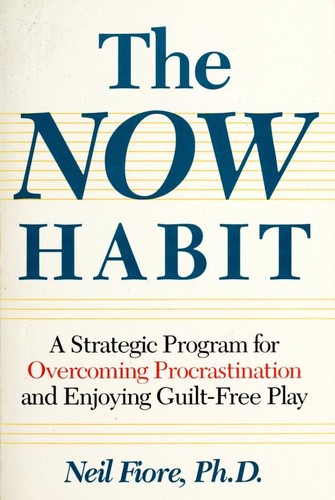
Read our notes instead. «The Now Habit» is half-right in the way that matters and untested in the way that sells. Neil Fiore, a psychologist at Berkeley’s counselling service, wrote in 1989 that procrastination is a self-protective response to a task that feels threatening — and that the standard advice to try harder, plan better and feel guiltier is the fuel, not the fix. That was a good call, made roughly two decades before the emotion-regulation literature caught up to it.
The book then converts that insight into a specific artefact: the «Unschedule», a weekly calendar on which you first block sleep, meals, commitments and play, and then log work in half-hour units only after it happens. Fiore claims this raises quality output. Nobody has ever checked. We looked. The grade for that claim on this site is «Untested», which is a different verdict from «Refuted» and should be treated as such.
The claim on trial
Stated fairly, Fiore’s argument runs: procrastination is not a time-management or discipline problem. It is an avoidance response to fear — of failure, of being judged, of never finishing, of a task that has become a referendum on your worth. Because the delay works (it removes the threat, briefly), it repeats. The fix is therefore to lower the threat rather than raise the pressure: replace «I have to finish» with «I choose to start», commit to a defined block rather than an outcome, and legitimize rest by scheduling guilt-free play first, so that recorded work becomes evidence of progress rather than a debt statement.
Two testable pieces sit inside that. First, the mechanism: is procrastination driven by aversive feelings about the task rather than poor scheduling? Second, the intervention: does the Unschedule produce more or better work than an ordinary planner? The first has been examined by hundreds of studies. The second has been examined by none.
The diagnosis that aged well
The strongest support comes from the largest synthesis in the field. Across 691 correlations, Steel, Psychological Bulletin, 2007 found that the traits folk wisdom blames (neuroticism, rebelliousness, sensation seeking) showed only weak connections to procrastination, while task aversiveness, task delay, low self-efficacy, impulsiveness and low conscientiousness were the strong and consistent predictors. Task aversiveness sits near the centre of that list. Fiore built his book on it eighteen years earlier.
The mechanism was then given a name: procrastination as a failure of emotion regulation in which short-term mood repair is prioritized over the interests of the future self, argued by Sirois and Pychyl, Social and Personality Psychology Compass, 2013. The experimental spine for that claim is older and unusually clean. In three experiments, Tice, Bratslavsky and Baumeister, Journal of Personality and Social Psychology, 2001 convinced some participants that their bad mood was temporarily frozen and could not be changed. Frivolous procrastination disappeared in that condition. If delay is a mood-repair move, removing the possibility of repair removes the motive — and it did.
Momentary data agrees. Using experience sampling across 501 real task episodes, Wieland et al., Frontiers in Psychology, 2021 found that delay onset was predicted by within-person drops in task value and rises in task aversiveness, while trait procrastination tendency did not predict delay on a specific task. That is a direct hit for Fiore’s framing: the problem is situated in the moment and in the task, not in a fixed character flaw. It also undercuts the entire genre of «are you a procrastinator?» self-diagnosis.
One more piece of ratification, from an unwelcome direction. In a large prospective cohort of Swedish university students, Johansson et al., JAMA Network Open, 2023 found that higher procrastination predicted worse subsequent mental health, pain and lifestyle outcomes. Fiore treated procrastination as a distress problem rather than a laziness problem. The epidemiology now treats it as a health-relevant behaviour.
Thirty-seven years, zero trials
Here is the part nobody else has written down, so we will be precise about both the finding and its limits.
In August 2026 we searched OpenAlex, PubMed, Crossref and the general web for any controlled or observational evaluation of Fiore’s Unschedule. Search terms covered the method name in its variants, the author’s name paired with procrastination and with intervention terms, and citation trails from the procrastination-intervention meta-analyses. The result is a flat negative: no randomized trial, no quasi-experiment, no pre-post study, no single-case series, no comparison against a conventional forward planner. OpenAlex returns the 1988 book record itself plus unrelated hits on unrelated senses of the word. The intervention meta-analyses do not include it, because there is nothing to include.
Two caveats, stated so this is not overread. Absence within those indexes is not proof that the method fails — an untested intervention is untested, not disproven, and the Unschedule is assembled from components (behavioural activation, small committed work blocks, scheduled recovery) that individually have support. And unindexed dissertations or in-house counselling audits could exist without surfacing in Crossref. What we can say is that after thirty-seven years, several editions and millions of copies sold, no one has run the study. A method with that reach and that little scrutiny is a statement about the self-help market, not about Fiore.
The grade this site applies to a claim in that position is «Untested». It is the same grade we would give a promising new drug with a good rationale and no phase II. You may still choose to take it. You should not pretend you know what it does.
What did not survive
The absolutist form of «procrastination is not a time-management problem» is wrong, and there is an experiment to prove it. Häfner, Oberst and Stock, Educational Studies, 2014 randomly assigned 96 students to a short time-management training or a control condition. The trained group distributed their work evenly across the available period and showed no clustering near the deadline; controls clustered. A brief scheduling intervention changed the exact behaviour Fiore says scheduling cannot touch. The honest reading is that time management is neither the whole cause nor useless — it is one lever among several, and Aeon, Faber and Panaccio, PLOS ONE, 2021, meta-analysing the wider literature, found time management only moderately related to performance and more strongly related to wellbeing than to output. Fiore oversold the negative; the productivity industry oversold the positive.
Second, the fear framing is too narrow. Wieland et al., Learning and Instruction, 2022 used experience sampling to identify task ambiguity (not knowing what the next concrete move is) as an in-the-moment driver of academic delay. Plenty of avoided tasks are undefined rather than frightening. If your task is «work on the report», no amount of guilt-free play will start it; a first sentence will.
Third, the causal story about self-kindness. A previous version of this review said students who forgave themselves procrastinated less, phrased as if forgiveness did the work. That was sloppy. Sirois, Self and Identity, 2014 found across four samples that self-compassion mediated the procrastination-stress link — a correlational mediation design, which cannot show that raising self-compassion lowers procrastination. Wohl, Pychyl and Bennett, Personality and Individual Differences, 2010 found that self-forgiveness after a first exam predicted less procrastination before a second: one small longitudinal self-report study, no random assignment, no manipulation. Both are compatible with Fiore’s anti-guilt stance. Neither licenses «forgive yourself and you will start».
Fourth, a boundary condition Fiore could not have known about. Gustavson et al., Psychological Science, 2014 found procrastination to be substantially heritable and to share essentially all of its genetic variance with impulsivity. A trait with that structure is not going to be dissolved by a weekly grid, however cleverly inverted.
What to use instead
The tested options are unglamorous and specific.
- Cognitive-behavioural treatment. Pooling 24 studies, k = 44, N = 1,173, van Eerde and Klingsieck, Educational Research Review, 2018 found a large reduction in procrastination that held at follow-up, with CBT outperforming self-regulation training and other intervention types. The single largest randomized test of a dedicated procrastination treatment, Rozental et al., Journal of Consulting and Clinical Psychology, 2015, established guided internet-delivered CBT as efficacious — meaning you can get a version of this without a waiting room.
- Emotion-regulation training. A two-arm randomized trial of 148 students, Schuenemann et al., Frontiers in Psychology, 2022, delivered nine weeks of online emotion-regulation training against a waitlist and significantly reduced procrastination, with the effect mediated by gains in emotion-regulation skills. This is the closest thing that exists to a controlled test of Fiore’s own theory of change — and it is not his method.
- Implementation intentions. Fiore tells you to start; he does not specify how the start is triggered. Gollwitzer and Sheeran, Advances in Experimental Social Psychology, 2006 meta-analysed if-then plans and found medium-to-large gains in goal attainment. «If it is 9:00 and I am at my desk, then I open the draft and write one paragraph» is the tested version of the sentence Fiore leaves vague.
- Actual recovery, defined properly. «Guilt-free play» has a nearest evidence base in Sonnentag and Fritz, Journal of Occupational Health Psychology, 2007, which validates psychological detachment, relaxation, mastery and control as distinct recovery experiences. Note the mismatch honestly: that work concerns recovery from work, not the onset of procrastination. It supports scheduling real detachment. It does not show that doing so makes you write more.
Who should read it
Read the book if the thing stopping you is dread — you have a task that has become a verdict on you, you are working seven days a week and enjoying none of them, and you need permission to stop treating rest as theft. Fiore is good on that, better than most clinicians writing today, and the first eighty pages do work that a summary cannot fully replace.
Skip it if your problem is a vague task list, a broken filing system, or a genuine scheduling collision. Skip it if you want to know what the evidence says about fixing procrastination, because the book predates almost all of it. And skip the Unschedule as a system unless you enjoy the ritual — as with everything we cover in our book reviews, an appealing mechanism with no trial behind it is a hypothesis you are running on yourself.
The researcher whose work supplies most of the modern evidence wrote his own book: «Solving the Procrastination Puzzle». For the workplace version of the same avoidance, see «Get Out of Your Own Way at Work».
One thing to try
Take the one avoided task you would name if forced. Write down the next physical action in under ten words — not «finish analysis» but «open the file and paste in the March numbers». If you cannot write it, ambiguity is your problem, not fear, and the fix is definition. Then attach it to a trigger: if it is Tuesday 9:00 and my laptop is open, then I do that ten-word thing for thirty minutes. Log it afterwards, in Fiore’s spirit, as evidence rather than debt. That combination borrows his reframe and the initiation mechanism that has randomized evidence behind it, and it costs nothing to run for a week.
Get the book
Find «The Now Habit» on Amazon — as an Amazon Associate, The Boring Work earns from qualifying purchases (disclosure).
The step-by-step version of the same diagnosis, written from the research rather than from the book, is our protocol for avoidance.
The boring bottom line
Fiore diagnosed procrastination as emotional avoidance in 1989, and the meta-analytic and experimental literature that arrived between 2001 and 2022 broadly agrees with him. He also declared time management irrelevant, which a randomized experiment contradicts, and framed everything as fear, which the momentary data says is only part of it. His prescription is a plausible, well-argued, entirely unexamined weekly planning ritual. Thirty-seven years is long enough for someone to have looked. Keep the diagnosis, take the reframe, and get your method from the trials.
When to see a professional
This is general information about a book and the surrounding research, not medical advice. Procrastination is not merely a foible: the prospective cohort data in Johansson et al., JAMA Network Open, 2023 links it to worse subsequent mental health, pain and lifestyle outcomes, which makes it a behavioural risk factor worth taking seriously. If delay is persistent, is costing you work, study, money or relationships, or travels with low mood, anxiety, or attention problems, see a clinician rather than another planner. The treatment with the strongest randomized support is CBT, including guided internet-delivered formats, and a qualified professional can tell you whether something else (depression, ADHD, anxiety) is doing the driving.
Sources
- Steel P (2007). The nature of procrastination: a meta-analytic and theoretical review of quintessential self-regulatory failure. Psychological Bulletin 133(1):65-94.
- Sirois FM, Pychyl TA (2013). Procrastination and the priority of short-term mood regulation: consequences for future self. Social and Personality Psychology Compass 7(2):115-127.
- Tice DM, Bratslavsky E, Baumeister RF (2001). Emotional distress regulation takes precedence over impulse control. Journal of Personality and Social Psychology 80(1):53-67.
- Schuenemann L, Scherenberg V, von Salisch M, Eckert M (2022). «I’ll worry about it tomorrow» — fostering emotion regulation skills to overcome procrastination. Frontiers in Psychology 13.
- van Eerde W, Klingsieck KB (2018). Overcoming procrastination? A meta-analysis of intervention studies. Educational Research Review 25:73-85.
- Rozental A, Forsell E, Svensson A, Andersson G, Carlbring P (2015). Internet-based cognitive-behavior therapy for procrastination: a randomized controlled trial. Journal of Consulting and Clinical Psychology 83(4):808-824.
- Häfner A, Oberst V, Stock A (2014). Avoiding procrastination through time management: an experimental intervention study. Educational Studies 40(3):352-360.
- Aeon B, Faber A, Panaccio A (2021). Does time management work? A meta-analysis. PLOS ONE 16(1):e0245066.
- Wieland LM, Ebner-Priemer U, Limberger MF, Nett UE (2021). Predicting delay in goal-directed action: an experience sampling approach. Frontiers in Psychology 12:695927.
- Wieland LM, Hoppe J, Wolgast A, Ebner-Priemer U (2022). Task ambiguity and academic procrastination: an experience sampling approach. Learning and Instruction 81:101595.
- Sirois FM (2014). Procrastination and stress: exploring the role of self-compassion. Self and Identity 13(2):128-145.
- Wohl MJA, Pychyl TA, Bennett SH (2010). I forgive myself, now I can study. Personality and Individual Differences 48(7):803-808.
- Gollwitzer PM, Sheeran P (2006). Implementation intentions and goal achievement: a meta-analysis of effects and processes. Advances in Experimental Social Psychology 38:69-119.
- Gustavson DE, Miyake A, Hewitt JK, Friedman NP (2014). Genetic relations among procrastination, impulsivity, and goal-management ability. Psychological Science 25(6):1178-1188.
- Johansson F, Rozental A, Edlund K, et al. (2023). Associations between procrastination and subsequent health outcomes among university students in Sweden. JAMA Network Open 6(1):e2249346.
- Sonnentag S, Fritz C (2007). The Recovery Experience Questionnaire. Journal of Occupational Health Psychology 12(3):204-221.