TL;DR
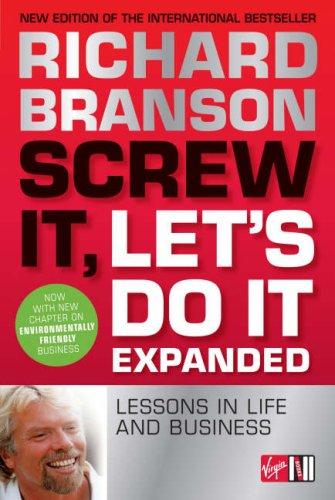
- «Screw It, Let’s Do It» is 111 pages published at £1 for a UK adult-literacy scheme. As a cheap paperback for people who do not read much, it is competent. As a theory of why Richard Branson succeeded, it names nine dispositions and tests none of them.
- «Just do it» is the weakest chapter. A meta-analysis of 46 studies covering 11,046 small firms found business planning raised performance, mean effect size 0.20 (95% CI 0.16–0.24). The effect is smaller in new firms (0.13) than established ones (0.24) — smaller, not negative.
- The cleanest test of the mindset this book sells: when experimental subjects volunteered knowing payoffs depended on their skill, average industry profit went from +$13.96 to −$13.13 per round, and 85% of them expected the average entrant to lose money and entered anyway.
- «Have fun» has the causal arrow backwards. In a weekly study of 54 entrepreneurs over eight weeks (341 observations), effort predicted later changes in passion. Passion is partly a product of doing the work, not a prerequisite for it.
- The structural problem is not that Branson is unrepresentative. It is that risky practices look good specifically in samples of survivors even when they are unrelated to performance in the full population — a proved result, not a sneer.
Verdict
Skip it — if you are reading it to learn what causes business success. Keep the last two chapters and discard the method.
Some fairness first, because it changes the standard. The British Library record lists this as ix + 111 pages, London: Virgin, 2006, in the «Quick reads» series. Quick Reads is run by The Reading Agency, launched in 2006, sold at £1 a copy and distributed through libraries, prisons, colleges and adult learning centres for readers who find books hard going: over 150 titles, 5.5 million copies. This is a reasonable entry in a useful programme (short chapters, plain sentences, concrete stories, no jargon) and it never claims to be research.
So the fair charge is not «this is bad science». The fair charge is that it presents nine chapter headings as the causes of an outcome, and the outcome is the only evidence offered for the causes.
The claim on trial
The contents page is the argument: Just do it — Have fun — Be bold — Challenge yourself — Stand on your own feet — Live the moment — Value family and friends — Have respect — Do some good. The claim is that this list explains a fortune, and that adopting it moves a reader toward the same outcome.
That is falsifiable in a way the memoir is not, which is why this page exists separately from our notes on «Losing My Virginity». A memoir describes one life. An advice book claims the described life generalises.
A checked negative first. We searched Crossref on 11 August 2026 for any empirical study testing Branson’s list, or this book’s prescriptions, against outcomes. There is one humanities essay meditating on a Branson text. There is no test. Untested is not refuted — it means the list stands on the plausibility of its parts, so the parts are what we check, and four of the nine map onto literatures with decades of data behind them.
«Just do it» against the planning evidence
This is the book’s title claim and the one with the most data against it. The planning literature used to be contradictory. It is no longer.
The key synthesis pooled 46 studies covering 11,046 small firms, 51 independent effect sizes. Planning was positively related to performance overall, mean standardised effect size 0.20 (95% CI 0.16–0.24, p < 0.001). One moderator cuts partly Branson’s way: for new firms the effect was 0.13 (p = 0.002), for established small firms 0.24 (p < 0.001), a significant difference (Q = 6.42, p < 0.05). Planning bought less in the fog of a startup than in a going concern. It still bought something. The authors’ own conclusion is «planning, learning and doing» in parallel, not planning replaced by doing (Brinckmann, Grichnik & Kapsa, Journal of Business Venturing, 2010).
One of the strongest studies inside that pool points the same way. Among 223 new ventures started in 1998 by a random sample of Swedish founders, planning reduced the chance of the venture disbanding and accelerated both product development and organising activity (Delmar & Shane, Strategic Management Journal, 2003).
So «screw it, let’s do it» describes what one survivor remembers doing, not what works. The version that survives contact with the evidence is duller: write two pages, then start, then rewrite the two pages as you learn.
The experiment this book is
One laboratory study models, almost exactly, what a book like this does to a reader. In eight sessions of 12 to 16 undergraduates at Chicago and Wharton, subjects decided round by round whether to enter a market of known capacity. The top-ranked entrants split $50; everyone below the cut lost $10. Ranks were assigned two ways: by random draw, or by the subject’s score on a logic or trivia test.
Under random ranking, entry was close to sensible: industry profit was positive in 75 of 96 rounds and averaged +$16.87. Under skill ranking, average industry profit was −$1.56. Subjects entered because they believed they were above average, and they cannot all have been.
The part that matters here is the recruitment condition. In four sessions, subjects had volunteered knowing success would depend on their trivia skill — a self-selected pool of people who fancied their chances. Average industry profit in those sessions was +$13.96 under random ranking and −$13.13 under skill ranking, an entry differential roughly three times larger than in the sessions without self-selection. Industry profits were positive in 3 of 48 skill rounds, against 34 of 48 in the non-self-selected sessions. And the subjects were not confused about the market: 85% of them expected the average entrant to lose money in skill rounds. They entered anyway. The authors named the effect reference group neglect (Camerer & Lovallo, American Economic Review, 1999).
A £1 paperback titled «Screw It, Let’s Do It» does not create overconfidence. It does something narrower and more measurable: it recruits. It selects the people who already like the sound of that, and encourages them not to look at who else is entering. That is the exact condition in which excess entry tripled.
«Have fun» and the direction of passion
Entrepreneurial passion has a formal definition — intense positive feeling tied to activities meaningful to the founder’s self-identity, in the roles of inventor, founder or developer (Cardon, Wincent, Singh & Drnovsek, Academy of Management Review, 2009). Branson’s «have fun» is the folk version, and the book treats it as the engine.
The direction is not settled the way the book assumes. A weekly field study followed 54 entrepreneurs for eight weeks, 341 observations, measuring effort and passion each week. Entrepreneurial effort predicted subsequent changes in passion. A follow-up experiment (n = 136) found the effect ran through perceived progress in the venture, and was moderated by whether the effort felt freely chosen (Gielnik et al., Academy of Management Journal, 2015). Passion is at least partly manufactured by working and getting somewhere.
The pooled payoff is modest. Across 17 studies and 3,810 participants, positive affect correlated with entrepreneurial performance at r = 0.18 (95% CI 0.06–0.29); negative affect at r = −0.12, not significant (95% CI −0.26 to 0.02, p = 0.097) (Fodor & Pintea, Frontiers in Psychology, 2017). Real, small, and mostly correlational.
«Be bold» and what boldness pays
Two questions hide inside this chapter. Are founders risk-seeking, and does the bet pay?
On disposition, the literature is contested and it is worth saying so rather than picking a side. A psychometric meta-analysis concluded entrepreneurs have higher risk propensity than managers (Stewart & Roth, Journal of Applied Psychology, 2001). A reply added 14 studies the first had missed and reached the opposite conclusion — entrepreneurs, and growth-oriented ones especially, are more risk avoidant (Miner & Raju, Journal of Applied Psychology, 2004). The rejoinder re-analysed and found the answer flips with the instrument: observed d = 0.31 with objective risk measures, d = −0.35 with the Miner Sentence Completion Scale (Stewart & Roth, Journal of Applied Psychology, 2004). A construct that changes sign with the questionnaire is not a foundation for advice. Behaviour is cleaner: in a representative US sample of nascent entrepreneurs, tested both on investment choices and on bias about the odds of success, founders came out consistently more risk-averse than non-entrepreneurs (Xu & Ruef, Strategic Organization, 2004).
On whether the bet pays: most entrepreneurs enter and stay despite both lower initial earnings and lower earnings growth than in paid work, implying a median earnings shortfall of 35% for people ten years into business (Hamilton, Journal of Political Economy, 2000). The portfolio is worse than the income figure suggests: about 75% of US private equity is held by households with at least half their net worth in it, who put on average over 70% of those holdings into a single company they actively manage — yet average returns to private equity were no higher than to public equity (Moskowitz & Vissing-Jørgensen, American Economic Review, 2002). The review that synthesises this literature states the puzzle plainly: many entrepreneurs enter and persist despite low risk-adjusted returns (Åstebro, Herz, Nanda & Weber, Journal of Economic Perspectives, 2014).
The base rate belongs next to that. In the UK, the five-year survival rate for businesses born in 2018 was 39.4%, and 2023 saw 316,000 business births against 309,000 deaths (ONS, Business demography, UK: 2023).
Now the structural point, stated precisely rather than as a complaint about Branson. A risky practice that is unrelated to performance across the whole population will still appear positively related to performance among the firms that survived — because risk widens the outcome distribution and survival truncates the bottom of it. The same logic makes unreliable, uninformed and concentrated-resource practices look superior to reliable, informed and diversified ones, purely as an artefact of who is left to observe (Denrell, Organization Science, 2003). «Be bold», written by a survivor, is the single prediction that model makes.
What the book gets right
Two of the nine chapters hold, and both are the ones least about business.
«Challenge yourself.» This is goal-setting theory in three words, and goal-setting theory is one of the better-supported findings in applied psychology. Specific difficult goals raise performance across well over 100 tasks, more than 40,000 participants and at least eight countries, with time spans from one minute to 25 years. Compared with urging people to «do their best», specific difficult goals produced effect sizes of d = 0.42 to 0.80 in meta-analyses; the effect of goal difficulty itself ran d = 0.52 to 0.82 (Locke & Latham, American Psychologist, 2002). Branson’s version omits the specificity requirement, which is the active ingredient, but the instinct is sound.
«Value family and friends.» The best-evidenced item in the book, and it is not about money at all. Across 148 studies following 308,849 people for an average of 7.5 years, stronger social relationships were associated with a 50% increased likelihood of survival (OR 1.50, 95% CI 1.42–1.59), consistent across age, sex, initial health status, cause of death and follow-up period (Holt-Lunstad, Smith & Layton, PLoS Medicine, 2010). A business-lessons book whose best-evidenced chapter is about not neglecting people is telling you something, though not what it meant to.
Who should read it
Someone who does not read much and might start here. That is what it was commissioned for, and at £1 and 111 pages it does the job: it moves, it is concrete, it does not condescend. Getting a reluctant reader through a whole book is a real result, worth more than our objections.
Nobody deciding whether to start a business. The parts of this book that bear on that decision are the parts the evidence contradicts, and the reader most drawn to «screw it, let’s do it» is exactly the self-selected entrant whose expected return the entry experiment measured at below zero.
The memoir behind these lessons is «Losing My Virginity», which makes no claim to generalise. For the same instincts inside an actual company, «Rework».
One thing to try
Write down the reference group before you commit to anything. Not your plan — the list of other people currently attempting the same thing, and your honest estimate of how many of them you would beat. Camerer and Lovallo’s subjects forecast total entry reasonably well; what they failed to do was connect that forecast to their own expected outcome. Then add one line: the survival rate for your sector, looked up rather than remembered. If your two-page plan still looks worth doing with those lines at the top of it, you have done the thing this book skips.
Get the book
Find «Screw It, Let’s Do It» on Amazon — as an Amazon Associate, The Boring Work earns from qualifying purchases (disclosure).
The boring bottom line
«Screw It, Let’s Do It» is an honest book about one life and a bad book about causation, and it is priced and packaged in a way that makes the first thing forgivable. The list of nine dispositions has never been tested as a list. Of the four items with a literature behind them, one is contradicted (planning helps, mean effect 0.20 across 11,046 firms), one has the arrow reversed (effort produces passion), one rests on a construct that changes sign with the questionnaire, and one — «be bold» — is precisely the belief that survivorship manufactures in observers whether or not it is true. The two chapters that survive are about setting hard goals and not losing your friends. Take those two, skip the method, and read the rest of our reviews for books that show their working.
When to see a professional
This page is general information about research on entrepreneurship. It is not financial advice and contains no investment recommendations. Decisions about mortgaging property, giving personal guarantees or otherwise concentrating your net worth in one venture belong with a regulated financial adviser or a qualified accountant who can see your actual balance sheet. If the pressure of a venture is affecting your sleep, mood or health, that belongs with a GP, not a paperback.
Sources
- British Library catalogue record for «Screw it, let’s do it: lessons in life», Virgin, 2006 (MARC, via the Internet Archive)
- The Reading Agency, «Quick Reads» programme
- Brinckmann, Grichnik & Kapsa, «Should entrepreneurs plan or just storm the castle? A meta-analysis», Journal of Business Venturing, 2010
- Delmar & Shane, «Does business planning facilitate the development of new ventures?», Strategic Management Journal, 2003
- Camerer & Lovallo, «Overconfidence and Excess Entry: An Experimental Approach», American Economic Review, 1999
- Cardon, Wincent, Singh & Drnovsek, «The Nature and Experience of Entrepreneurial Passion», Academy of Management Review, 2009
- Gielnik, Spitzmuller, Schmitt, Klemann & Frese, «I Put in Effort, Therefore I Am Passionate», Academy of Management Journal, 2015
- Fodor & Pintea, «The “Emotional Side” of Entrepreneurship: A Meta-Analysis», Frontiers in Psychology, 2017
- Stewart & Roth, «Risk propensity differences between entrepreneurs and managers: a meta-analytic review», Journal of Applied Psychology, 2001
- Miner & Raju, «Risk Propensity Differences Between Managers and Entrepreneurs: A Reply in a More Conservative Vein», Journal of Applied Psychology, 2004
- Stewart & Roth, «Data Quality Affects Meta-Analytic Conclusions», Journal of Applied Psychology, 2004
- Xu & Ruef, «The myth of the risk-tolerant entrepreneur», Strategic Organization, 2004
- Hamilton, «Does Entrepreneurship Pay? An Empirical Analysis of the Returns to Self-Employment», Journal of Political Economy, 2000
- Moskowitz & Vissing-Jørgensen, «The Returns to Entrepreneurial Investment: A Private Equity Premium Puzzle?», American Economic Review, 2002
- Åstebro, Herz, Nanda & Weber, «Seeking the Roots of Entrepreneurship: Insights from Behavioral Economics», Journal of Economic Perspectives, 2014
- Office for National Statistics, «Business demography, UK: 2023»
- Denrell, «Vicarious Learning, Undersampling of Failure, and the Myths of Management», Organization Science, 2003
- Locke & Latham, «Building a practically useful theory of goal setting and task motivation: A 35-year odyssey», American Psychologist, 2002
- Holt-Lunstad, Smith & Layton, «Social Relationships and Mortality Risk: A Meta-analytic Review», PLoS Medicine, 2010