TL;DR
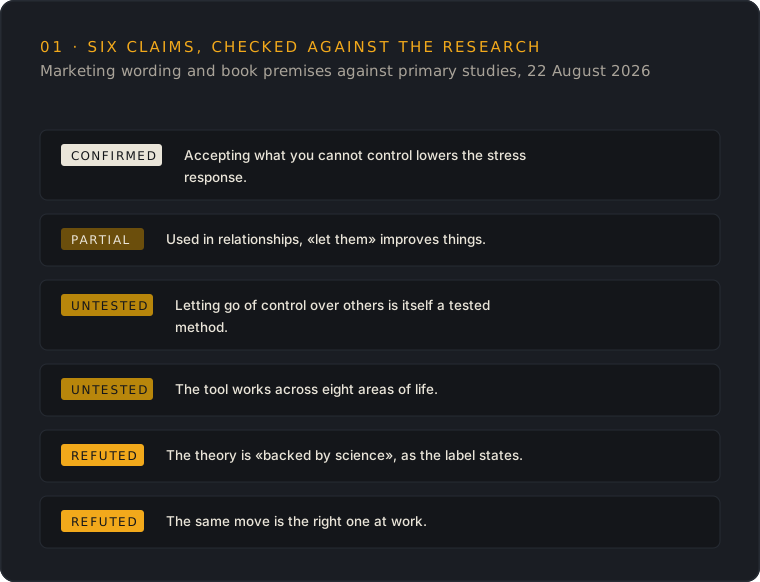
- The book is sold as «backed by science» — yet neither the author’s site nor the publisher ever names a single study, theory or researcher.
- The surprise: half of the idea works. In an experiment with 153 stressed adults, the people who learned to accept what they were feeling ended up with lower stress hormones and lower blood pressure under pressure.
- The idea is not new. Psychologists described it back in 1982 and gave it a name: secondary control — changing yourself when you cannot change the situation.
- The catch: people who constantly feel «it’s out of my hands» report more anxiety, in data from more than 33,000 adults. So the phrase is not harmless if you point it at your own life.
- In couples, «let them» can turn into silent withdrawal — one of the most reliably harmful patterns in relationship research, seen across 74 studies.
Verdict
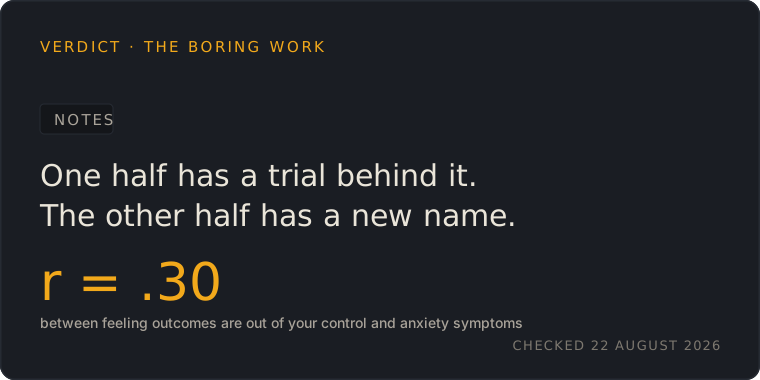
Worth reading for the notes — with one warning attached. The «let me» half of the formula has real science behind it. The «let them» half is an old idea wearing a new name. And the «backed by science» sticker? We went looking for the science it points to, and nobody involved in selling the book will show you any.
What the book promises
You have probably met the idea already, even if you never opened the book. A friend doesn’t invite you to dinner. A colleague takes credit for your work. Your mother criticises your choices again. And instead of stewing about it, you say two words to yourself: let them. Let them not invite you. Let them think what they think. Then comes the second half: let me — let me decide what I do about it.
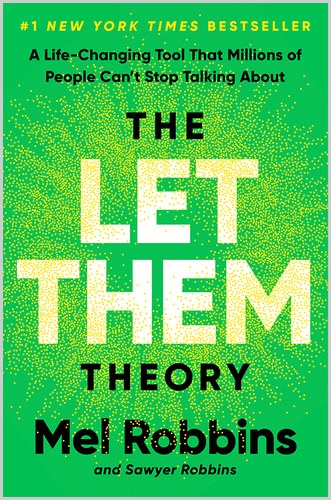
Mel Robbins turned those two moves into the bestselling self-help book of the moment. Her own page promises a lot: «Stop wasting time and energy on things you can’t control… Backed by science and embraced by millions, this mindset shift will transform your life» (Robbins, 2024). The publisher says the same thing in the same words — «the same no-nonsense, science-backed approach», applied «in eight key areas of your life» (Hay House, 2024).
Two moves, two separate promises. So we checked them separately, because one half of this formula deserves far more respect than the marketing gives it, and the other half deserves far more caution.
«Backed by science»: by what?
Here is a small experiment you can run yourself. Open the author’s page and the publisher’s page, and try to find the science the cover promises. There is no study, no researcher’s name, not even the name of a field. The phrase «backed by science» is doing all the work by itself, like a «doctor recommended» sticker with no doctor attached.
To be fair, this seems to be house style rather than a special claim about this book: the same page sells an earlier Robbins book as «a simple tool, backed by research» — again with nothing behind the words.
But here is the twist that makes this story interesting. The science exists. It is just that the people selling the book never point at it — so we will.
Strongest evidence: the dismantling trial
Imagine you want to know which ingredient in a soup makes it good. You would cook it several times, leaving one ingredient out each time, and taste the difference. Scientists call this a dismantling trial, and in 2018 a team ran exactly that experiment on mindfulness training.
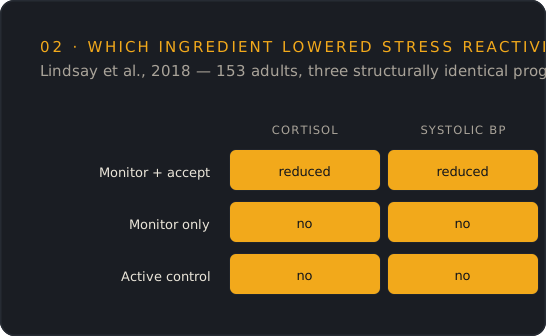
They split mindfulness into its two ingredients. One group of stressed adults learned only to notice what they were feeling. Another learned to notice and accept it — to let the feeling be there without fighting it. A third group got a generic coping course. Then all 153 people went through a standard laboratory stress test (giving a speech in front of stone-faced judges), while researchers measured their stress hormone cortisol and their blood pressure.
The result was clean: «Monitor+Accept training reduced cortisol and systolic blood pressure reactivity compared to Monitor Only and control training» (Lindsay et al., 2018). In plain words: noticing your feelings did nothing by itself. Accepting them calmed the body — not just the mood, the actual physiology.
And this is not one lonely study. A whole school of therapy is built on the same pair of moves — accept what you feel, act on what you value. Across 39 clinical trials with 1,821 patients it beat control conditions clearly (A-Tjak et al., 2015), and a review of 20 meta-analyses found it worked about as well as the best therapies we have (Gloster et al., 2020).
One honest caveat: those results come from weeks of structured practice, often with a therapist — not from whispering two words at a party. The mechanism is real. The dosage in the book is homeopathic by comparison.
Notice the irony, though. The strongest scientific endorsement of what Robbins is selling comes from a study her book never mentions.
The idea already has a name
There is another thing the book presents as a discovery. Psychologists have been studying «what to do when you can’t change the situation» since 1982, and they gave the answer a name: secondary control. Primary control is changing the world to fit you; secondary control is adjusting yourself when the world won’t budge — like a sailor who cannot command the wind but can trim the sails.
A major review concluded that this kind of acceptance «is adaptive for coping» and works especially well in cultures where fitting in matters more than standing out (Morling & Evered, 2006).
This cuts both ways for the book. Good news: the idea is real, measurable and helpful in the right conditions. Awkward news: it has forty years of research, its own questionnaires and its own known limits — and pointing to any of that would have been easy. «Backed by science» was one citation away from being true.
Where «Let Them» runs into the control research
Now the part the book skips entirely. There is a well-studied difference between two thoughts that sound almost identical:
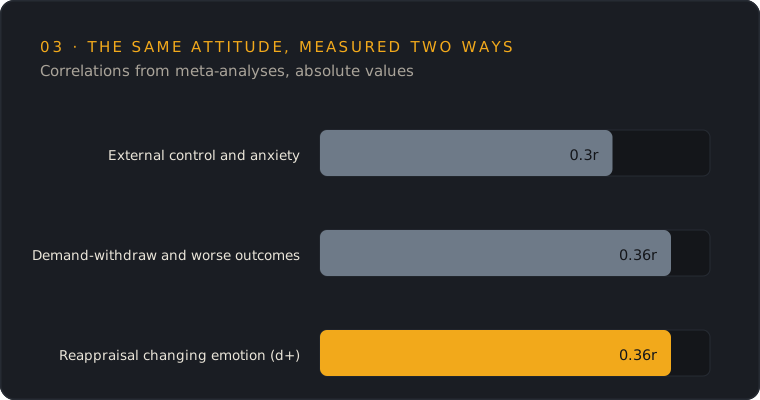
«What other people do is up to them.» That is acceptance — the healthy idea above. «What happens in my life is out of my hands.» That is something psychologists call an external locus of control, and it keeps bad company. In data pooled from 152 samples (more than 33,000 adults in 18 world regions) people who felt their outcomes were outside their control reported noticeably more depression and anxiety (Cheng et al., 2013). Not a death sentence, but a consistent, measurable pattern.
Interestingly, the cost was smaller in collectivist societies, where adjusting yourself to circumstances is how life works. Culture changes the price tag.
The trouble is that «let them» never tells you which of the two thoughts you are practising. On a good day you release other people’s behaviour. On a bad week you slide into «nothing depends on me» — and that is the version linked to anxiety. Two words cannot police that line, and at work the research leans the other way outright: people who feel in control of their work tend to be more motivated and have better experiences on the job (Ng et al., 2006). «Let them» is at its weakest as career advice.
In relationships: acceptance or withdrawal
Here is where the tool gets risky, because most people point it at the people closest to them. The vocabulary readers reach for at this point (anxious, avoidant, secure) carries its own evidence problem, set out in are you an «anxious attachment».
Picture two versions of the same evening. In the first, your partner cancels plans again, and you make peace with it — you feel the disappointment, let it pass, and move on with your evening. In the second, you say «fine, let them» through gritted teeth, go silent, and carry the anger to bed. From the outside, both look like calm. Inside the body and inside the relationship, they are opposites. Research on emotion regulation shows that people who reframe feel better and connect better, while people who suppress feel worse and their relationships suffer (Gross & John, 2003).
Couples researchers even have a name for the second pattern: demand/withdraw — one partner pushes to talk, the other pulls away. Across 74 studies and more than 14,000 people, it is one of the most reliable markers of a relationship in trouble, and it gets worse in couples already under strain (Schrodt et al., 2014). A tool that tells one partner to disengage sits exactly on top of that pattern.
An older framework sorts responses to a partner’s bad behaviour into four boxes: speak up, stay loyal, walk away, or neglect (Rusbult et al., 1991). «Let them» can be loyalty — or it can be neglect. The phrase itself will never tell you which one you are doing.
So before using it on someone you love, ask one question: after I let them, does anything still need to be said? If the matter is closed for you — that is acceptance. If you keep the grievance and only stop mentioning it, you have chosen the option with the worst track record in the data.
Being left out
The book’s signature scene: you find out about the party you weren’t invited to. Let them, says Robbins, and the pain dissolves. The science says something more honest.
Being excluded hurts automatically — researchers describe the reaction as a built-in alarm, and it fires «even when participants know the exclusion is meaningless» (Williams, 2007). In experiments, people feel the sting even when a computer excludes them from a game they don’t care about. No phrase switches that alarm off, the way no phrase stops your hand hurting when you touch a hot stove.
What you can choose is what happens in the minutes after the sting: what story you tell yourself, and what you do next. That is the «let me» half again — and research on hundreds of emotion-regulation experiments shows that changing the story helps modestly, while looking away helps not at all (Webb et al., 2012). The book works when read as advice about the aftermath. It misleads when read as anaesthesia.
The origin question, in dates
One more thing readers keep googling: where did the phrase come from? That is not a science question, but the record has dates, so here they are.
A poet named Cassie Phillips says she wrote a poem called «Let Them» in 2019. In September 2022 it went viral after she posted a photo of the phrase tattooed on her arm; a month later her follow-up poem «Let Me» went viral too. In May 2023 Robbins posted a reel: «I just heard about this thing called the “Let Them Theory” and holy crap… I absolutely LOVE this!!!!» The book came out in December 2024 — and the outlet that laid out this timeline adds: «Best Life can verify there is no mention of Cassie Phillips in the book» (Best Life, 2025).
We make no accusation and read no minds. Those are the dates, in order; do with them what you like.
Who should read it, and who should not
Read it if your problem is burning energy on other people’s opinions and choices — and if «let them» in your mouth means real acceptance rather than swallowed resentment. That describes a lot of us, and give the book its due: the phrase sticks in the mind in a way forty years of academic papers never managed.
Skip it, or at least handle with care, in three situations the book never fences off. When a relationship needs a conversation — stepping back silently is the worst-performing move in the data. At work — where feeling in control is linked with doing well. And whenever the phrase starts becoming a polite way to stop saying what bothers you: that is suppression wearing acceptance’s clothes.
For neighbouring checks on this site: polyvagal theory, another case of a mechanism outrunning its evidence, and the piece on self-improvement for how «backed by science» became an industry house style.
When a book is the wrong tool
A lot of searches pair this book with abusive or controlling relationships. Nothing on this page applies there, and no two-word phrase does. If someone is being harmed, controlled or frightened, the useful step is a professional or a support service, not a mindset tool — a boundary the book’s own framing never draws.
Nothing here is therapy, diagnosis or clinical advice. The trials cited above involved structured programmes and, in the clinical cases, clinicians.
Another bestseller built on letting go is «The Subtle Art of Not Giving a F*ck», where one idea has an experiment behind it and the self-esteem chapter does not.
The boring bottom line
Strip away the marketing and a fair picture emerges. Half of this book stands on solid ground: learning to accept what you feel calms the body — an experiment with 153 people showed lower stress hormones and blood pressure, and a whole branch of therapy is built on the same move. But the idea is forty years old, psychologists call it secondary control, and the book’s «backed by science» label points at none of it.
The other half needs a warning label the book never prints. Practise «it’s out of my control» on your own life, and you are rehearsing a mindset that travels with anxiety. Practise it on your partner through gritted teeth, and you are running the most reliably corrosive pattern couples researchers know. The two words are fine. Knowing which door you are opening with them — that part, the book leaves entirely to you.
Sources
- Robbins, M (2024). The Let Them Theory — the author's own book page. melrobbins.com. Read on 22 August 2026. The absence of any named research on the author's own page is itself the finding examined here. melrobbins.com
- Hay House (2024). The Let Them Theory — publisher's description. hayhouse.com. Read on 22 August 2026. Like the author's page, it names no study. hayhouse.com
- Vaux, N (2025). Mel Robbins accused of plagiarizing viral «Let Them» theory. Best Life. Read on 22 August 2026. Used for dates and for one independently verified fact about the book's text, not for any characterisation of intent. bestlifeonline.com
- Lindsay, E. K., Young, S., Smyth, J. M., Brown, K. W., & Creswell, J. D (2018). Acceptance lowers stress reactivity: Dismantling mindfulness training in a randomized controlled trial. Psychoneuroendocrinology. 87, 63-73. The strongest evidence in this file for the acceptance half of the book's formula, and it is not cited by the book. doi:10.1016/j.psyneuen.2017.09.015
- Webb, T. L., Miles, E., & Sheeran, P (2012). Dealing with feeling: A meta-analysis of the effectiveness of strategies derived from the process model of emotion regulation. Psychological Bulletin. 138(4), 775-808. Sets the size of what any single-session regulation instruction can do, and puts reframing above disengagement. doi:10.1037/a0027600
- Cheng, C., Cheung, S.-F., Chio, J. H.-M., & Chan, M.-P. S (2013). Cultural meaning of perceived control: A meta-analysis of locus of control and psychological symptoms across 18 cultural regions. Psychological Bulletin. 139(1), 152-188. Feeling that outcomes lie outside your control is not neutral, and how costly it is depends on where you live. doi:10.1037/a0028596
- Gallagher, M. W., Bentley, K. H., & Barlow, D. H (2014). Perceived control and vulnerability to anxiety disorders: A meta-analytic review. Cognitive Therapy and Research. 38(6), 571-584. Listed as a pointer to the perceived-control literature; nothing here rests on it. doi:10.1007/s10608-014-9624-x
- Morling, B., & Evered, S (2006). Secondary control reviewed and defined. Psychological Bulletin. 132(2), 269-296. The book's core idea already has a name in the literature, and it is forty years old. doi:10.1037/0033-2909.132.2.269
- Gross, J. J., & John, O. P (2003). Individual differences in two emotion regulation processes: Implications for affect, relationships, and well-being. Journal of Personality and Social Psychology. 85(2), 348-362. The distinction that decides whether «let them» is acceptance or silence. doi:10.1037/0022-3514.85.2.348
- Schrodt, P., Witt, P. L., & Shimkowski, J. R (2014). A meta-analytical review of the demand/withdraw pattern of interaction and its associations with individual, relational, and communicative outcomes. Communication Monographs. 81(1), 28-58. The measured risk of one partner responding to conflict by stepping back. doi:10.1080/03637751.2013.813632
- Rusbult, C. E., Verette, J., Whitney, G. A., Slovik, L. F., & Lipkus, I (1991). Accommodation processes in close relationships: Theory and preliminary empirical evidence. Journal of Personality and Social Psychology. 60(1), 53-78. Cited for the four-way distinction, which is the vocabulary this page uses to separate a useful «let them» from a corrosive one. doi:10.1037/0022-3514.60.1.53
- Williams, K. D (2007). Ostracism. Annual Review of Psychology. 58, 425-452. Relevant to the book's most-quoted example — being left out — and to what a decision not to mind can and cannot change. doi:10.1146/annurev.psych.58.110405.085641
- A-Tjak, J. G. L., Davis, M. L., Morina, N., Powers, M. B., Smits, J. A. J., & Emmelkamp, P. M. G (2015). A meta-analysis of the efficacy of acceptance and commitment therapy for clinically relevant mental and physical health problems. Psychotherapy and Psychosomatics. 84(1), 30-36. The clinical version of «accept what you cannot control, act on what you can», delivered over weeks with a therapist. doi:10.1159/000365764
- Gloster, A. T., Walder, N., Levin, M. E., Twohig, M. P., & Karekla, M (2020). The empirical status of acceptance and commitment therapy: A review of meta-analyses. Journal of Contextual Behavioral Science. 18, 181-192. The ceiling on the same idea when it is delivered properly. doi:10.1016/j.jcbs.2020.09.009
- Ng, T. W. H., Sorensen, K. L., & Eby, L. T (2006). Locus of control at work: A meta-analysis. Journal of Organizational Behavior. 27(8), 1057-1087. The workplace is where «let go of control» has the least support, and the data are correlational. doi:10.1002/job.416