TL;DR
- Atomic Habits convincingly shows that a small, properly designed start is more useful than grand intentions without action.
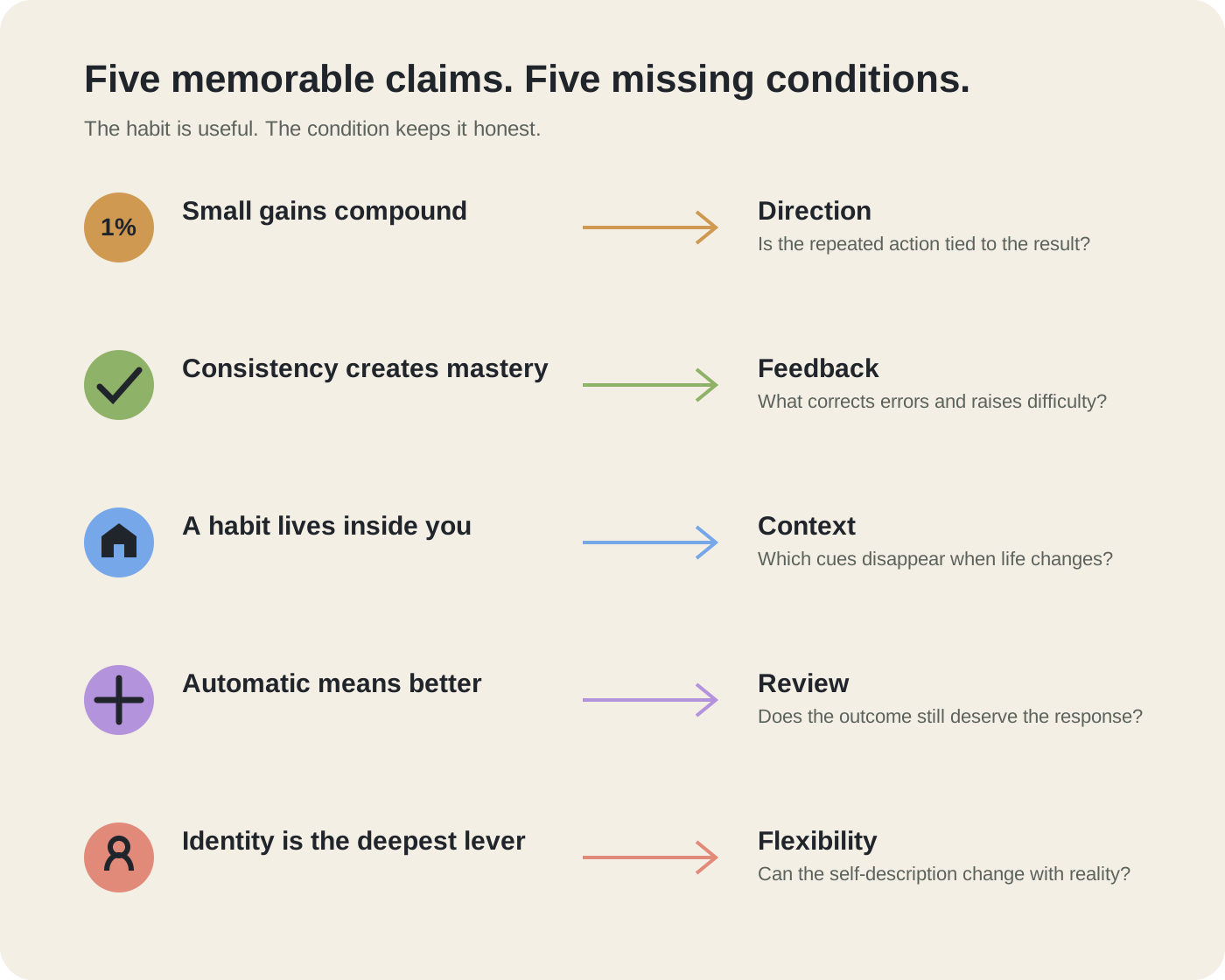
- Small improvements do not compound at a guaranteed interest rate.
- Consistency does not become mastery without correction and feedback.
- Habits depend more on environmental stability than on identity alone.
- Automaticity is useful until it blinds us to change.
- A robust system must know not only how to repeat behaviour, but how to revise it.
Verdict
Atomic Habits is perhaps the best popular book about making an action repeatable—and that is exactly why it is so easily mistaken for a book about how all change happens. It is worth reading, provided repetition remains answerable to direction, quality, feedback, resources, and changing circumstances.
James Clear’s book Atomic Habits: An Easy & Proven Way to Build Good Habits & Break Bad Ones was published in 2018 and became one of the most influential self-improvement books of the 21st century.
It was bought by people who wanted to start working out, read regularly, spend less time on their phones, work better, wake up earlier, save money, or finally finish a task they had been postponing to Monday for years.
The book’s success is easy to explain. James Clear offered readers not another sermon on discipline, but a set of simple tools. No need to wait for inspiration. No need to completely change your life in one day. No need to become a different person before taking the first step.
You need to make the beneficial action more obvious, attractive, easy, and satisfying. And then repeat it.
This sounds reasonable. In many cases, it actually works.
The problem started later — not necessarily on the pages of the book itself, but in how its main ideas began to live in popular culture.
The metaphor about small improvements began to be repeated as if human development works according to the compound interest formula. Consistency began to be confused with mastery. Automaticity — with progress. Environment design — with almost complete control over one’s own behaviour. And the apt thought about identity — with the belief that it is enough to “vote” with correct actions long enough to become anyone.
Thus, a theory much larger than what it can withstand emerged around a useful book.
This review is not meant to prove that James Clear was wrong about everything. Such a conclusion would be both unfair and uninteresting. A significant part of his practical advice remains useful. The book still explains well how to reduce resistance before starting an action, how to use the environment instead of constantly fighting yourself, and how to turn a good intention into a repeatable behaviour.
But in the years since its publication, the limits of this system have become clearer. It also became noticeable how Clear’s powerful metaphors turned into myths — simple, convincing, and not entirely true notions about how people change.
Therefore, the main question of this review does not sound like this:
Do “atomic habits” work?
It is too general to have an honest answer.
It is more correct to ask:
What exactly does Clear’s system help to change, and what have we merely gotten used to explaining with its help?
This review sits at the intersection of three libraries: our critical book reviews, our evidence-based guide to how habits form and break, and our collection of self-improvement myths checked at the source.
1. Why “Atomic Habits” Became So Convincing
A person who has not read Atomic Habits can understand almost its entire system in a few minutes.
Clear starts with a simple thought: big results are often the consequence of small actions repeated long enough. A single workout changes almost nothing. One read page does not make a person educated. One day without unnecessary expenses does not create financial stability.
But the repetition of these actions supposedly gradually changes the trajectory of life.
Hence the word atomic. It means not only “very small”. Clear uses it to denote the basic units of a larger system: each habit seems insignificant, but everyday human behaviour is composed of such elements.
The author describes habit formation as a four-part loop:
- Cue triggers your brain to initiate a behaviour.
- Craving provides the motivational force.
- Response is the actual habit you perform.
- Reward satisfies the craving and teaches the brain to repeat this loop.
Based on this scheme, Clear formulates the Four Laws of Behaviour Change:
- make the good habit obvious;
- make it attractive;
- make it easy;
- make it satisfying.
For undesirable behaviour, the laws must be inverted: make its cue invisible, the action itself unattractive, difficult, and unsatisfying.
This is the main strength of the book. It shifts the conversation from character to the architecture of behaviour.
Instead of:
I lack discipline.
the reader gets different questions:
When exactly should the action start?
What will remind me of it?
What extra steps get in the way of starting?
Which behaviour is currently easier than the desired one?
What in my environment constantly pushes me toward the old decision?
This is an important shift in perspective.
When a person cannot work out regularly, the usual moral response sounds like this: they are not motivated enough. Clear suggests checking whether the clothes are prepared, whether it is convenient to get to the workout location, whether the action is tied to a specific time or event, and whether the plan starts with a load that already causes aversion in advance.
When a person is constantly distracted by their phone, it is not necessary to test their willpower every hour. One can remove notifications, take the device out of the room, or make access to the most intrusive apps less convenient.
These tips do not seem revolutionary. That is exactly why they are useful.
A System Instead of Waiting for the Right Person
One of the central theses of the book is that goals themselves do not determine the outcome.
Winners and losers can have the same goals. Two people can equally want to write a book, lose weight, build a business, or learn a foreign language. The difference arises not in the desired finale, but in what they do regularly.
Clear advises being less fascinated by the image of future victory and paying more attention to the system:
- when the action happens;
- how easy it is to start;
- how often it is repeated;
- what brings a person back to it after a miss.
This does not mean that goals are unnecessary. They determine the direction. But every day, a person lives not inside the goal, but inside the processes that either bring them closer to the result or not.
This is where the book is strongest. It returns attention from the imaginary future to the everyday mechanics of today.
The Two-Minute Rule
One of Clear’s most famous techniques is the Two-Minute Rule.
When a person starts a new habit, the first version of the action should take no more than two minutes:
- not “read every evening”, but open a book;
- not “run five kilometers”, but put on sneakers;
- not “write an article”, but open a document and create the first paragraph;
- not “clean the whole house”, but put away one item.
At first glance, this looks like self-deception. An open document is not a written article, and wearing sneakers does not improve physical fitness.
But the rule is not aimed at the result. It changes the moment of entry into the action.
Large tasks often cause resistance even before starting. A person mentally sees the whole workout, the entire complex text, or all the mess. The two-minute version reduces the psychological weight of the decision. It does not promise to finish the job. It only helps to cross the line between inaction and action.
This is one of the best tools in the book — provided the reader understands its purpose. The Two-Minute Rule helps to start. It does not guarantee that after starting, the person will do the job well, choose the right method, or even work on the right task.
This difference will become important later.
Environment is Stronger Than Good Intentions
Another powerful idea of the book: behaviour depends not only on what we want, but also on what we constantly see and have easy access to.
If sweets are on the table, they more often become part of the decision. If a book is hidden in a closet, and the phone is always in hand, the intention to read every evening faces unequal competition. If a beneficial action requires ten preparatory steps, and an undesirable behaviour is available with one click, the outcome is often determined even before the moment of conscious choice.
Clear advises not turning every day into a heroic struggle. The beneficial action should be visible and accessible. The undesirable one — less obvious and more inconvenient.
In popular psychology, this is sometimes presented as a little trick. In reality, it contains one of the most serious thoughts of the book:
A person is not an independent mind that makes decisions from a blank slate every time.
We react to the arrangement of things, the availability of options, previous actions, habitual routes, and cues that we often don’t even notice.
Clear teaches well how to see this hidden architecture.
Every Action as a Vote for a Certain Version of Yourself
The most emotionally powerful part of the book is the concept of identity-based habits.
Instead of starting with the result — “I want to run a marathon” — Clear suggests starting with the question:
What kind of person do I want to become?
Then every small action becomes a kind of vote for this identity.
A person who read a few pages today cast one vote for the image of a reader. One who completed a workout — for the image of a person who cares about physical fitness. One who recorded expenses — for the image of a person who is careful with money.
One vote decides nothing. But repeated actions supposedly gradually create evidence on which a new self-image is built.
This idea explains why the book resonated with far more people than a standard set of time management tips.
Clear talks not only about how to perform a certain action more often. He talks about the possibility of changing the answer to the question “who am I?”.
It is the strongest ideas that most often give rise to the biggest myths. We will return to the flip side of the identity approach later.
“Never Miss Twice”
Clear does not demand perfect continuity. He acknowledges that people skip workouts, break schedules, and revert to old behaviours.
His rule sounds like this: one miss can be an accident, but the second one starts a new sequence. Therefore, after a bad day, it is important to get back on track as quickly as possible.
In its best reading, this is not a call to maintain a flawless streak. It is an attempt to prevent shame from turning a single failure into a complete abandonment of the system.
People often think in binary terms. If the plan is already broken, the day is supposedly lost. If a workout is missed, there is no point in returning until Monday. If a diet is broken by one meal, the rest of the day no longer matters.
Clear offers a different logic: what matters is not that the system never breaks, but how quickly it recovers.
This is a much more realistic view of change than the cult of perfect discipline.
Clear Did Not Invent Most of These Ideas — And That is Not the Main Problem
Behavioural loops, the role of cues, rewards, repetition, environment, and small steps existed in psychology and popular literature long before Atomic Habits. In the studies provided for this review, the book is rightly described primarily as a strong systematization of already known approaches, rather than as an original scientific theory.
But a popularizer is not obliged to be a discoverer.
People rarely change their behaviour after reading an academic review tens of pages long. They need a model that can be remembered, explained to someone else, and applied without special education.
This is exactly what Clear did.
He gave known ideas:
- a clear structure;
- short names;
- simple formulas;
- expressive stories;
- a sense of a complete system.
His true talent is not in discovering the mechanism of human habits. His talent is that after reading the book, a person can change the arrangement of things on their desk the next morning, prepare workout clothes, or shrink a new action down to a version that is hard not to do.
For a practical behaviour book, this is a major achievement.
And at the same time, it is precisely the completeness of the system that creates the main danger of its reading.
The four laws look so simple and universal that one is tempted to explain much more with them than they actually explain. Apt metaphors begin to be perceived as laws. Useful tools — as a complete model of change. And stories chosen to illustrate a principle — as proof of its universality.
Therefore, an honest review of Atomic Habits should begin with an acknowledgment:
James Clear created one of the best popular systems for organizing repeatable behaviour.
And then ask a harder question:
What notions about human development arise when this system is mistaken for something more?
For two narrower tests of the book’s practical claims, see whether habit stacking actually outperforms a fixed time and how long habit formation really takes.
2. The 1% Myth: Small Actions Don’t Work Like Compound Interest
The most famous idea of Atomic Habits appears almost at the very beginning of the book.
If you get 1% better each day, writes Clear, then in a year the result will be approximately a 37-fold improvement. If you get 1% worse each day, you will gradually approach zero.
The mathematical basis of this metaphor is simple:
The formula is correct.
The problem is that it describes not human development, but the sequential multiplication of a number by the same coefficient.
For this math to truly explain human changes, several conditions must be met. We must know exactly what it means to “get 1% better”. Each improvement must be fully preserved until the next day. The new gain must be added to all previous ones. The process must have no ceiling, plateau, losses, conflicts between different indicators, or the need to spend energy simply maintaining what has already been achieved.
In real life, almost none of these conditions are met.
It is impossible to improve health, intellect, professional mastery, or relationships by 1% every day in the same way a sum in an account with a fixed interest rate grows. In these areas, there is no single unit of measurement that invariably transfers from one day to the next.
What does it mean to become a 1% better writer today?
Write 1% more words? Make sentences 1% shorter? Spend 1% more time editing? Get 1% more satisfaction from the reader?
Any answer already shows the problem: we are not measuring a single variable. We choose one of many indicators and call it development.
The metaphor works as long as it remains a metaphor. It reminds us that small actions can have long-term consequences and that the result of one day does not show the value of repeatable behaviour.
But as soon as it is read as a model of reality, a myth arises:
If a small improvement is repeated long enough, a big result is almost inevitable.
This is exactly what the formula does not prove.
Progress Not Only Grows — It Changes Shape
Human development rarely resembles a smooth curve that rises slightly higher every day.
At the beginning of a new endeavor, progress can indeed happen quickly. A person corrects obvious mistakes, learns basic rules, gets early results. Then the growth slows down. What previously gave a noticeable effect becomes insufficient. Further development requires more precise feedback, more difficult tasks, new methods, or more time.
After this, a plateau may occur.
A plateau does not necessarily mean that the person is working incorrectly. Often it is a natural part of learning. The visible result temporarily does not change, although a restructuring takes place inside the system. In other cases, a plateau indicates that the old method has exhausted itself and simple repetition adds nothing more.
There are also regressions.
Illness, fatigue, stress, a break, or a change in conditions can temporarily worsen the result. Part of the effort goes not into growth, but into returning to the previous level. Another part — into maintaining it.
A person who works out regularly does not get stronger after every session. Some workouts maintain fitness. Some are needed to restore technique after a break. Some give no noticeable effect. And increasing the load too often may not accelerate progress, but end in injury.
The same happens in other areas. Practice can lead to development, but it can also simply keep the skill from being lost. Rest sometimes looks like a day without improvement, although it is exactly what allows the system to keep working.
The compound interest formula has no room for such days. In it, each subsequent step simply multiplies the previous result.
Humans are wired more complexly.
The criticism of this metaphor runs through three provided studies: they draw attention to plateaus, regressions, physiological limits, diminishing returns, and the absence of a universal unit of “betterness”.
Small Actions Can Accumulate Not Only Benefit
The idea of accumulation sounds optimistic until we silently assume that every repetition is correct.
But repetition in itself does not distinguish a good action from a bad one.
You can write every day and repeat the same weak techniques for years. You can work out regularly with incorrect form. You can strictly follow a workflow that creates no value. You can check a box in a tracker without becoming more competent.
In such cases, what accumulates is not mastery, but the persistence of a mistake.
This does not negate the usefulness of repetition. Without repetition, most skills really do not develop. But repetition alone does not guarantee the direction of development.
For improvement to accumulate, the system must be able to answer at least three questions:
- Is the correct action being repeated?
- Is the quality of its execution improving?
- Is the actual result changing?
Atomic Habits helps very well with the first question. It shows how to make the action regular.
But the first question does not automatically entail the next two.
Small Does Not Mean Important
The metaphor of atomic changes also creates another subtle assumption: if improvements can be made constantly, then many small changes will eventually outweigh one big one.
Sometimes this is true.
But systems are not made of equal parts. They have bottlenecks, critical decisions, and factors that determine almost the entire result.
A company can spend months perfecting meetings, email templates, and morning rituals, but have no product that people are willing to pay for. A student can carefully organize their desk and keep a perfect tracker, but use an inefficient learning method. An author can hit a daily word count, but not understand who they are writing for and why.
Minor improvements do not compensate for a mistake in the main decision.
Moreover, a focus on micro-optimization sometimes helps to avoid asking an unpleasant question about the whole system. Improving details is psychologically easier than admitting that the wrong direction was chosen.
A person feels movement because they are measuring, tweaking, and perfecting something. But activity and progress are not synonyms.
In a good system, small changes amplify the right strategy.
They do not replace it.
Big Results Often Depend on Uneven Changes
Life does not always change gradually.
Sometimes consequences indeed accumulate invisibly and then become visible. This is exactly what Clear illustrates with the image of an ice cube that does not melt with a slight temperature increase until a critical threshold is crossed.
But the threshold effect is not compound interest.
In other cases, the result changes due to one decision that cannot be broken down into 365 identical improvements:
- a person stops a project that is not working;
- changes their learning method;
- seeks professional help;
- leaves an environment that supported the old behaviour;
- gains access to a resource they didn’t have before;
- abandons a goal that was imposed or lost its meaning.
These changes can be prepared by hundreds of small actions. But the result itself does not arise because each of them added an equal percentage.
It arises due to a change in the structure of the system.
This is exactly where the important boundary between two types of work lies:
- optimization, where we improve what is already working;
- rethinking, where we must decide if we are optimizing the right system at all.
Clear’s book is almost flawlessly suited to the first type. It teaches how to reduce friction, set up cues, maintain repetition, and quickly bounce back after a failure.
But big changes often require the second.
Not a better habit inside the old system, but a decision to change this system.
What Then is the True Power of Small Actions
Rejecting the compound interest metaphor does not make small actions useless.
On the contrary, it allows us to explain more accurately why they work.
A small action lowers the cost of starting. It is easier for a person to agree to a short step than to the full volume of future work.
A small action increases the number of attempts. And more attempts mean more opportunities to spot a mistake, get a reaction, and adjust the approach.
A small action helps maintain contact with the activity. Even minimal execution sometimes prevents a skill or project from completely disappearing from life.
A small action creates data. Instead of endlessly planning, a person sees what happens in practice.
A small action can weaken the fear of a big task. What seemed monolithic turns into a sequence of concrete steps.
And finally, a small action sometimes triggers a bigger one. Opening a document is easier than promising yourself to write two thousand words. But after opening the document, the person might continue.
All of these are real and sufficiently strong reasons to use small steps.
For this, you do not need to promise a 37-fold improvement.
A more accurate version of Clear’s central idea might sound like this:
Small actions do not guarantee a big result. They make starting cheaper, repetition more likely, and learning possible.
This phrase is less spectacular than compound interest.
But it does not turn development into an automatic process.
Why the Myth is So Attractive
The 1% idea gives the reader two things that are often missing in real life: predictability and a moral order.
It promises that correct small actions will not disappear without a trace. That every effort will be preserved. That it is enough to be consistent — and time will start working for you.
In a world where results depend on chance, resources, other people, and circumstances, such a promise is comforting.
It also explains failures simply: if there is no big result, it’s likely the small actions were not consistent enough.
But reality is not always so fair.
A person can do a lot of right things and not get the expected result. Another can achieve significant progress due to access to resources, a strong starting position, or one lucky opportunity. A third can maintain discipline for years in a direction that does not lead to where they hoped.
This does not make habits unnecessary. It only means that habits are one of the factors, not the hidden accounting of fate.
Verdict on the 1% Rule
The 1% rule should stay in the book — but it needs to be read correctly.
As a motivational metaphor it reminds us:
- not to devalue small actions;
- not to demand immediate results;
- to evaluate the direction, not a single day;
- to allow repetition to create an effect that is not visible after the first attempt.
As a scientific explanation of progress, it does not work.
Human changes do not accumulate at a stable interest rate. They depend on the quality of repetition, feedback, the body’s limits, the structure of the environment, the correctness of the chosen direction, and the moments when the system needs to be changed, not improved.
Therefore, the main myth of Atomic Habits is not that small actions matter.
They do.
The myth is something else:
That time automatically turns sequence into progress.
It doesn’t.
Time amplifies what is repeated. But whether that will be development, stagnation, or a well-practiced mistake depends on more than just time.
Sources for the 1% myth: Wood and Rünger, Psychology of Habit (2016); Macnamara, Hambrick and Oswald, deliberate-practice meta-analysis (2014).
3. Consistency is Not Mastery
In Atomic Habits there is a piece of advice that is easy to remember: don’t try to do something perfectly — first learn to just show up.
You don’t need to do a full workout right away. First, just go to the gym. You don’t need to write brilliant pages. First, just sit down regularly to write. You don’t need to rebuild your whole life. Create an action that can be repeated even on a bad day.
This advice has great practical value.
Many endeavors do not start not because of a lack of ability, but because of too high a barrier to entry. A person waits for the time, mood, confidence, or a perfect plan. A small regular action breaks down this barrier. What previously required a separate decision gradually becomes part of the day.
But right here one of the most prominent myths associated with the book arises:
If you perform an action regularly for long enough, quality will naturally follow.
Sometimes it happens.
But far from always.
A habit answers the question:
Will I start this action under familiar conditions?
Mastery answers completely different questions:
How well do I perform it?
Do I see my own mistakes?
Are the tasks becoming harder?
Do I change the method when the old one stops working?
These processes are connected, but not identical.
You can have a strong habit and a weak skill. You can repeat an action for years without getting much better at it. And vice versa: sometimes a person develops complex competence, even though their work does not look at all like a stable daily ritual.
Repetition Teaches You to Do What You Repeat
Clear rightly emphasizes: habits are formed not by reading about them, but by repetition.
But repetition has a literal property. It strengthens exactly the way of acting that is reproduced again and again.
If a person repeats correct technique, it becomes more stable.
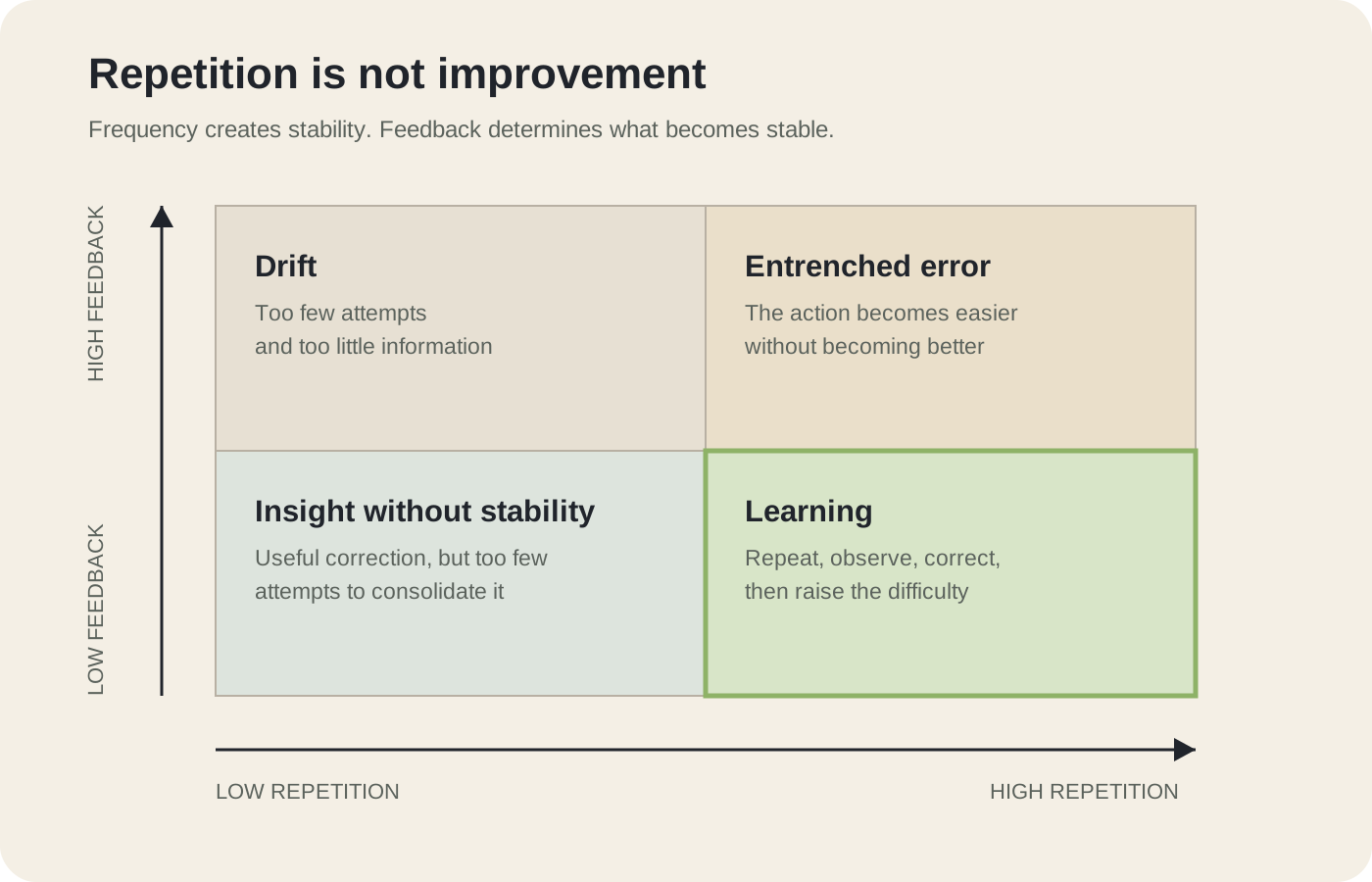
If they repeat a mistake, the mistake also becomes more stable.
If they do a task superficially, the speed of superficial execution may increase, although the quality will remain at the same level.
In this sense, repetition is neutral. It doesn’t know if the pattern being reinforced is beneficial. It only makes a familiar action easier and more accessible.
That is why years of experience do not always equal years of development. A person can have ten years of practice. Or they can have one year of practice repeated ten times.
The difference is created not by the sheer number of repetitions, but by what happens between them:
- does the person get information about the result;
- do they notice deviations;
- do they correct mistakes;
- do they step outside what is already comfortable;
- do they review the method of work itself.
Clear’s system perfectly helps to make repetition more likely. But it cannot determine by itself whether the repetition itself is correct.
Stability Can Hide Stagnation
In the early stages, consistency almost always feels like progress.
A person who previously did not write starts writing every day. One who was not physically active starts working out. One who studied chaotically before exams sits down with the material in advance.
Compared to inaction, this is an undeniable improvement.
But over time, the criterion must change.
In the beginning, it is important to ask:
Did the action happen?
Later, this is no longer enough. Other questions are needed:
What has changed in its quality?
What result does it create?
What do I still not know how to do?
What part of the process has become mechanical, but not better?
If you continue to judge yourself only by the fact of execution, a strong habit can hide weak development.
The tracker shows twenty days without a miss. The calendar is full of checkmarks. The ritual is performed almost automatically. The person feels consistent — and has reasons for it.
However, the tracker itself does not know if the execution has improved.
It will equally credit:
- attentive work and formal time-serving;
- precise execution and repetition of a mistake;
- a complex task and an action mastered long ago;
- a real step forward and the bare minimum done just to keep the streak going.
This is not a flaw in the tracker. It simply measures what it was created for: the fact of repetition.
The myth arises when the fact of repetition starts to be perceived as sufficient proof of development.
Habit Eliminates Decisions — Mastery Brings Back Complexity
One of the advantages of a habit is that it reduces the number of decisions.
A person no longer has to argue with themselves every evening whether to open a book. They don’t have to choose again whether to start a workout. A cue triggers a familiar sequence, and part of the behaviour happens almost without internal negotiation.
For starters, this is great.
But the development of mastery moves in the opposite direction. The better a person understands an activity, the more distinctions they begin to see.
A novice repeats a general procedure. An expert notices when the standard procedure doesn’t fit. A novice is glad they completed the task. An expert sees where the result only seems sufficient. A novice seeks stability. An expert must know when to break it.
Therefore, a complex activity cannot be entirely turned into one smooth habit.
You can automate preparation for work. You can create a stable start time. You can remove unnecessary obstacles. You can make reviewing results a regular practice.
But high-quality work itself often requires the very things a habit partially frees us from:
- attention;
- doubt;
- choice;
- diagnostics;
- changing approach.
The best system doesn’t try to automate everything. It uses automaticity to free up energy for what cannot be done mechanically.
“Doing” is Too Broad a Category
The popularity of Clear’s system is partly explained by the fact that it applies to almost any action.
Reading. Writing. Studying. Working out. Working. Saving. Meditating. Running a business.
At the level of starting, they indeed have something in common. Every action can be tied to a cue, made more accessible, and repeated more often.
But after starting, the similarity quickly ends.
Different types of activities develop according to different rules. Some really get better simply due to the volume of practice. Others require precise feedback. A third group depends on knowledge that a person cannot gain merely through repetition. A fourth requires strategic choices, where the main thing is not the frequency of the action, but the correctness of the decision.
The book talks about habits at a very high level of generalization. This allows applying its advice almost anywhere. But this same universality hides the differences between a simple repetitive act and complex activity.
For example, “write every day” sounds like a single habit. In reality, under the word “write” can hide:
- finding a topic;
- gathering material;
- building an argument;
- creating a first draft;
- editing;
- fact-checking;
- abandoning a bad idea.
A person can regularly perform one of these actions and avoid the rest. They will honestly maintain a writing habit, but the weak spot of their work will remain untouched.
That is why the advice to “just show up” is useful only up to a point.
Then you have to clarify: what exactly are you showing up for?
Not Everything That is Easy to Repeat is Worth Repeating
Clear’s fourth law advises making good behaviour easy.
This works when we already know which behaviour is good. But in complex fields, this is often exactly what remains uncertain.
A person naturally gravitates toward the part of the work that is:
- well known;
- quickly completed;
- easily measured;
- gives a feeling of productivity;
- is less likely to threaten failure.
If you additionally reduce friction around this action, you can create a wonderful system for performing secondary work.
Processes that leave many visible traces are especially dangerous: checkmarks, page counts, hours, messages, calls, completed items. They provide immediate satisfaction and fit perfectly into the habit system.
Instead, the most important part of the work may be uncomfortable, slow, and poorly measurable:
- realizing that a chosen idea is weak;
- admitting a mistake;
- asking for critical feedback;
- studying a complex topic;
- changing a long-familiar method;
- starting the work over.
Here a paradox arises.
A system created to overcome resistance can help a person systematically avoid exactly the work toward which resistance is greatest.
They do a lot. They do it regularly. They do it without hesitation.
But they don’t necessarily do what is essential.
Feedback is More Important Than a Flawless Streak
For consistency to turn into mastery, repetition must be part of a cycle:
- perform the action;
- see the result;
- compare it with the desired outcome;
- determine the cause of the error;
- change the next attempt.
Without this cycle, a person merely reproduces a familiar pattern.
Clear’s book contains thoughts on reviewing habits, gradual complication, and the danger of boredom. Therefore, it would be unfair to say that the author entirely ignores the issue of quality. However, these caveats do not carry the same weight in the system as repetition, ease, and automation.
A reader will remember much better:
Don’t miss twice.
than:
Regularly check whether you should continue doing it exactly this way.
The first phrase is short, concrete, and easily turns into a rule. The second requires judgment — and judgment cannot be formatted as easily as a tracker.
This is exactly where the boundary of any self-help system lies. A simple rule can launch behaviour. But it cannot take on the full complexity of evaluation.
A Habit Should Serve Practice, Not Replace It
At best, habits create an infrastructure for development.
They help to:
- start regularly;
- prepare the environment;
- store materials;
- bounce back after a break;
- set aside time;
- avoid spending energy on the same organizational decisions.
This is a lot.
Without such an infrastructure, a person can have good intentions but practice too rarely to get a result.
But this same infrastructure does not determine:
- what to work on next;
- what the main mistake is;
- when to increase complexity;
- whether the goal is correct;
- whether the method is outdated;
- whether the quality is high enough.
This requires something more than a habit: knowledge, mentorship, criteria, an outside perspective, experimentation, and a readiness to rebuild one’s own work.
In the practical study provided for this review, this boundary is clearly visible across all examined roles: a habit system can stabilize the start of studying, job hunting, business processes, or the execution of procedures, but it does not replace the quality of learning, strategy, professional selection of decisions, or specialized judgment.
Hence a more accurate definition of Atomic Habits‘ usefulness:
The book helps to build conditions under which practice will happen regularly. But whether this practice becomes development depends on things beyond the laws of habit.
A Beginner Needs Consistency. An Expert Needs Its Disruption
At the beginning of learning, stability is particularly valuable.
It is difficult for a beginner to perform an action because almost every part of it requires attention. Regular repetition lowers the load. Basic elements become familiar. A reserve of mental energy appears for more complex tasks.
But what helps at the beginning can limit you later.
When an action becomes too familiar, a person stops getting new information from it. They just execute what they already know. The practice remains comfortable, predictable, and generates almost no mistakes — not because mastery has peaked, but because the task no longer tests its limits.
Development restarts when the usual procedure is disrupted:
- complexity increases;
- conditions change;
- a new criterion appears;
- someone points out an unnoticed mistake;
- the old method stops yielding results.
Therefore, a mature system must contain not only a mechanism for repetition but also a mechanism for complication.
Not just:
How to make the action easier?
But also:
When did it become too easy to teach anything?
This question is almost the opposite of Clear’s third law, “make it easy.” In reality, there is no contradiction between them if you separate the stages.
The beginning should be easy.
Practice should not stay easy forever.
The Most Dangerous Habit is Not a Bad One, But a Mindlessly Good One
Bad habits are easy to spot when their consequences are obvious. It is much harder to notice behaviour that has all the signs of being beneficial:
- it is regular;
- requires discipline;
- is socially approved;
- creates a sense of order;
- is easily measurable.
That is exactly why it is rarely questioned.
A person can be proud of their consistency for a long time and not notice that the system has stopped delivering the desired result. That an action which was once a means has become an end in itself. That the streak in the calendar is being protected no longer for the sake of development, but for the sake of the streak itself.
At this point, the habit doesn’t look like a problem. It looks like proof of character.
And that is precisely why it is hard to change.
This is one of the key takeaways missing from the popular reading of Atomic Habits:
A strong habit is not always a well-tuned path to a goal. Sometimes it is just a well-tuned path.
You still need to check where it leads.
Verdict: Consistency Creates the Possibility of Development, Not Development Itself
Clear is right about the main thing: without repetition, it is hard to build almost any long-term change.
A person who waits for inspiration practices too rarely. One who starts every time by fighting with themselves spends most of their energy before the work even begins. A habit can indeed make practice stable.
But consistency is only a pass to the next stage.
It creates the possibility to learn. It does not guarantee learning.
It provides more attempts. It does not guarantee that the attempts change.
It makes an action familiar. It does not guarantee that the action is correct.
It helps you show up. It does not decide what you do after showing up.
Therefore, the second great myth spawned by the popular reading of Atomic Habits can be formulated like this:
That it is enough to make a beneficial action regular — and time itself will turn it into mastery.
It will not.
Mastery begins where repetition stops being exactly the same.
Sources for the consistency myth: Macnamara, Hambrick and Oswald (2014); Macnamara, Moreau and Hambrick, sports meta-analysis (2016).

4. The Hidden Condition of Habits: The World Must Repeat Itself At Least A Little
In James Clear’s system, the environment plays a central role.
For a beneficial action to happen more often, its cue must be made obvious. Place a book where it can be seen. Prepare workout clothes in advance. Remove undesirable stimuli from your line of sight. Tie a new action to an existing one:
After I do X, I will do Y.
This is one of the most powerful ideas in Atomic Habits. It frees a person from the exhausting thought that every failure is a consequence of weak character. Behaviour really does depend on availability, cues, and context.
But from this correct thought another myth has grown:
If you organize the environment well enough, beneficial behaviour will become stable.
Hidden in this statement is a condition that is easy to miss.
The environment must remain sufficiently stable.
A habit arises not simply because a person has performed an action many times. They learn to react a certain way in a certain situation. Time, place, surrounding objects, previous action, route, other people — all this can become part of the cue.
That is why a habit sometimes feels almost automatic at home but suddenly disappears during a trip. That is why a new schedule can destroy a morning routine that worked effortlessly for years. That is why after moving, a person unexpectedly loses even those beneficial actions they already considered part of their character.
It’s not necessarily the person who changed.
The situation that triggered their behaviour changed.
A Habit Does Not Live Inside Us Apart From the World
It’s easy to talk about habits as if, after enough repetitions, they are written inside a person and then travel along with them.
As if a once-formed habit to read, exercise, or plan the day should trigger under any conditions.
But behaviour is much more strongly tied to context.
A person might read regularly before bed because the book is on the nightstand, the light is already dim, the phone is charging in another room, and the preceding action is brushing teeth. In this system, “reading before bed” is not a single isolated habit. It is an entire chain of interconnected conditions.
Remove a few of them — and the behaviour can become much less automatic.
During a trip, the book is in a suitcase. The phone ends up next to the bed. The day ends at a different time. The room is unfamiliar. The familiar sequence doesn’t trigger.
A person might explain it to themselves like this:
I lost my discipline.
Although it would be more accurate to say:
I lost the system of cues holding this behaviour together.
This is not an excuse for every relapse. It is a more precise explanation of how habits work.
In the materials provided for this review, the stability of context constantly appears as one of the basic prerequisites for automation. The practical study also shows that the same system works differently for people with a stable study or work rhythm compared to those whose day is defined by a variable schedule and external circumstances.
“Environment Design” Assumes the Environment Belongs to You
The advice to change your environment sounds universal. In reality, the ability to do so is distributed unevenly.
One person can dedicate a separate room for work, set a stable schedule, remove all distractions, and leave the necessary items in plain sight.
Another lives with several people, works shifts, depends on someone else’s schedule, or reacts daily to unpredictable events.
For the first person, environment design is a practical task.
For the second, the environment itself may be the main source of instability.
And here it’s important not to exaggerate the complaint against the book. Clear does not claim that everyone has full control over their life. He gives advice that usually works better when control is present.
The myth arises later — when the successful application of this advice begins to be seen primarily as a sign of a correct system, and failure as proof that the person designed it poorly.
But not every obstacle can be removed from the table.
Not every schedule can be stabilized.
Not every action can be tied to morning coffee if the morning itself happens differently every time.
Therefore, the effectiveness of habits depends not only on knowing the four laws. It also depends on how much predictability already exists in a person’s life.
A System Can Be Fragile Precisely Because It Works Well
The more precisely a habit is tied to a single cue, the easier it is triggered in familiar conditions.
And the more vulnerable it can become when they change.
The formula “after morning coffee I write for ten minutes” works better than the vague “I will write every day”. In the first case, there is a specific cue. But if coffee disappears from the morning, is moved to another place, or the structure of the morning itself changes, the writing might disappear along with it.
This is the paradox of a contextual habit:
A strong cue simultaneously reinforces behaviour and makes it dependent on itself.
During a stable period, this dependency is almost unnoticeable. It seems to a person that the action has become part of their personality. They no longer think about triggering it and spend almost no energy on it.
But then a job changes, a new school year begins, a child is born, a person moves or gets sick — and the behaviour they considered reliable falls apart.
This doesn’t mean the habit was fake.
It was real, but contextual.
We tend to underestimate this difference because a stable context becomes invisible. While it works, all the results are attributed to the person: their system, discipline, identity. Only after the conditions collapse does it become clear how much work the environment itself was doing.
Return is More Important Than Continuity
Habit culture loves streaks.
Thirty days without missing. A hundred workouts. A year of daily writing. An unbroken chain of checkmarks on a calendar.
A streak provides simple proof of consistency. It is visible, measurable, and psychologically pleasing.
But a streak poorly describes behaviour in a life where contexts change.
A person might have a long unbroken sequence only because their conditions remained stable. Another might regularly lose their routine due to external changes, but rebuild it each time in a new form.
Who has the stronger system?
From the tracker’s perspective — the first.
From the perspective of life resilience — not necessarily.
The most valuable ability might not be the flawless preservation of one form of behaviour, but the skill to reconstruct it after conditions change.
Not just:
I work out at seven in the morning.
But:
When my schedule changes, I find a new place for a workout in the week.
Not just:
I write after coffee.
But:
I know how to create a new cue when the old morning sequence disappears.
In such a reading, the strength of a habit is measured not by the length of the streak, but by the ability to survive a change in context.
This significantly changes the meaning of the rule “never miss twice”.
It doesn’t necessarily have to be understood as an order to immediately bring back the exact same action in the exact same volume. Sometimes the old format no longer fits reality. A return might mean creating a smaller, different, or temporary version of the behaviour.
The main thing is not to save the ritual at any cost.
The main thing is not to lose the ability to rebuild the system.
Not Every Break is a System Failure
Habit culture often views a break as a dangerous moment. One miss is tolerable, but then you must quickly restore momentum before the old behaviour returns.
There is sense in this. A short break really can turn into total abandonment.
But not every interruption needs to be fixed immediately.
Sometimes conditions have changed, and along with them — needs, resources, or the goal itself. An attempt to restore the old habit at all costs can become a form of blindness.
A person continues to demand a morning workout from themselves, even though a new schedule makes it incompatible with sleep. Tries to return to the former volume of work after an illness. Protects a familiar ritual, even though it was created for a different stage of life.
In such a situation, the question shouldn’t be:
How do I force the old system to work again?
But:
What behaviour now matches the new reality?
This is more difficult than a rule about restoring a streak. There is no universal answer here, because you must evaluate the context, not just the fact of execution.
However, this is what mature work with habits looks like.
A system must have not only a mechanism to start, but also a mechanism to finish.
A Habit Has a Life Cycle
In most popular conversations, a habit has only two states:
- not yet formed;
- already formed.
In reality, its life is more complex.
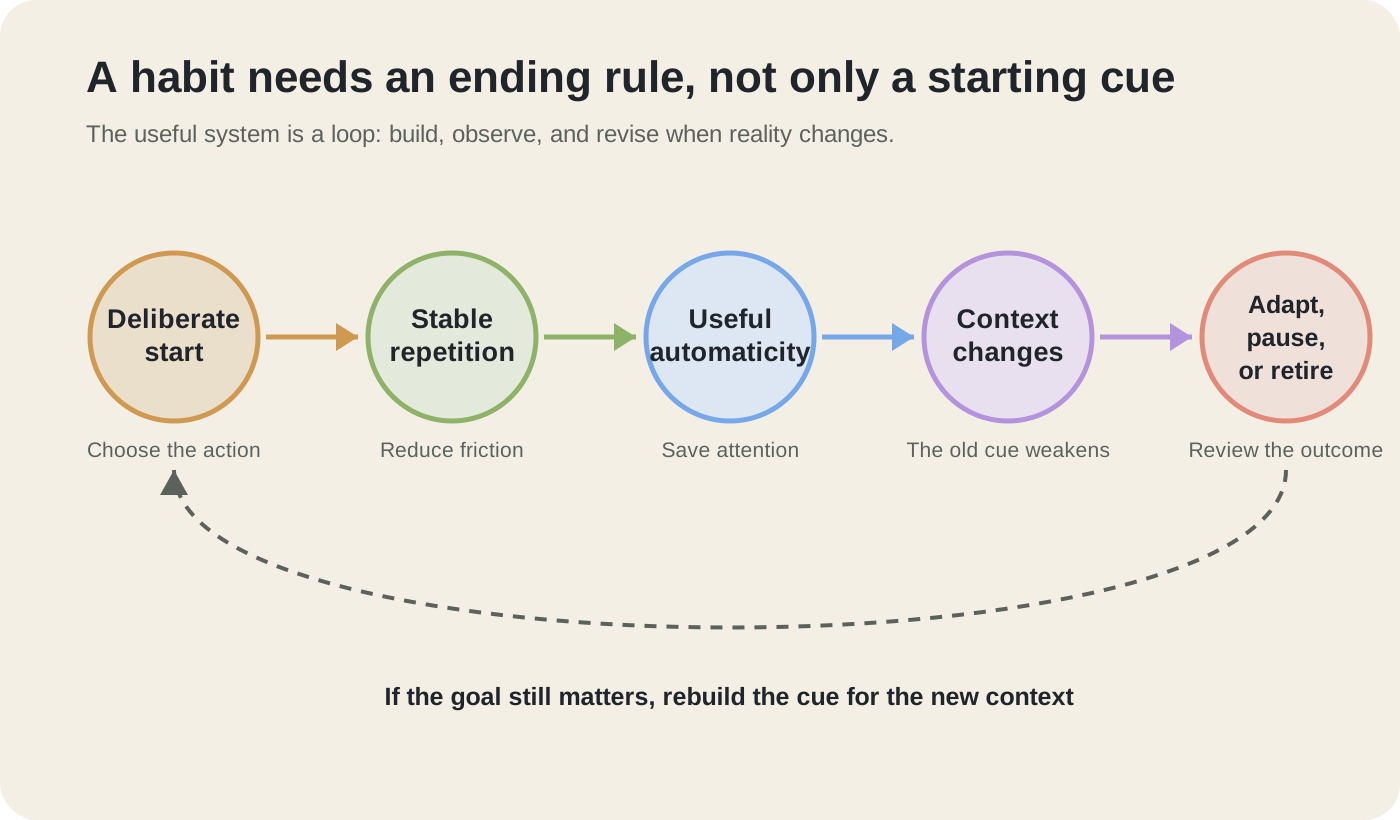
First, a person creates a cue and simplifies the action. Then they repeat it until it becomes familiar. Next, the behaviour is maintained in a stable context. Later, conditions may change, the cue might weaken, and the action might lose its former function.
At this point, different decisions are possible:
- move the habit to a new context;
- shrink it;
- change the cue;
- temporarily pause it;
- replace it with another behaviour;
- finish it completely.
Thus, a mature habit system has at least five stages:
- Creation — define the cue and the minimal action.
- Consolidation — repeat in sufficiently stable conditions.
- Maintenance — not only continue but also monitor its usefulness.
- Adaptation — rebuild after a change in context.
- Completion — abandon behaviour that is no longer needed.
Atomic Habits is strongest in the first two stages.
It explains in detail how to start and how to make repetition easier. Aging, transferring, and finishing a habit receive much less attention.
That is why a reader can get a wonderful manual on creating a system, but get almost no language for the moment when that system stops fitting their life.
The Environment Doesn’t Just Help Habits — It Determines Which Are Possible
In the simplest reading, environment design is a way to make the right choice easier.
But its significance is deeper.
The environment determines not only what action a person will choose. It determines what actions are available at all, how much they cost, and how often they can be repeated.
A stable habit requires not only desire, but infrastructure:
- time;
- place;
- access;
- predictability;
- a sufficient amount of energy;
- the absence of constant interference from stronger demands.
When these conditions are met, the result is easy to explain as proper organization.
When they are absent, a person is often told to better organize what they have minimal control over.
Here arises one of the most serious myths of self-improvement culture:
That correct behaviour is primarily the result of a correct personal system.
In reality, a personal system operates within a broader system.
It can use the available order.
It can partially shield a person from chaos.
But it cannot always cancel that chaos.
Verdict: Habits Depend on Stability More Than We Like to Admit
James Clear is right: environment is often stronger than motivation.
However, this thesis implies more than just practical advice to rearrange items on a desk.
It leads to a much more serious conclusion:
If behaviour depends on the environment, then its stability cannot be entirely attributed to a person’s character.
A good habit does not exist apart from the cues, rhythms, and opportunities that support it. When these conditions disappear, behaviour can weaken even in a person who didn’t “ruin” anything in themselves.
Therefore, the third great myth associated with Atomic Habits can be formulated like this:
That it is enough to design a habit correctly once, and then it will become a reliable part of a person.
In reality, we form habits not only for ourselves.
We form them for a specific life.
And life occasionally changes the rules, the schedule, and the arrangement of furniture.
A truly strong system is not one that never breaks after these changes.
A strong system is one that can be put back together again.
Sources for the context-stability myth: Wood and Rünger (2016); Stojanovic, Grund and Fries (2022); Ebert and Lin (2024); Thomas, Poortinga and Sautkina (2016).
The context argument also explains why the brain does not simply delete an old habit: familiar cues can reactivate a response even after a long period of disuse.
5. Automaticity is Not Always Progress
One of the most attractive promises of Atomic Habits is that correct behaviour can eventually require less and less effort.
At first, a person consciously reminds themselves of an action. Then they repeat it in identical conditions. Eventually, the cue almost automatically triggers the desired reaction.
There is obvious benefit in this.
If every time before brushing your teeth, working out, or recording expenses you had to conduct internal negotiations, even a simple action would become exhausting. Automaticity removes unnecessary decisions. What used to depend on mood gradually becomes part of an ordinary day.
That is exactly why habits save attention.
But from this correct idea, it is easy to draw an overly broad conclusion:
The less a person thinks about an action, the better that action is formed.
Here is where the myth begins.
Automaticity is an advantage only when the situation repeats itself sufficiently, and the correct reaction remains almost unchanged. If conditions change, quality depends on details, or the cost of a mistake is high, less attention can mean blindness rather than efficiency.
A Habit Continues to Act After the Reason Has Disappeared
Clear often describes a habit as a way to hand over part of behaviour to an autopilot.
But an autopilot has one fundamental property: it flawlessly reproduces a familiar route, but it doesn’t decide if the route is still correct.
A person creates a routine because it meets a certain need. Over time, conditions change, but the sequence itself remains.
Previously, the action saved time. Now it creates extra work.
Previously, the rule protected against chaos. Now it prevents adaptation.
Previously, the ritual helped start. Now a person spends more energy maintaining it than receiving benefit from it.
The more automatic a behaviour becomes, the less often the question arises:
Why am I still doing this?
This does not mean habits inevitably become harmful. Most everyday automaticitys remain completely useful. The problem arises when automaticity begins to be considered proof of correctness.
A familiar action feels natural.
But “natural” does not mean “relevant.”
Automaticity Reduces Not Only Effort But Also Sensitivity
At the beginning of a new activity, a person notices almost every step. They don’t yet know what is normal, where difficulties arise, and what details matter.
After many repetitions, a portion of the information stops reaching conscious attention. This is exactly one of the main advantages of learning: you don’t have to reprocess familiar elements every time.
But along with unnecessary noise, you can stop noticing important changes.
A person sees not what is happening right now, but what they are used to seeing.
They don’t re-evaluate the action, they recognize a familiar scenario.
In simple procedures, this saves time. In complex situations, it creates danger: a new case only outwardly resembles an old one, but the automatic reaction has already triggered.
That is why an experienced professional differs not by doing everything mindlessly. They do automate part of the work, but thanks to this, they have more attention for deviations.
True mastery lies not in a complete transition to autopilot, but in the ability to distinguish:
- what can be performed without a new decision;
- what must be checked every time;
- what cue requires stopping a familiar procedure.
In the critical materials for this review, this boundary is described as a conflict between a habitual, more rigid reaction and behaviour that is sensitive to the current result and changing conditions.
It’s Best to Automate the Beginning, Not the Conclusion
The practical value of Clear’s system is especially visible where a crucial action needs to be launched regularly.
You can make it a habit to:
- start a check at a specific moment;
- open the necessary document;
- record a result;
- consult a checklist;
- pass information on.
All this reduces the risk of forgetting an essential procedure.
But the conclusion that arises after a check often cannot be turned into the same automatic reaction.
This is exactly where the example of the zookeeper from one of the provided studies is important. Personal habits can help timely begin an observation, make an entry, or execute a sequence of control actions. However, they cannot replace professional judgment, veterinary requirements, or official procedures.
A worker might get used to checking the lock.
But they must not get used to assuming the lock is checked simply because they performed a familiar motion.
They might regularly inspect an animal.
But they must not automatically see a “normal state” if a situation merely looks like hundreds of previous ones.
This is not a narrow problem of one profession. It is a general principle:
The more important it is to notice a deviation, the more dangerous it is to rely completely on the familiarity of a procedure.
A good system automates the moment when attention is required.
A bad one automates the belief that everything is fine.
A Checklist Does Not Equal Mindless Routine
At first glance, it might seem that complex and responsible processes are exactly what require maximum standardization.
This is true.
Checklists, established action sequences, and repeatable procedures reduce the risk of missing the obvious. They are especially important where a person might get tired, distracted, or overestimate their own memory.
But a standard procedure is useful not because it allows you to stop thinking.
It frees your thinking from the need to remember every basic step.
The difference is fundamental.
A checklist should support attention, not replace it. It reminds you what to check. But it doesn’t predetermine what exactly you will see.
When a checklist turns into a formality, its items start getting checked off before the true state of affairs is evaluated. The procedure seems to be completed, but its protective function has vanished.
On the outside, such behaviour looks like a perfect habit:
- the cue is obvious;
- the action is easy;
- the sequence is stable;
- execution repeats.
And yet it is precisely automaticity that makes it weaker.
So, the problem is not in a routine as such. The problem is in a routine that no longer brings attention back to reality.
Not All Effort Savings Are Beneficial
One of the main arguments in favor of habits is that they free up mental resources.
This is true. But it matters exactly what those freed resources are spent on.
At best, a person stops thinking about preparatory trivia and can focus on the more complex part of the work.
At worst, they simply perform the whole activity with less attention.
These two cases might look the same from the outside.
The action has become faster.
There is less internal resistance.
The decision requires almost no conscious control.
But in one case, automaticity created space for mastery. In the other, it removed quality control.
Therefore, efficiency cannot be determined solely by how easily behaviour happens.
Sometimes friction is an unnecessary obstacle.
And sometimes it is a signal that the situation needs evaluation.
If you mindlessly eliminate every inconvenience, you might remove not only extra steps but also useful pauses — moments when a person needs to stop and check their decision.
A Pause Can Also Be Part of a Good System
The book teaches how to create cues that quickly trigger an action.
But for complex decisions, sometimes you need cues of the opposite type — those that stop an automatic reaction.
For example:
- when the result differs from what was expected;
- when conditions have changed;
- when a procedure doesn’t yield the usual effect;
- when a mistake repeats;
- when the consequences of a decision have become more serious.
In such moments, the useful habit is not speed, but a pause.
Not:
I always act the same way.
But:
Upon a certain cue, I stop acting automatically and re-evaluate the situation.
This is also a behavioural system. Its goal is just not to eliminate thinking, but to bring it back in time.
Perhaps the best habit in a complex activity is the habit of periodically stepping out of the habit.
Familiar Execution Creates an Illusion of Reliability
An automatic action often feels right exactly because it goes smoothly.
A person doesn’t hesitate. They don’t get confused. They don’t spend extra time. The sequence is well-known.
This smoothness is easily perceived as a sign of competence.
But the feeling of ease primarily shows familiarity, not quality.
You can very confidently do something that is long outdated.
You can flawlessly execute a procedure that no longer solves the needed problem.
You can quickly jump to the wrong conclusion because similar conclusions have been reached many times before.
That is exactly why stable systems require periodic review from the outside or by criteria that don’t depend on a sense of familiarity.
You need to ask not only:
How easily am I executing this?
But also:
Does this action produce the result for which it was created?
The Autopilot Myth is Especially Strong in Productivity Culture
Automaticity appeals not only because it makes behaviour easier.
It creates an image of a person who has finally “fixed themselves.”
They don’t argue in the morning, don’t depend on motivation, don’t waste time choosing. Their day consists of correct routines that run almost by themselves.
This is a very powerful image of order.
But within it, it’s easy to lose the distinction between a life and a well-tuned mechanism.
A mechanism is valuable because it reacts identically to identical conditions.
A human is also valuable because they are capable of noticing: conditions are no longer identical.
This very ability — to change a response, revise a rule, abandon the familiar — is not an obstacle on the path to a good habit.
It is a defense against its obsolescence.
Verdict: Automaticity is a Tool, Not the Peak of Development
James Clear convincingly shows that beneficial behaviour shouldn’t depend on a heroic effort every day.
This is one of the most important thoughts in the book.
However, reducing effort is not a universal measure of progress.
Automaticity works well where:
- the situation repeats;
- the correct reaction is known;
- conditions change little;
- a mistake is easy to spot and fix.
It becomes dangerous where:
- the details of each case matter;
- quality needs to be evaluated;
- an old rule might become obsolete;
- a familiar situation hides a new risk;
- the cost of a mechanical error is high.
Therefore, the fourth great myth associated with Atomic Habits sounds like this:
That the ultimate goal of good behaviour is to become so automatic that it requires almost no attention.
In reality, a good system doesn’t eliminate attention.
It distributes it.
It automates what needs to be repeated.
And preserves thinking for what might change.
Sources for the automaticity myth: de Wit et al., outcome-revaluation study (2022); Wood and Rünger (2016).

6. Identity Can Not Only Liberate But Also Lock You In
Among all the ideas of Atomic Habits, the thought about identity is probably remembered the longest.
Clear suggests not starting with a list of desired outcomes.
Not just:
I want to read fifty books.
But:
I want to become a reader.
Not just:
I want to run a marathon.
But:
I want to become a person who works out regularly.
Not just:
I want to get my finances in order.
But:
I want to become a person who is careful with money.
According to Clear, every action is a vote for a certain version of yourself. One workout doesn’t yet make a person an athlete. One page — a reader. One expense record — a financially disciplined person.
But repetition creates evidence.
Over time, a person is no longer just forcing themselves to do something. They behave in accordance with their idea of who they are.
This is a powerful idea.
It moves change from the level of a temporary result to the level of personal meaning. Weight may not drop this week, a text might not receive approval, and a business might not bring the expected income. But an action doesn’t lose its meaning if it confirms a chosen identity.
A person no longer asks:
Will this give me a quick result?
They ask:
What would the person I want to be do in this situation?
For long-term behaviour, this can be a more reliable support than constant dependence on mood, ratings, and short wins.
However, exactly the emotional power of this concept created one of the most persistent myths around the book:
That correct repetitions gradually and almost unequivocally create a correct identity, and a new identity then naturally supports behaviour.
This cycle can indeed work.
But identity doesn’t just support actions.
It also protects them from revision.
Behaviour Becomes Proof Not Only of Progress But of Self-Worth
As long as a habit remains a tool, it can be evaluated relatively calmly.
Does it help?
Does it match the current goal?
Is it worth the time spent?
Does its form need to be changed?
But when a habit becomes proof of identity, these questions acquire a different meaning.
Abandoning an action can now mean not just changing a method, but losing a part of oneself.
A missed workout stops being just a miss. It begins to contradict the image of “I am a disciplined person.”
A bad workday becomes not a process problem, but a doubt about professionalism.
The inability to maintain a streak feels not like a change in circumstances, but like proof that the new personality was fake.
Thus, a behavioural tool imperceptibly turns into a moral test.
A person is no longer just doing or not doing an action.
They are confirming or denying themselves.
In the first of the provided studies, this danger is described as a risk of self-blame and overly rigid conflation of a repetitive action with self-esteem. The second and third studies also draw attention to how productive behaviour in self-improvement culture easily becomes a sign of personal virtue.
The problem isn’t that Clear directly urges you to judge yourself for every miss. On the contrary, he reminds you that a single vote doesn’t determine an election outcome.
But the voting metaphor itself has a consequence: every action still gains the meaning of evidence.
A successful repetition confirms the desired version of yourself.
Failure to execute easily starts to seem like a vote for the opposite.
A Useful Identity Can Outlive Its Usefulness
At the start of a change, a new self-image helps.
A person who considers themselves a reader will pick up a book more often. One who considers themselves an entrepreneur will better tolerate uncertainty. One who sees themselves as a responsible employee will perform their duties more attentively.
But over time, identity might start dictating behaviour even when circumstances have changed.
“I am someone who never gives up” sounds inspiring, as long as persistence is directed at a viable endeavor.
That same phrase can prevent someone from shutting down a project that has been draining resources for years and has no prospects.
“I always keep my promises” is a strong moral stance.
But it can force a person to defend a commitment that was made under different conditions and now causes obvious harm.
“I write every day” can create a stable practice.
Or it can make the word count more important than the thought for which the text exists.
In each case, identity initially helps behaviour.
Then behaviour starts helping the identity survive.
A person continues an action not because it is still useful, but because giving it up would force them to revise their self-image.
That is why bad habits are sometimes easy to drop, and “good” ones are hard.
A bad habit is already flagged as a problem.
A good one is protected by the reputation of a virtue.
Identity Compresses a Complex Person Into a Single Rule
Clear’s metaphor works because of its simplicity.
A person chooses a desired image and accumulates actions that confirm it.
But real identity is rarely so homogeneous.
A person can simultaneously be:
- responsible and exhausted;
- ambitious and cautious;
- disciplined in one area and chaotic in another;
- persistent, yet capable of quitting;
- a reader who barely reads for several months;
- an athlete who needs long recovery.
These states do not necessarily contradict each other.
However, a rigid identity rule handles complexity poorly.
“I am a person who does this every day” leaves little room for the question of why today is different.
“I never miss” turns flexibility into a weakness.
“I always see things through to the end” makes abandoning a mistake look like a defeat.
The simpler the rule, the easier it is to control behaviour with it.
And the more reality it has to discard.
A Person Can Start Serving Their Own Image
Identity feels like internal freedom: I no longer react to every result, but act according to chosen principles.
But if this image becomes too rigid, freedom disappears from the other side.
A person starts serving their own reputation to themselves.
They continue doing what confirms a familiar image and avoid actions that might complicate it.
For instance, a person who considers themselves exceptionally independent finds it hard to ask for help.
One who builds their identity on productivity finds it hard to admit exhaustion.
One who prides themselves on consistency finds it hard to allow an experiment that might ruin a beautiful streak.
One who sees themselves as an expert finds it hard to return to the position of a student.
Thus, identity supports stability, but reduces the capacity for revision.
And revision is needed every time an old answer stops fitting new conditions.
“Every Action is a Vote” is a Powerful But Incomplete Metaphor
The election metaphor conveys one important thought well: a single bad action doesn’t define a person.
One miss doesn’t cancel all previous repetitions. One relapse doesn’t prove a lack of character. Identity is formed by a general pattern, not a single episode.
This is a humane and useful part of the idea.
But an election implies a fixed list of candidates.
As if a person votes either for a “disciplined” or “undisciplined” version of themselves. For a “reader” or a “non-reader.” For an “athlete” or a “slacker.”
In reality, the choice might be more complex.
Missing a workout might be a vote not against a healthy identity, but for recovery.
Abandoning a project — not against entrepreneurship, but for a more precise use of resources.
A day without writing — not against authorship, but for contemplating what’s worth writing.
Changing a system — not a vote against consistency, but for adaptability.
Thus, the same action doesn’t have a fixed meaning outside of context.
It only becomes a “vote” after interpretation.
And interpretation cannot be completely automated by the four laws of habit.
Identity Doesn’t Necessarily Have to Be a Noun
The most rigid formulations are often built as final definitions:
I am a writer.
I am an athlete.
I am an entrepreneur.
I am a disciplined person.
There is power in these phrases. They are short and easily guide choice.
But they also create a border: true behaviour must match the label.
A more flexible version speaks not of an unchangeable essence, but of practice:
I regularly return to writing.
I maintain physical activity in an accessible form.
I test ideas in practice.
I know how to create structure when it’s needed.
Such formulations sound less solemn.
Instead, they allow changing the method of acting without experiencing a loss of self.
A person can remain committed to a value even when a specific habit no longer fits.
This is a crucial distinction:
- identity tied to a ritual protects the form;
- identity tied to a value allows changing the form for the sake of substance.
For example, a person can value learning without reading every day. Can care about health by temporarily abstaining from intense workouts. Can remain responsible by renegotiating an unrealistic commitment.
Such an identity is not weaker.
It simply doesn’t demand proving itself with one single repetitive action.
The Ability to Quit is Also Part of Character
In habit culture, persistence almost always looks like a virtue.
It’s easy to start. Not to miss. To come back. To accumulate proof.
But changes require not only the ability to continue.
They require the ability to stop.
To give up a method that no longer works.
To admit that an old goal has lost its meaning.
To change your mind given new information.
To conclude a habit that has fulfilled its function.
Not all unfinished business is a defeat. Not all broken streaks are relapses. Not every change of course indicates a weak identity.
Sometimes the most mature proof of character is a willingness to stop defending your own consistency.
Clear himself warns against being too rigidly attached to a single self-image and reminds us of the need to review habits. However, the popular reading of the book has absorbed the striking formula “every action is a vote” much better than the more complex question of when to stop voting.
This is exactly how myths arise: not necessarily through a direct false statement by the author, but through the unequal power of his ideas.
A short metaphor is remembered.
A caveat is not.
Verdict: Identity Should Support Change, Not Forbid It
The idea of identity-based habits is one of the most valuable parts of Atomic Habits.
It helps a person not depend on an immediate result. Shows that repeatable behaviour gradually alters self-image. Gives a small action meaning it wouldn’t have if evaluated only by today’s result.
But this power has a limit.
Identity becomes a trap when:
- every miss turns into a judgment on yourself;
- abandoning a ritual is perceived as a betrayal of character;
- a person defends an action after it’s lost its usefulness;
- consistency becomes more important than real outcome;
- self-image stops changing along with life.
Therefore, the fifth great myth associated with Atomic Habits sounds like this:
That correct repetitions gradually create a correct and stable version of a person.
In reality, repetition creates more than just stability.
It creates attachment.
Sometimes this attachment helps you not give up.
And sometimes it prevents you from changing in time.
A more accurate version of Clear’s idea might sound like this:
Every action is not a vote for a final version of yourself, but information about who you are learning to be.
A vote needs to be defended.
Information can be revised.
A strong identity is not one that forces a person to repeat the same behaviour under any conditions.
A strong identity withstands a change in behaviour without crumbling along with it.
Sources for the identity myth: Verplanken and Sui (2019); Zhu et al., systematic review and meta-analysis (2025).
7. The Story of British Cycling is Too Good to Be Complete
Atomic Habits doesn’t start with a lab study or a story of an ordinary person.
It starts with a victory.
In the early 2000s, British cycling was supposedly in a miserable state. The team hadn’t won much of anything for decades, bike manufacturers didn’t want to supply them with equipment, and the prospects for great success seemed illusory.
Then Dave Brailsford took over and introduced a principle that came to be known as the “aggregation of marginal gains.”
The idea was simple: search for a 1% improvement in everything concerning cycling.
The book mentions changes in bike design, clothing, athlete recovery, and hygiene. The team allegedly looked for an edge even in proper hand washing, sleep quality, pillow selection, and cleanliness inside the trucks that transported equipment.
None of these improvements alone could turn a mediocre team into a world leader.
But together, they supposedly created an edge that led British cyclists to Olympic dominance and Tour de France victories.
For Clear, this is the perfect story.
It makes his main metaphor visible. The reader no longer just hears that small changes can make a big difference. They see a team that achieved historic success by picking up a percent here, a percent there, and another percent in a place competitors hadn’t even noticed.
The story fits the book’s thesis so well that it’s easily perceived as proof.
This is exactly where the problem arises.
The Story Explains Success in Hindsight
After a big victory, you can almost always find dozens of small decisions that preceded it.
A modified saddle.
Better fabric for clothing.
A more precise recovery regimen.
A different pillow.
A new way of cleaning equipment.
Already knowing the result, we see these details as parts of a calculated path to victory. They form a coherent story: the team looked for tiny edges, accumulated them, and became the best.
But such a story doesn’t show which improvements actually influenced the result.
It doesn’t show how many other changes were tested and discarded.
Doesn’t show which minor decisions yielded nothing.
Doesn’t let you separate the effect of pillows and hand-washing from the effect of better athletes, coaches, technologies, funding, and organization.
We look at the winner’s list of actions and conclude that this specific list created the victory.
This way of thinking is very common.
A successful person wakes up at 5 a.m. — and early rising becomes the secret to success.
A famous company holds short meetings — and short meetings start seeming like the reason for its efficiency.
A winning team brings its own pillows — and pillows become a symbol of a continuous improvement culture.
The problem isn’t that these actions are useless.
The problem is that after a success, every quirk of the winner starts to look more significant than it really was.
The British Success Didn’t Start With Pillows
In the studies provided for this review, the story of British cycling is reconstructed in a broader context.
The team’s transformation didn’t start from scratch in 2003 when Brailsford became performance director. Back in the second half of the 1990s, British cycling received new leadership, massive state and lottery funding, and the ability to build a professional athlete preparation system.
The money made it possible to retain the team full-time, develop training infrastructure, attract specialists, use modern tech, and systematically train athletes over many years.
On such a foundation, marginal gains really could matter.
When you already have strong athletes, pro coaches, equipment, medicine, analytics, and stable funding, even a small extra edge can decide the fate of a competition where fractions of a second separate the winner from rivals.
But this is an entirely different thesis.
Not:
Small improvements created a strong system.
But:
A strong system gained an extra edge thanks to small improvements.
The difference between these formulations is massive.
In the first version, micro-optimization is the source of success.
In the second — it is the final layer on an already established foundation.
The provided studies especially emphasize the role of previous leadership, the National Lottery, the professionalization of the squad, and major technological resources, which almost disappear in the short retelling of the story.
Small Advantages Hold the Most Value Where the Big Things Are Already Done
For an Olympic athlete, a tiny change really can be decisive.
At the highest level, competitors already:
- have exceptional physical traits;
- have trained for years;
- work with pro teams;
- use high-quality gear;
- follow complex nutrition and recovery programs.
When the core conditions are nearly equal, one minor edge can flip the result.
But it does not follow from this that the same logic works equally for a system lacking foundations.
If an athlete has no proper training program, the right pillow won’t make them a champion.
If a business hasn’t created the right product, optimizing the morning meeting won’t save it.
If a person uses the wrong learning method, a prettier tracker won’t turn repetition into knowledge.
Marginal gains are especially effective after solving the big problems.
They rarely replace solving them.
In this sense, the story of British cycling doesn’t refute the principle of small changes. It more accurately defines where it works best.
Not at the beginning, when the system still needs to be built.
But closer to the top, when major advantages are already tapped and the battle is fought over details.
The Story Quietly Swaps the Cause With the Culture
Perhaps the most interesting part of the British example isn’t the specific improvements, but the culture that birthed them.
The team had resources, authority, and experts who could continuously analyze performance, experiment, and fix weak spots. Its success might be tied less to any specific set of minor changes and more to the capacity to systematically search for edges.
This is an important distinction.
A list of improvements can be copied.
A culture of inquiry is much harder to copy.
You can buy the exact same pillow, change the color inside your truck, or mimic a training ritual. But these actions won’t replicate an organization that:
- collects quality data;
- has competent people;
- can fund experiments;
- distinguishes a useful change from a useless one;
- discards what doesn’t work;
- integrates findings into a broader strategy.
This very capacity might have been the true edge.
Not the cult of the one percent.
But a culture where even small decisions are tested and linked to results.
Yet when the story gets boiled down to a few catchy details, the thinking process disappears. What remains is a list of clever tricks that is easily turned into a recipe.
Winners Can Afford to Notice Dust
In Clear’s telling, the decision to paint the inner walls of the truck white to better spot dust that could affect bike maintenance is especially memorable.
This detail perfectly captures an obsession with quality.
But it also inadvertently shows another side of the story.
To look for an edge in the color of a truck’s walls, you must already have:
- a truck;
- expensive equipment;
- a crew that services it;
- time to analyze minor risks;
- resources to implement changes;
- a baseline system where dust has actually become a noticeable limitation.
For a team lacking proper funding, a training base, or access to top athletes, dust inside a truck is hardly their main problem.
This contrast matters far beyond sports.
Optimization advice is often born in environments where basic needs are already met. It’s then carried over into the lives of people and organizations whose main problems are of a completely different scale.
Thus arises the illusion that any outcome can be achieved through attention to detail.
But sometimes a person doesn’t need a better morning routine.
They need time.
Not a more efficient to-do list.
But fewer tasks.
Not another percent of optimization.
But access to a resource they don’t have.
A Good Story Removes Uncertainty
Why did the version about marginal gains become so popular?
Because it turns complex success into an understandable principle.
The real story of British cycling involves leadership, funding, talent scouting, politics, tech, coaching, sports medicine, infrastructure, chance, and dozens of decisions whose impact is hard to measure in isolation.
This is a terrible story for the first chapter of a popular book.
It lacks a single cause.
Lacks a clean moral takeaway.
You can’t tell the reader after a few pages: “Now do the exact same in your life.”
The aggregation of marginal gains provides exactly that opportunity.
It turns a complex system into a rule:
Search for 1% everywhere — and the sum of changes will create a breakthrough.
This isn’t necessarily a lie.
It’s selection.
Out of a multi-factor reality, the factor that best supports the book’s main thesis is kept.
This is how much of persuasive non-fiction works. The author doesn’t invent an event but creates a frame for it in which the event starts “proving” something.
It’s crucial for the reader to see the difference between two things:
- a story that illustrates a principle;
- a story that proves this exact principle caused the result.
The British cycling case executes the first function flawlessly.
It cannot withstand the second.
What About the Medical Scandals?
The provided studies separately examine medical and anti-doping scandals linked to British Cycling and Team Sky. In particular, they mention the case of former chief doctor Richard Freeman, whom a medical tribunal found guilty of ordering banned testosterone, knowing or believing the drug was meant for an athlete to boost performance.
This context is important for the full history of the British system, but it doesn’t give grounds to claim that all the team’s victories were due to banned substances, or that Clear deliberately hid the “true” cause of success.
Such an accusation would outpace the available evidence.
For this review, a more modest and precise conclusion is sufficient: the real system was far more complex, expensive, and controversial than the clean narrative of a sum of tiny improvements.
The myth collapses without the need to replace one simplified version with another.
An Example is Not Proof of the 1% Rule
The British case is often presented alongside the mathematical metaphor of compound interest. Because of this, a sense of a logical link arises between them.
Here is the formula.
Here is a team that supposedly applied it in practice.
Here is the historical result.
But in reality, the story doesn’t confirm that every improvement equaled 1%, that their effects multiplied together, or that their sum explains the victories.
Some changes might have had a huge effect.
Some — a minimal one.
Some might have interacted.
Others — yielded nothing.
The term “marginal gains” itself doesn’t turn distinct interventions into one mathematical variable.
The number 1% in this story is not a measurement result, but a mindset: looking for small opportunities to improve.
This is a useful management principle.
But it doesn’t prove a formula for human progress.
The Real Lesson of British Cycling
If you strip away the legend of the magical sum of percentages, the story doesn’t become less interesting.
It simply offers a different lesson.
Great results can arise when a strong system:
- gets sufficient resources;
- attracts competent people;
- develops base capabilities for years;
- measures what happens;
- constantly looks for weak spots;
- tests even minor ways to improve.
Small changes play a big role here.
But they stand at the end of a long chain, not replacing it.
A more precise formula would sound like this:
Massive resources and proper structure do not guarantee victory. But without them, most marginal gains remain just marginal.
This is a less democratic idea than the promise that anyone can start with 1%.
Instead, it better explains why the same tips produce different outcomes in different systems.
Verdict: Small Changes Don’t Create a Level Playing Field
The story of British cycling doesn’t refute the value of small improvements.
It refutes the convenient illusion that small improvements can be viewed in isolation from a system, resources, and starting position.
The team didn’t become a world leader just because it paid close attention to pillows, dust, and hand-washing.
It had professional infrastructure, funding, talent, and technology, inside which attention to detail could convert into a real edge.
Therefore, the sixth great myth, boosted by Atomic Habits, sounds like this:
That the sum of small changes alone is capable of creating massive success.
Sometimes it is.
But more often, small changes amplify a system that already has power.
They can resolve the final percent of a competition.
But you can’t always build the first ninety-nine out of that final percent.
Sources for the British Cycling case: House of Commons, Combatting doping in sport (2018); British Cycling, Brailsford career retrospective (2014).
8. Verdict: A Great Book About Repetition, An Incomplete Theory of Change
After all this critique, it is easy to draw an overly simple conclusion: if Atomic Habits spawned so many myths, then the book itself is overrated.
That would be a mistake.
James Clear wrote a genuinely useful book. It helped millions of people stop waiting for the right mood and view behaviour as a system that can be modified.
This is no minor achievement.
Before Atomic Habits, a person might explain years of failed attempts with one word — “laziness.” After it, they had more precise questions:
- does the action have a clear cue;
- is the first step too big;
- is undesirable behaviour made much more accessible;
- does the environment support what the person is trying to do;
- can the system survive one bad day.
Clear showed that useful behaviour doesn’t have to start with a heroic feat every day.
Sometimes it’s enough to prep your things in advance. Remove one obstacle. Pick a specific moment. Shrink an action to a version you aren’t afraid to start. Don’t wait until a new personality appears on its own, but give it a first small piece of proof.
These tips worked before the book’s release and continue working after it.
In the practical study provided for this review, Clear’s system proves useful in vastly different fields — from studying and job hunting to business processes and the regular execution of work routines. The common thread in these cases is not the profession, but the type of task: a repeatable action that can be tied to a cue, simplified, and made visible.
This is exactly where the book’s true domain of power lies.
The Best Book About How to Start More Often
Atomic Habits is strongest in the moment right before an action.
In that short interval when a person already knows what they should do, but hasn’t started yet.
That is exactly where dozens of tiny obstacles pop up:
- the action seems too big;
- the needed items aren’t prepared;
- the cue is unclear;
- the old option is easier;
- the result is too distant;
- starting requires a fresh decision every time.
Clear knows how to break this moment down into pieces.
He doesn’t just tell a person to “pull yourself together.” He shows why they aren’t pulling themselves together and what can be tweaked before blaming character again.
In this sense, Atomic Habits is one of the best books about launching repeatable behaviour.
Perhaps even the framing “a book about habits” is too broad.
It would be more accurate to say:
This is a book about how to make a desired action more likely next time.
This is more modest than a promise of massive life transformation.
But that’s exactly why it is truer.
Problems Start When a Tool Becomes a Worldview
None of the debunked myths render Clear’s core tools useless.
Small actions matter.
Consistency is important.
Environment shapes behaviour.
Automaticity saves effort.
Self-image can support long-term action.
All these statements remain sound.
Myths arise when the word “always” is stealthily added to them.
Small actions always stack up into a big result.
Consistency always leads to mastery.
A well-designed environment always sustains behaviour.
Automaticity always signals progress.
Identity always makes a habit sturdier and more useful.
This is exactly what the book cannot guarantee.
Clear created a toolkit. But the convenience and cohesion of the system tempt you to accept it as a universal model for human change.
Then almost any problem starts looking like a misconfigured habit.
Lacking results — you must better organize repetition.
A skill isn’t developing — you must keep consistency longer.
Conditions shifted — you must bounce back to the system faster.
A person doubts their direction — they must anchor their identity stronger.
But not every problem is a repetition problem.
Sometimes a person regularly does the wrong thing.
Sometimes they lack knowledge, not discipline.
Sometimes an environment cannot be redesigned by a personal choice.
Sometimes automaticity needs to be hit with the brakes.
Sometimes quitting an old behaviour is evolution, not a relapse.
The Book’s Greatest Merit Simultaneously Became the Source of Its Myths
Clear simplifies brilliantly.
He takes complex ideas about behaviour and turns them into easily recalled formulas:
- get 1% better;
- focus on the system, not the goal;
- make it obvious;
- make it easy;
- never miss twice;
- every action is a vote for your identity.
Thanks to this clarity, the book became so influential.
But simplification always trims something away.
The 1% formula trims away the unevenness of progress.
Consistency trims away the question of quality.
Environment design trims away the gap between those who control their surroundings and those who just adapt to them.
Automaticity trims away the need for periodic reassessment.
Identity trims away the complexity of a human who can change behaviour without betraying themselves.
The British story trims away a massive system to better spotlight the power of tiny gains.
This doesn’t mean Clear intentionally misleads the reader.
This is how almost all powerful popular literature works. To stick, an idea must have clean boundaries, a simple image, and a sense of completion.
The trouble begins not when an author simplifies.
The trouble begins when a reader forgets they are looking at a simplification.
What Myths the Book Actually Spawned
After breaking it all down, they can be formulated without exaggeration.
First myth: small improvements work like compound interest.
In reality, they can accumulate, merely maintain a level, conflict, fade, or cement a flaw. Time doesn’t turn just any repetition into progress.
Second myth: consistency naturally births mastery.
In reality, it only yields a chance to practice. Without feedback, increased difficulty, and correction, a person can stay very stably at the exact same level.
Third myth: a correctly designed habit becomes a reliable piece of a person.
In reality, it often stays a piece of a specific context. When life flips, the system has to be rebuilt.
Fourth myth: automaticity is the ultimate finish line of good behaviour.
In reality, it’s valuable only where reactions can stay uniform. In complex endeavors, automaticity must free up attention, not substitute it.
Fifth myth: repetition forges the right identity, which then sustains change.
In reality, identity can both reinforce behaviour and turn it too rigid. Sometimes a person keeps going not because an action serves them, but because they wouldn’t know who to be without it.
Sixth myth: a sum of tiny tweaks alone engineers epic success.
In reality, micro-optimizations sing best inside a system that already possesses resources, competence, proper direction, and a way to tell useful changes from decorative ones.
None of these myths obliterate the book.
They merely shrink it back to its proper scale.
What to Keep From “Atomic Habits”
After reading, you should leave yourself with a few questions.
Not “how do I completely change myself?”, but:
What specific action do I keep putting off?
Not “how do I become a disciplined person?”, but:
What is currently making the right choice unnecessarily hard?
Not “how do I never ever miss?”, but:
How will I bounce back after the inevitable stumble?
Not “how do I automate this behaviour?”, but:
What part can be run on autopilot, and where must I keep my eyes open?
Not “what kind of person must I become?”, but:
What value is this action meant to uphold — and does it honestly still uphold it?
And finally:
How will I know that repetition is yielding a real outcome?
This last question sounds rarer in habit books than it should.
But without it, even the greatest system can morph into a highly efficient way of standing still.
What Not to Demand From the Book
It would be unfair to chide Clear for Atomic Habits not being a grand unified theory of learning, personality, social inequality, professional mastery, or life crises.
He didn’t promise a book about everything.
The title promises an easy and proven way to build good habits and break bad ones. Inside this practical scope, the book often hits its mark.
So an honest critique shouldn’t read:
Clear failed to explain the full complexity of a human.
No habit book could.
The truer grievance is this:
The persuasiveness of the delivery gives off the vibe that the laws of habit explain far more of human change than they actually do.
Part of this is on the author, who selects spectacularly convincing metaphors and tales.
Part is on readers and the self-improvement culture, which loves twisting a neat tool into a master key.
Thus, the aim of an honest review isn’t to “expose” the book, but to return it to its correct job.
Who Truly Needs This Book
It is phenomenally useful to someone who roughly knows what they want to do regularly, but cannot bridge the gap between intent and repeated action.
Someone who:
- always starts too big;
- hinges on motivation;
- underestimates the environment’s role;
- relitigates the same decision every single time;
- tosses the whole plan after a single hiccup;
- confuses a lofty goal with an actual system of action.
For this reader, Atomic Habits hands over more than lifehacks — it hands over a new lens for viewing their own behaviour.
It will offer far less to someone who is already religiously knocking out reps but netting zero returns.
This person likely doesn’t need an even slicker habit.
They might need:
- a different method;
- sharper feedback;
- a gnarlier task;
- an outside expert;
- a fresh strategy;
- a reboot of the goal itself.
This is exactly where the book maxes out.
It helps collapse the distance between intention and action.
But not always — between action and result.
Final Grade
Atomic Habits earns its runaway success.
Not because James Clear unlocked a universal law of human growth.
And not because every anecdote inside is bulletproof validation of his system.
It earns it because it takes a messy, often humiliating topic and makes it practical.
A person who spent years calling themselves lazy suddenly sees that their behaviour has architecture.
Architecture can be tinkered with.
A cue can be swapped.
Friction can be shaved down.
A starting step can be shrunk.
After a miss, you can just plug back in.
This supplies real hope — not vague faith in your own greatness, but the chance to just do one specific thing differently tomorrow.
But it’s best to read Atomic Habits not as a map to all human growth.
But as a superbly built toolkit.
A hammer can be magnificent.
The trouble begins when every problem starts looking like a nail.
Final Conclusion
James Clear’s biggest triumph is teaching millions of people to stop waiting for massive transformations and to work on small, repeatable actions.
The biggest myth spawned by the book is that tiny, repeating actions can supposedly explain practically everything.
They can’t.
Habits help launch.
The environment helps sustain.
Repetition creates stability.
But growth also demands quality, feedback, resources, correct bearing, and the guts to drop what no longer works.
Therefore, the ultimate verdict on Atomic Habits can be boiled down to a single sentence:
It is perhaps the greatest popular book on making action repeatable — and that is exactly why it is so easily mistaken for a book on how all change happens.
It is worth reading.
Just remember after the final page:
Repetition is not proof of the correct direction. It is just a force that makes the chosen direction harder to shake.
If the deeper problem is avoidance rather than forgetting, compare Clear’s system with our critical review of The Now Habit and the broader framework in The New Psychology of Self-Improvement.
Afterword: How to Read “Atomic Habits” After This Review
After a critical teardown, it’s easy to swing to the other extreme and eye any habit advice with suspicion.
That would also be a mistake.
Small actions do change lives. Just not by themselves, not always predictably, and not by bank-interest rules.
Consistency is crucial. It just doesn’t replace learning.
Environment does steer behaviour. Just not everyone can totally redesign theirs.
Automaticity does free up bandwidth. Just not every choice belongs on autopilot.
Identity does anchor a long-term shift. Just a person shouldn’t become hostage to an image that once served them.
So the best way to deploy Clear’s system is not to treat it as gospel.
Treat it as a set of hypotheses to test in your own life.
Before building a new habit, ask yourself five questions.
1. Do I know exactly what I want to make regular?
Not “improve my health,” but a specific action.
Not “get educated,” but an actionable process.
Not “boost productivity,” but behaviour you can spot and loop.
Habits thrive on the concrete. The blurrier the goal, the easier it is to spawn a ritual that looks productive but has zero tether to a real outcome.
2. How do I know this action is actually useful?
Consistency simply reinforces the direction you have chosen.
So before making an action easy, attractive, and automatic, examine the direction itself.
Is there evidence that this method works?
Am I seeing any results?
Am I repeating this action merely because it is easy to track?
A badly picked habit doesn’t get better through flawless execution.
3. How will I judge quality, not just reps?
A calendar checkmark answers if the action triggered.
It doesn’t answer if the action was executed well.
So alongside frequency, you need at least one gauge for quality or real yield.
Not just gym sessions logged, but a shift in strength, stamina, or feeling.
Not just pages read, but the ability to recall and apply them.
Not just hours logged, but the value of the result produced.
A tracker must help you see reality, not draft a cozy substitute for it.
4. What will I do when conditions change?
A system that works only under a perfect schedule is fragile.
So map it out early:
- the smallest version of the action;
- a backup cue;
- a return plan after a long break;
- the conditions under which the habit should be paused;
- the threshold at which the old system must be rebuilt.
The most important skill is not avoiding every interruption.
It is preventing an interruption from becoming a permanent exit.
5. What cue will make me review or sunset this habit?
We usually plan how to initiate behaviour.
We rarely plan how to recognise when it has outlived its usefulness.
But every system needs review triggers:
- the result stopped changing;
- the cost exceeds the benefit;
- the goal expired;
- the context changed;
- the ritual began to displace more important work;
- the action bolsters a self-image, but not real-world value.
A habit should not continue forever merely because it was once useful.
Updated Formula of Change
After all tweaks, the Atomic Habits system could be rewritten like this:
- Pick an action that actually hooks up to the needed result.
- Make starting it obvious and frictionless enough.
- Loop it in an environment that backs the behaviour.
- Pull feedback not just on frequency, but on quality.
- Ratchet up difficulty and tweak methods when dumb repetition stops teaching.
- Rebuild the system when the context shifts.
- End the habit when it stops serving the goal.
This formula is less elegant than Clear’s four laws.
It sits worse on a single slide.
It is less suited to a social-media post.
But change has no obligation to be so simple it fits into a single quote.
In Six Sentences
Atomic Habits convincingly shows that a small, properly designed start is more useful than grand intentions without action.
But small gains don’t compound at a guaranteed interest rate.
Consistency won’t magically morph into mastery without correction and feedback.
Habits lean on environmental stability heavier than on sheer identity.
Automaticity is a win right up until it blinds you to shifts.
And a robust system must know not only how to repeat behaviour, but how to revise it.
That is the central lesson to take from this book.
Not that tiny moves are worthless.
But that they work only inside a system capable of learning.
Get the book
Find Atomic Habits on Amazon — as an Amazon Associate, The Boring Work earns from qualifying purchases (disclosure).
Part of Self-Improvement Myths — memorable claims traced back to the evidence and assumptions beneath them.
Sources
- Clear, J. (2018). Atomic Habits: An Easy & Proven Way to Build Good Habits & Break Bad Ones. Avery. ISBN 9780735211292. Penguin Random House.
- Wood, W. and Rünger, D. (2016). Psychology of Habit. Annual Review of Psychology, 67, 289–314. doi:10.1146/annurev-psych-122414-033417.
- Stojanovic, M., Grund, A. and Fries, S. (2022). Context Stability in Habit Building Increases Automaticity and Goal Attainment. Frontiers in Psychology, 13, 883795. doi:10.3389/fpsyg.2022.883795.
- Ebert, A. A. and Lin, J. (2024). Confirming the Causal Role of Consistent Contexts in Developing a Walking Habit. Annals of Behavioral Medicine, 58(11), 741–751. doi:10.1093/abm/kaae045.
- Macnamara, B. N., Hambrick, D. Z. and Oswald, F. L. (2014). Deliberate Practice and Performance: A Meta-Analysis. Psychological Science, 25(8), 1608–1618. doi:10.1177/0956797614535810.
- Macnamara, B. N., Moreau, D. and Hambrick, D. Z. (2016). Deliberate Practice and Performance in Sports: A Meta-Analysis. Perspectives on Psychological Science, 11(3), 333–350. doi:10.1177/1745691616635591.
- Thomas, G. O., Poortinga, W. and Sautkina, E. (2016). Habit Discontinuity, Self-Activation, and the Diminishing Influence of Context Change. PLoS ONE, 11(4), e0153490. doi:10.1371/journal.pone.0153490.
- de Wit, S. et al. (2022). Investigating habits in humans with a symmetrical outcome-revaluation task. PMID: 35867208.
- Verplanken, B. and Sui, J. (2019). Habit and Identity. Frontiers in Psychology, 10, 1504. doi:10.3389/fpsyg.2019.01504.
- Zhu, L. et al. (2025). The relationship between habit and identity in health behaviours: A systematic review and three-level meta-analysis. Applied Psychology: Health and Well-Being, 17(2), e70017. doi:10.1111/aphw.70017.
- House of Commons Digital, Culture, Media and Sport Committee (2018). Combatting doping in sport. UK Parliament.
- British Cycling (2014). Sir Dave Brailsford at British Cycling: A career retrospective. British Cycling.
Leave a Reply
You must be logged in to post a comment.