TL;DR
- The advice in «Your Brain at Work» is mostly serviceable. The neuroscience holding it up has been dismantled since 2009, and the book has never been revised to say so.
- The core metaphor (a tiny prefrontal stage burning limited fuel) rests on ego depletion, which failed two preregistered multilab replications: 23 labs, N = 2,141, d = 0.04; then 36 labs, N = 3,531, d = 0.06.
- The glucose story is worse. The brain does not measurably raise its metabolic rate during self-control tasks, and p-curve analysis finds the sugar-and-willpower literature has essentially no evidential value.
- SCARF, the book’s social model, was published in Rock’s own in-house journal. No DOI, no Crossref record, zero PubMed hits. Its founding premise (that rejection runs on physical pain circuitry) was contradicted by multivariate imaging in 2014.
- What survives: working memory is small, task switching costs real time, and minds wander about 47% of the time. Three findings do not need a fuel metaphor to be useful.
Verdict
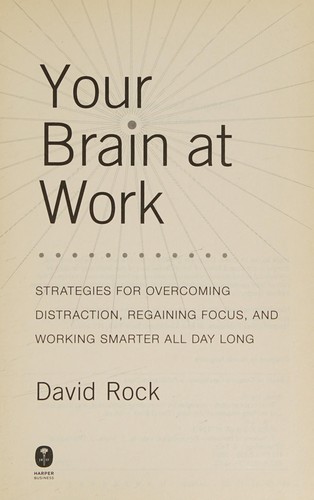
Read our notes instead. David Rock’s «Your Brain at Work» is a competently built book: it stages a decade of attention research inside a fictional workday, follows two characters through email, meetings and a difficult conversation, and converts each scene into a rule. Most of those rules are fine. Prioritize hard thinking early. Do one thing at a time. Write things down instead of holding them in your head. None of this will hurt you.
The problem is the load-bearing explanation. Rock tells you these rules work because the prefrontal cortex is a small, metabolically expensive stage whose fuel supply is finite and spent by every conscious act. That mechanism is the reason the book felt authoritative in 2009 and the reason it should not be quoted as neuroscience in 2026. The fuel model has been tested at scale and did not hold. We are rewriting this review because the previous version rated the advice and never named the mechanism that collapsed underneath it — the exact failure mode this site exists to catch. Our other book reviews follow the same rule: the claim on the cover gets tested, not the usefulness of the tips.
The claim on trial
Stated plainly, the book’s argument is: conscious thought happens on a small stage with limited energy; that energy depletes with use, which is why willpower and focus fail late in the day; and separately, the brain processes five social domains (status, certainty, autonomy, relatedness, fairness) on threat and reward circuitry evolved for survival, so managing those domains is a neurologically grounded management practice. Together these are supposed to make the workplace advice evidence-based rather than merely sensible.
Verdict on the claim: partly held. The descriptive half (capacity is small, switching costs time, attention drifts) survives contact with the evidence. The causal half (a depleting fuel supply, and social pain running on physical pain hardware) does not.
What survived
Start with the part Rock gets right, because it is the part most business books get wrong. He rejects Miller’s «seven plus or minus two» and says the real number is closer to four. That matches the evidence. Cowan, Behavioral and Brain Sciences, 2001 reviewed procedures that block rehearsal and chunking and put pure short-term storage at roughly 3-5 chunks. Rock cites the smaller number in a genre that still repeats the larger one. Credit where it is due.
Task switching also survives, with a correction. Rubinstein, Meyer and Evans, Journal of Experimental Psychology: Human Perception and Performance, 2001 measured the time cost of shifting between tasks and found it grows with task complexity and rule novelty. That is a real, replicated laboratory effect. What is not real is the «40% productivity loss» figure that circulates with this paper attached to it. That number is a press-release gloss, not a general workplace effect the paper reports. The experiments involved switching between arithmetic and geometric problem types in controlled trials — not a knowledge worker’s day. When you see 40% quoted, the paper it points to does not contain it. Say the honest version instead: switching costs are measurable, they scale with complexity, and nobody has published a defensible single percentage for real jobs.
The third survivor is the one that needs no neuroscience at all. Killingsworth and Gilbert, Science, 2010 sampled thousands of people at random moments and found minds wandering about 47% of the time, and (with time-lagged analyses pointing from wandering to mood rather than the reverse) that people were less happy while wandering, including during pleasant activities. That is a description of the baseline condition of working attention. It is also the strongest empirical support in the whole neighbourhood for closing the browser tabs.
What did not survive
The stage-and-fuel metaphor is downstream of ego depletion: the claim that self-control draws on a limited resource that later tasks then lack. It was one of the most cited ideas in social psychology, with a meta-analytic effect size around d = 0.6. Then it was tested properly.
Hagger, Chatzisarantis, Alberts and colleagues, Perspectives on Psychological Science, 2016 ran a preregistered replication across 23 labs, N = 2,141, using a protocol agreed in advance with proponents. The result was d = 0.04 with a confidence interval spanning zero. Proponents objected that the chosen task was weak. So it was done again with a different paradigm: Vohs, Schmeichel, Lohmann and colleagues, Psychological Science, 2021, 36 labs, N = 3,531, d = 0.06, nonsignificant, with Bayesian evidence roughly 4:1 favouring the null. Note the first author: Kathleen Vohs is one of the original architects of the depletion literature, running the test that failed to find her own effect. That is the field working correctly, and it is not a result you can wave away as hostile replication.
Why the original literature looked so strong is answered by Carter and McCullough, Frontiers in Psychology, 2014, who applied bias-correction methods to the published depletion studies and found the effect shrinking to approximately zero once small-study bias was accounted for.
The glucose sub-claim (that self-control literally burns sugar, so a lemonade restores it) fails on two independent grounds. Metabolically, Kurzban, Evolutionary Psychology, 2010 reviewed the energetics and found no measurable rise in the brain’s metabolic rate during self-control tasks. The brain’s consumption is roughly constant and enormous; effortful tasks shift where activity happens, not how much fuel is consumed overall. The costs are opportunity costs (what else that machinery could be doing) not fuel costs. Evidentially, Vadillo, Gold and Osman, Psychological Science, 2016 ran p-curve and bias analyses on the sugar-and-willpower literature and concluded it carries essentially no evidential value.
There is a further problem the book cannot answer. Ma, Husain and Bays, Nature Neuroscience, 2014 document the shift in working memory theory away from fixed-slot models toward continuous-resource accounts, in which memory precision degrades gradually as load increases rather than items falling off a cliff at item five. There is no theatre with a fixed number of seats. There is a resource that gets thinner as you spread it. The practical implication is similar (do less at once) but the mechanism Rock draws on the whiteboard is the wrong picture.
SCARF was never validated
SCARF is the book’s second engine and the one that made Rock’s consulting business. Its source publication is Rock D (2008), NeuroLeadership Journal 1:44-52 — a journal published by Rock’s own NeuroLeadership Institute. Here is the checked negative result: the article has no DOI and no Crossref record, and a PubMed journal search returns zero items. This is not an obscure paper that indexers missed. It is a paper in a venue outside the indexed literature entirely, cited thousands of times in the management world as though it were a research finding.
Its neuroscientific premise comes from one famous study. Eisenberger, Lieberman and Williams, Science, 2003 scanned people excluded from a virtual ball-tossing game and found dorsal anterior cingulate activation resembling the pattern seen in physical pain — the origin of «social pain runs on the same circuitry as a broken leg».
Then the method improved. Woo, Koban, Kross and colleagues, Nature Communications, 2014 applied multivariate pattern analysis rather than averaging activation across whole regions, and found that physical pain and social rejection have distinct, separable neural representations — even inside the same anatomical areas. Overlap at the resolution of a coloured blob is not overlap at the resolution of the actual code. In fairness, the original authors defended their position: Lieberman and Eisenberger, PNAS, 2015 used large-scale reverse inference over the Neurosynth database to argue the dorsal anterior cingulate is selective for pain. That defence was rebutted directly by Wager, Atlas, Botvinick and colleagues, PNAS, 2016, who showed that reverse inference from a term-frequency database cannot establish selectivity, because term coverage in the literature is not a measure of what a region does.
The ordering matters and I want to be fair about it. Eisenberger 2003 was the best available evidence when the book went to press. Woo 2014 arrived five years after publication. Rock could not have known. Anyone repeating SCARF’s «same circuitry as physical pain» line in a 2026 leadership workshop can know, and mostly does not.
The model does have one genuine empirical test, and the result is instructive. Aplin-Houtz et al., Journal of Management & Organization, 2025 ran a two-wave study of 277 US employees on workplace exclusion. Exclusion undermined all five SCARF domains — so the domains describe something real. But only fairness and status mediated turnover intentions. Certainty, autonomy and relatedness were nonsignificant. A five-factor model where two factors do the work is not a validated framework; it is a list with two useful entries.
The structural critique is well documented. Lindebaum and Zundel, Human Relations, 2013 show that leadership neuroscience routinely reasons backward from a brain region to a mental state and over-extrapolates from small fMRI samples. Jack, Rochford, Friedman, Passarelli and Boyatzis, Organizational Research Methods, 2019 make the same case from inside the field — sympathetic practitioners cataloguing reverse inference, underpowered designs and misapplied localization in their own literature.
The last piece explains why any of this sells. Weisberg, Taylor and Hopkins, Judgment and Decision Making, 2015 found that adding logically irrelevant neuroscience information makes bad explanations feel more satisfying. And Dekker, Lee, Howard-Jones and Jolles, Frontiers in Psychology, 2012 surveyed teachers and found that those most interested in brain science held the most neuromyths — exposure to popularized neuroscience predicted more false beliefs, not fewer. That is the mechanism by which a book like this one leaves a reader more confident and less accurate at the same time.
Who should read it
Read the full book if you manage people, have no background in cognitive psychology, and need a narrative that makes «protect your team’s morning» feel worth defending in a planning meeting. The scene-based structure is good at that, and the behavioural advice will not damage anyone.
Skip it if you already accept that attention is limited and interruptions are expensive — the book will spend 250 pages telling you that with a mechanism attached that you should not repeat. Skip it entirely if you are building training material, writing internal policy, or citing anything in a document. SCARF in a slide deck is an unindexed 2008 article from the author’s own institute resting on a 2003 finding that better methods contradicted. Cite Cowan, Rubinstein and Killingsworth directly and you get the same practical guidance with a real evidence trail.
The mechanism this book borrows is dismantled in more detail in «The Willpower Instinct», and «Making the Brain Body Connection» is the same brain-based reasoning with nothing under it.
One thing to try
Pick your single hardest task tomorrow and offload its working memory before you start it. On paper or in a plain text file, write the goal in one line, the three or four concrete steps under it, and every open question you would otherwise hold in your head. Then close everything unrelated and work only from that page, updating it as you go.
This is justified without any fuel model. Cowan, 2001 says you can hold roughly 3-5 chunks — so anything above that count is going to be dropped or refreshed at cost, and paper holds it for free. Rubinstein et al., 2001 says every switch away and back is billed in reconfiguration time that grows with how complex the task is, so a hard task is the worst possible thing to interleave. Killingsworth and Gilbert, 2010 says your mind will leave anyway about half the time, so what matters is having a written anchor to return to rather than reconstructing your place from memory. Three findings, three independent reasons, no depleting battery required.
Get the book
Find «Your Brain at Work» on Amazon — as an Amazon Associate, The Boring Work earns from qualifying purchases (disclosure).
The most famous book built on the same decade of priming and depletion research is «Thinking, Fast and Slow», and its author withdrew a chapter of it himself.
The boring bottom line
«Your Brain at Work» is a 2009 book that has aged into a case study of its own subject. The behaviour it recommends is defensible. The explanation it offers for why that behaviour works (a small stage running out of fuel, social threats firing pain circuits) is the part that made it persuasive, and it is the part that failed. Two preregistered multilab replications with a combined N of 5,672 found effects of d = 0.04 and d = 0.06. The metabolic premise does not hold. The bias-corrected literature is near zero. SCARF’s founding imaging result was superseded by better analysis, and SCARF itself was never published anywhere that could check it.
None of that means you should be interrupted, multitask, or hold your project plan in your head. It means the reason not to is smaller, duller and better established than the one in the book: your capacity is about four chunks, switching is billed in seconds that add up, and your attention wanders half the time regardless. Take the advice. Drop the mechanism. And when someone opens a workshop by telling you exclusion hurts «like physical pain because the brain uses the same circuitry», you now know exactly which paper says otherwise and what year it arrived.
Sources
- Cowan N. The magical number 4 in short-term memory. Behavioral and Brain Sciences, 2001.
- Rubinstein JS, Meyer DE, Evans JE. Executive control of cognitive processes in task switching. Journal of Experimental Psychology: Human Perception and Performance, 2001.
- Killingsworth MA, Gilbert DT. A wandering mind is an unhappy mind. Science, 2010.
- Hagger MS, Chatzisarantis NLD, Alberts H, et al. A multilab preregistered replication of the ego-depletion effect. Perspectives on Psychological Science, 2016.
- Vohs KD, Schmeichel BJ, Lohmann S, et al. A multisite preregistered paradigmatic test of the ego-depletion effect. Psychological Science, 2021.
- Kurzban R. Does the brain consume additional glucose during self-control tasks? Evolutionary Psychology, 2010.
- Vadillo MA, Gold N, Osman M. The bitter truth about sugar and willpower. Psychological Science, 2016.
- Carter EC, McCullough ME. Publication bias and the limited strength model of self-control. Frontiers in Psychology, 2014.
- Eisenberger NI, Lieberman MD, Williams KD. Does rejection hurt? An fMRI study of social exclusion. Science, 2003.
- Woo CW, Koban L, Kross E, et al. Separate neural representations for physical pain and social rejection. Nature Communications, 2014.
- Lieberman MD, Eisenberger NI. The dorsal anterior cingulate cortex is selective for pain. PNAS, 2015.
- Wager TD, Atlas LY, Botvinick MM, et al. Pain in the ACC? PNAS, 2016.
- Ma WJ, Husain M, Bays PM. Changing concepts of working memory. Nature Neuroscience, 2014.
- Aplin-Houtz M, et al. Unraveling the SCARF. Journal of Management & Organization, 2025.
- Lindebaum D, Zundel M. Not quite a revolution: scrutinizing organizational neuroscience in leadership studies. Human Relations, 2013.
- Jack AI, Rochford KC, Friedman JP, Passarelli AM, Boyatzis RE. Pitfalls in organizational neuroscience. Organizational Research Methods, 2019.
- Weisberg DS, Taylor JCV, Hopkins EJ. Deconstructing the seductive allure of neuroscience explanations. Judgment and Decision Making, 2015.
- Dekker S, Lee NC, Howard-Jones P, Jolles J. Neuromyths in education. Frontiers in Psychology, 2012.